• RELEASES
  • VIDEOS
  • ARTISTS
  • NEWS
  • ABOUT
  • STORE

steve-smith

Steve Smith 11/10 pt.2

July 14, 2017
News, Steve Smith
Steve Smith


AL: I remember checking out the interview you did some time ago with Bill Milkowski where you talked about drum machines. Do you have any general opinion about how the trend in having a musician actually play drums to emulate a machine has taken music, or where you feel it might be going?

Steve Smith: For thousands of years music was created by musicians playing without the technology of computers or drum machines. The idea of drummers keeping time, without a click track, and coming up with interesting drum parts was one of the main reasons why you got hired as a drummer, whether it was Ringo playing with the Beatles, Gene Krupa playing with Benny Goodman or Hal Blaine getting called for countless sessions. Especially in the ‘60’s and 70’s studio drummers were hired because of their creativity and time keeping ability. Then as it became popular to use click tracks in the mid to late ‘80’s, right around when the drum machine came in, things started changing where it became crucial not only to have good time but to be able to play in perfect sync with a click track and to be able replace the drum machine part. Generally what happened in the studio, starting in the late ‘80’s to the present, was an artist would record a song with a drum machine or computerized drums and then have the drummer replace that with live drums. With this scenario there is less creativity asked of the drummer because the drum part has already been composed. The drummer learns the parts, maybe embellishes them a bit, and cuts the tracks. Performance accuracy becomes very important because there’s no room for the time to move around naturally the way it has for the past 20,000 or 30,000 years, or however long you want to look back, in music making. I think one of the musical ideas that has changed over time is, composers can tend to find what I consider, “awkward tempos” because they program a drum beat and write a tune that is composed at a particular exact tempo. A real band might never actually play that tempo and feel, or care to play it, because it’s some uncomfortable tempo crack. That’s something that I’ve noticed that’s different from the earlier days, whether it’s Buddy Holly, The Beatles, James Brown or Led Zeppelin. The tempos that different groups play are quite natural whether they are easily danced to or whatever it is. Tempos are so finite with machines that they’re not that natural to play. With the exact steadiness of tempo, it’s an unnatural way to approach music. Music naturally has more breath, tempo moves up and down. Imagine “Stairway to Heaven” with a click track, it wouldn’t have worked. There are thousands of examples of music like that; “Lucy in the Sky with Diamonds,” for instance, that’s a tune where the tempo changes a couple times. In some ways I think clicks can keep people from having a freer approach. A good musician, an evolved musician hopefully, can go beyond that, but “perfect time” has its pluses and minuses. One way you can see it a plus is that people can overdub parts and more easily create music that way. But another way of looking at it is that it’s an artificial way of making music. Overdubbed records can tend to sound that way, especially if they are jazz oriented records. They don’t sound like people playing music together — just my thoughts on the subject.

AL: You said in an interview a long time ago you practiced every day. Do you still get a chance to get in the hours and if so, what are you practicing?

SS: I still do like to practice every day but I don’t practice as religiously as I used to because it’s difficult these days. I live in New York City a portion of the year and I can’t practice in my apartment. It’s not practical, it’s just too small. Actually I go to the Drummers Collective to practice, which is a drum school in New York. For me to go to the Drummer’s Collective I have to get on a schedule and go in for two or three hour increments, so it all has to be planned in advance. At least three or four days a week I go to The Collective. When I don’t go to The Collective I practice on a practice pad here in the apartment just to try to stay in shape. When I’m at my house in Oregon I have a drum room there, so I can practice every day. But one of the other things, since that interview in 1997, is that my life as a band leader and the person organizing the details of tours has become even bigger and more time consuming. There’s a lot of administrative work with having a band on the road and sometimes my life gets taken up with all of those details. I don’t like it, but that’s the problem with being a bandleader and musician. I still like to practice but unfortunately I don’t feel like I get to do it quite enough.

Lately what I’m working on is developing the konnokol and incorporating the Indian rhythms on the drumset and different ways of orchestrating the Indian rhythms on the drum kit. Lately, because of the “Raga Bop” tour, I’m working on memorizing the songs and coming up with a lot of vocabulary for each song. My practice tends to be on exactly what it is I’m doing, not practicing chops for their own sake, but I keep it focused work on the music that I’m playing.

AL: I remember reading the liner notes to the second “Vital Tech Tones” record where you said “With Vital Information I’m not so concerned with virtuosic playing. We have more of an overall sound that we’re putting across so we’re focusing more on the vibe of the tunes. We have solos but virtuosity is not an over-riding concern. It is with this band. Is it ever a concern that taking an approach like that the music can become too clinical, for lack of a better word?

SS: No [laughter]. No, because I think that with the all the musicians that I work with there’s a certain aesthetic of earthiness and blues and rock that comes across. Some of those quotes were addressing the vibe of the times. When Mike Varney (the president / owner of Tone Center Records) came up with the idea to make records for Tone Center there was a lot of smooth jazz in the air. People were simplifying their music. Mike and I had talked and felt there were a large segment of record buyers that were being ignored. The people who were fans of the Mahavishnu Orchestra and Return to Forever or Larry Coryell’s Eleventh House and Weather Report were not being addressed. The musicians that played on those recordings were no longer making music in that style, or the some of the artists who were making music were not address their fan base. A lot of the concept of Tone Center was to push beyond that. I feel like the Tone Center records that I produced and played on had a very good musical concept. Whether it was Henderson / Wooten, Gambale / Hamm, or Howard Levy / Jerry Goodman, or the other strong lineups, there was always a very musical aesthetic along with the virtuosity.

For example, in the 90’s, if you made a record for Columbia they’d ask, “Who’s going to buy this record? Who will this appeal to?” So they’d try to go for, what they thought was, the biggest market and that can lead a big record company to try to make the music a little more “listener friendly” which means catchier melodies, simpler grooves and all the stuff that everyone knows about. Mike Varney was saying the opposite. He said let’s appeal to those people who don’t want to buy the smooth jazz records. They have all the classic fusion records but they want to buy a new fusion record. Imagine that person going into the store looking for some new music, that’s a wonderful idea! That’s a great idea! And I miss that about the current market. To be fair to Columbia, back in the ‘60’s and ‘70’s Columbia was on the cutting edge of having great fusion music. They signed Miles Davis, The Mahavishnu Orchestra, Weather Report and The New Tony Williams Lifetime. There was a time when all the major labels had fantastic jazz and fusion. Without those labels pushing those musicians to make those records we would not have a lot of those amazing records. It’s much more difficult in today’s world, as far as I’m concerned, because you have to finance the recordings yourself. In the days where Atlantic was saying to John Coltrane, “Maybe you should make an album with Johnny Hartman,” that was genius! In today’s world we might not have a record like that because we’re left totally to the ideas, and more importantly the BUDGETS, of the artists. Musicians might not think of a particular collaboration or might not want to finance it themselves, or be able to finance it. As much as some people are saying there is great liberation with people making their own music, I think there’s a lot that’s lost in the process in the well. You can look back at whether it’s Blue Note, Columbia or Atlantic, there’s a lot of great of jazz and fusion records that came about as a result of a record company wanting to put out an album that people would buy, so they came up with music that we now have and can listen to forever. Without Mike Varney we wouldn’t have those great Tone Center albums. We had a fusion renaissance for about 10 years and now Mike’s not making new albums. Now the future is Abstract Logix where Souvik Dutta is really taking the lead in putting out adventurous music. This is great, I’m really pleased to be associated with Souvik and I hope he continues to make albums for a long time. But the sad part is that it’s unfortunate that we’re in a world where there are so few labels putting out adventurous music.

AL:When you interpreted the music for your recent DVD Drum Legacy: Standing on the Shoulders of Giants you took on the compositions of some of the legendary jazz drummers, was your focus on recreating the music exactly or interpreting the music as yourself?

SS:The first thing I did was research the approach and vocabulary that great drummers used. I transcribed and learned vocabulary from Max Roach, Art Blakey, Philly Joe Jones, Tony Williams and Elvin etc. I’ve always done that since I was a teenager but I readdressed it to get deeper into that jazz vocabulary. Each one of those drummers had unique approaches as far as how they developed their concepts. Each developed into the next sequentially. You needed one innovation before the next idea emerged — there’s logic to how that vocabulary evolved. It’s interesting to get inside that, and then to internalize it so that I’m comfortable in that approach. When I play the tune I do my best to get inside that approach but not in a re-creationist way. My drums are tuned the way I like to have them tuned in today’s world. I play with an energy and an attitude that is current but I pay respects to the vocabulary and direction of the drummers who originally played that music. Even though I’ve done the homework and learned the licks and phrases, at a certain point I let my creativity take over and flow with the discipline that each tune takes to make it work. It’s hard to describe, and it’s more organic than it may sound in an interview. In the end I increase my vocabulary and it can be used in a variety of ways. In general, as different projects come up, and I complete them, there’s a sense of finality and integration that occurs and that tends to open up possibilities for new ideas to come.

AL:What are you currently listening to?

SS:I’m very eclectic in what I listen to. From the new Roots album, How I Got Over and their new collaboration with John Legend to Stravinsky’s Rite of Spring. I’m always a fan of Prince, I buy whatever he puts out. I also listen to the records that my friends make. For example I like Walt Weiskopf’s new album See The Pyramid. Anthony Wilson, Diana Krall’s guitar player, has a very good album out Jack Of Hearts. Mark Soskin’s got a new one out with Ravi Coltrane called Man Behind the Curtain with Bill Stewart on drums. I enjoy all of Bill Stewart’s records too like his latest Incandecence. Ari Hoenig is another young drummer who is really innovative. There are a lot of great young jazz drummers and I’m always amazed at how they developed such evolved concepts at such a young age in this society and culture. There seems to be no shortage of them, that’s for sure.

It’s the music, man.

It’s the music, but it takes a very discerning young person to be drawn to jazz. It has to be quite a different person than the average teenager or young adult who doesn’t see beyond rap or heavy metal. Of course there are certain rock things there that I like. Porcupine Tree is an incredible band. If I had to name a favorite band it would be that one. They’re really singular, they’re that unique.

Buy

Itunes-note 
Amazon  Bandcamp
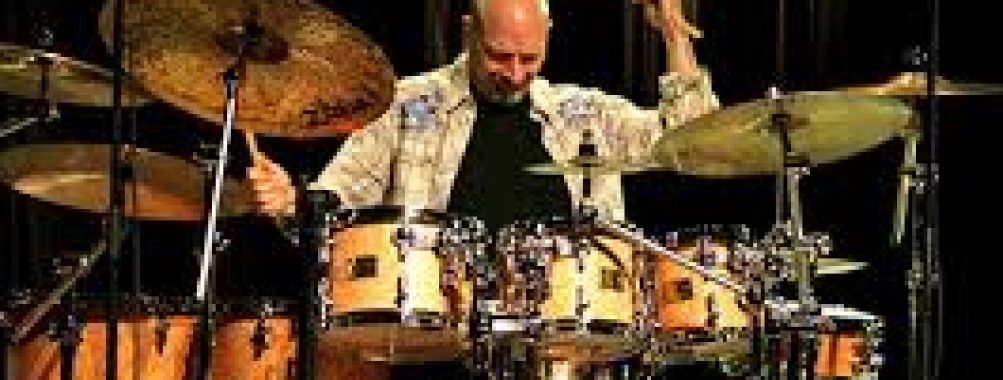
Steve Smith Interview Raga Bopping

July 14, 2017
News, Steve Smith
Steve Smith

For nearly three decades in music Steve Smith has proven himself as one of the finest technicians worldwide on the drum kit. Adept at nearly every style from fusion (Jean-Luc Ponty, Steps Ahead, Vital Information), pop (Journey, Mariah Carey), and straight jazz (Buddy’s Buddies, Jazz Legacy) through to his original iconoclastic work on the Tone Center label, Smith’s formidable technique has earned him innumerable accolades and awards both from connoisseurs and contemporaries. In 2010 he continues his experiments with Indian music with “Raga Bop”, his collaboration with Carnatic guitarist Prasanna Ramaswamy and sax maestro George Brooks. Prior to the group’s tour of North America, Smith took time out to talk to Abstract Logix via phone from his New York residence. In part one of this two-part interview Smith talks about his interest in Indian music and the genesis of the exciting new project.

Abstract Logix: What initially got you into Indian music?

Steve Smith: In 2001, a tabla player named Sandip Burman hired me to do a tour. At that time he was really trying to make a name for himself. He had just played with the Flecktones and he put together an all-star band and by doing that was successful in booking a tour of the USA. The group was Jerry Goodman, Howard Levy, Victor Bailey, Randy Brecker, Paul Bollenback and David Pietro. It was a very good band. Really, nobody knew Sandip but we all knew each other so everyone said they’d do it. Sandip was living in Chicago and he had dictated his music to Howard Levy orally and Howard wrote it down. At the time Howard didn’t really know much about Indian music, so when Howard wrote the charts of Sandip’s tunes some of the charts had each measure in a different time signature. There’d be a bar of 9/8, a bar of 7/8, a bar of 5/8 and then another bar of 9/8 and so on. One of the reasons that Howard and Jerry decided to call me was that they knew I was a good reader and could play odd time signatures. We had just made an album for Tone Center called “The Stranger’s Hand”, with Oteil Burbridge on bass. They called me to do the tour and that was my introduction to Indian music.

I didn’t know anything about the music but during that tour I figured out a couple of things. The first thing was that I learned how to play with a tabla player, as far as volume goes. I altered my drum set radically and ended up using a small Sonor jungle kit that has a 16” bass drum and just a couple of flat ride cymbals and splash cymbals and I was using brushes and bundle-like sticks. I found that the tabla was much softer than any jazz situation that I was ever in, even compared to an acoustic bass and piano trio. Playing with a tabla player is even much softer than that. So I developed an approach to playing with tabla players. The next thing that happened is that as the tour progressed I was able to see that the music was not really in a lot of odd time signatures but each tune was in one time signature but the phrasing of the rhythms could have the appearance of odd time signatures if you didn’t understand the music. I started to see the rhythmic structure that was inside the music, which was very interesting to me. For instance, one of the songs that Howard had written out with lots of different time signatures was actually in 4/4 but he didn’t realize that. I started to notice the rhythmic symmetry, the phrasing and patterns and explained it to him. And then a light bulb went off in that way where it was all very interesting to us. Unfortunately that tour ended on 9/11 because of the tragic attacks that happened, the remainder of the tour was cancelled. But during that tour I developed a curiosity about the Indian rhythms.

A year later when I was teaching at a drum camp in Gemany in 2002 there happened to be a thavil player named Karuna Moorthy who was teaching Indian rhythms and basic konnokol. I went to his class every day for a week. He was very clear at teaching the fundamentals of Carnatic rhythm theory and konnokol. Karuna is a very good teacher and because I have an extensive musical background, it’s not like I’m learning the music from nothing. I have a lot to relate it to as far as western music and rhythms. As a result of that I was able to learn the concepts very quickly and understand them easily. After the drum camp I worked on the rhythms by myself, practicing over the next year, and then I met George Brooks on a gig with Larry Coryell. Larry was playing a gig in the San Francisco area and hired Kai Eckhardt, George and myself as his “local” band. George and I talked about Indian music because I learned that he was into Indian music and was putting together his group Summit. He was in the stage of organizing the line-up and asked me to be the drummer. That was a fantastic situation and opportunity so I jumped at that chance, and Zakir Hussain was the tabla player in that group. In 2003 we recorded an album and Zakir really appreciated the fact that I could play at a very low volume and play all these rhythms with him. When we recorded that first Summit CD he and I played in the same room together about five feet apart. At first he very surprised that that worked because he was used to overdubbing or being in a different room from a normal kit drummer, but as it turned out we could play together. We had a strong rapport because he realized that I respected not only his playing but that I could play at a volume level that was comfortable for him. That was a fantastic opportunity for learning that developed over the course of more than three years where we played a number of gigs and tours with Summit, the entire time I was learning from Zakir. And the method of learning on the job is really crucial to becoming a great musician. You can take lessons and practice by yourself but it doesn’t become something that you own until you play with the musicians and have the music happen on stage. And that really occurred during those years with Summit where I could internalize the rhythms, play the music and have great musical experiences with Zakir and the entire Summit group.

AL: So when you were playing with Zakir was it coming from a Hindustani vocabulary, or a Carnatic thing when it was in Summit?

SS: Well I would say it was initially more from the Carnatic side because that’s what I knew and those rhythms tend to be a bit more universal when it comes to fusion projects. Zakir is well versed in Carnatic rhythms because of his association with Shakti and specifically Vikku Vinayakram. Zakir would also show me some of the Hindustani rhythms, and of course they’re different but they’re related so they’re not radically different. Sometimes I would learn rhythms that he would teach me and I really couldn’t tell you if their background was Carnatic or Hindustani but he would show me rhythmic compositions and I would memorize them or write some notes so I would remember them and then memorize the rhythms and we’d perform them. I’d say my association with Zakir was as valuable an experience as a jazz musician getting a gig with Miles Davis. It was a game changer in that it was a fantastic learning environment from a master that’s a once in a lifetime type of opportunity. And we’ve continued to play and have had different musical experiences. For instance Zakir invited me to come to Mumbai, India to play the Homage to Abbaji [the annual concert dedicated to the memory of Zakir’s father Allah Rakha]. That event is amazing because it starts around six o’clock in the morning and goes until ten o’clock at night. People play all day and over 3,000 people attend so it’s quite incredible. In 2009 Zakir had four nights at Carnegie Hall where he could do whatever he wanted and one of the nights he had a four-piece group, Masters of Percussion, that was Vikku Vinayakram and Giovanni Hidalgo, Zakir and myself so I was able to play an exciting concert with him at Carnegie Hall. That was fantastic.

In 2003 and 2004 I was playing with Summit and through the Indian grapevine Prasanna heard that I was a western drummer playing Indian rhythms and so he hired me to play some duet gigs. I didn’t know about him but he tracked me down and called me up. Those turned out to be really interesting and great opportunities. We were playing in a setting that was, in a way, traditional for Indian music because there was a melodic instrument and a percussion instrument, but the instrumentation was very modern because it was a drumset and an electric guitar. I learned a lot from Prasanna because in order for me to play his music I had to learn a lot of Carnatic patterns and concepts in order to accompany him. He uses a lot of Carnatic patterns and devises in his improvising. So again, that on-the-job learning really expanded my rhythmic knowledge and musicianship. And there’s been other fantastic musicians that I’ve had the opportunity to work with. I’ve played quite a bit with Vikku Vinayakram and he always greets me with a lesson, or a new composition within the first five minutes of saying hello. It’s all very natural, it’s simply his way of relating. Then I have to learn his rhythmic composition right away and he’ll want to play it that night! And another fantastic musician who is very well versed in both north and south Indian rhythms is Pete Lockett. Pete is British and lives in London and we’re always looking for opportunities to play together. I’ve worked a lot with Pete Lockett lately and he’s also an excellent teacher. He shows me a lot of rhythms and worked with me on my konnokol because he’s really fantastic at konnokol. In fact I had him perform on my Vital Information album called “Vitalization” where I incorporated a lot of Indian rhythms into the music. I’ve been working the Indian rhythms into my concepts, whether it’s solo drumming, Vital Information or other group situations I’m involved in.

What led directly to the creation of the Raga Bop Trio was the latest George Brooks Summit record called “Spirit and Spice”. One of the things I really enjoy about working with George Brooks is that he still writes music with pen and paper — not a computer demo — and comes in with a chart and we work out all the details of the groove and tempo and the form of the song. One of the downsides of modern technology is that a large part of drummers job is done for him by the composers when they program the drum parts into the computer demos. A big part of what used to be valued as a creative part of a drummer’s life was being presented with music and the drummer had to come up with an interesting drum part, that is not so much a part of today’s drummers’ world. If we go back to 1976, where I first got my start on the international touring scene with Jean-Luc Ponty, he hired me to play in his band and play on his record “Enigmatic Ocean”. He handed me charts and said “the tempo is about here,” he counted it off, we played the music and I needed to come up with drum parts. That was common for every musical situation I was in up until more recent times, where that creative part is generally much less. With the new Summit record George came to my house and just the two of us worked on the music before we rehearsed with the other band members. So I was in on the ground floor of helping the music take shape. We found that it sounded pretty good with just the two of us playing together which recalled another situation of a duo which was me and Prasanna. I mentioned, “Do you know Prasanna,” and he had heard of him but didn’t really know him. Then I suggested we do something with the three of us. There are different ways of looking at the construction of this trio, one way you could look at Raga Bop Trio is it started as a duo: drums and guitar, and we added a sax, or a drums and sax duet adding a guitar. Anyway, we liked the idea, so after we were finished with the Summit album we booked some time to get together with Prasanna and jam for a few days. In fact in those three days we came up with all of the music for the “Raga Bop Trio” album. George and Prasanna brought in some compositions they thought would work and we rehearsed them and came up with a couple of original pieces, we had a very successful collaboration. Next we booked recording time at a studio in Northern California, Prairie Sun, which has a little living facility where we could go and live and record. We spent four days there and recorded the entire album during that time. We made the record by getting together in a room and playing, we didn’t construct it with computers and overdubbing. Prasanna and I were in the same room and George was in the vocal booth and we played the music and that’s what you hear on the record.

Buy

Itunes-note  Amazon  Bandcamp

Steve Smith Interview

December 18, 2003
News, Steve Smith
Steve Smith

Buy

Itunes-note


Amazon


Bandcamp

Steve Smith is one of the most respected drummers in the world today. His distinctive style has propelled the playing of Jean Luc Ponty, Larry Coryell, Journey and his fusion group, Vital Information. Steve is an endless student of rhythm. Recently he has been focusing on performing Indian music with Zakir Hussain in the new supergroup Summit that also features George Brooks, Kai Eckhardt and Fareed Haque. Steve just released a two DVD set on which he interprets the history of US Beat and Drumming. Abstract Logix recently caught up with Steve.

AL: YOU ARE CONTINOUSLY LEARNING AND EVOLVING.

SS: I see music as a path through life that offers limitless learning and experiences with many facets. There is the mystical; surrendering to the moment and becoming one with your instrument, one with the other musicians you are playing with and then we all become one with the music. This is what all musicians want to do — transcend space and time and be in the moment, channeling the music of the Great Beyond. In order to find that kind of freedom with demanding, high level music, this requires using the intellect; great knowledge of music, the physical; a highly developed instrumental ability, and wisdom; the experience to know how to interact with the musicians you are playing with. Because I mainly play with high-level musicians I’m often learning new and insightful musical concepts. I’m always refining my playing technically, through daily practice and a relaxed approach. I’m also learning new combinations of rhythms and phrases mainly through the study of Indian rhythms.

AL: WHAT HAS IT BEEN LIKE PLAYING WITH ZAKIR HUSSAIN?

SS: First of all it has been a humbling experience. Zakir knows so much about rhythm and is such a master of drumming he can be intimidating to play with. But when he plays he is open and very responsive, he is truly a great jazz musician — in the moment and very aware of what all the other musicians are playing.

AL: HOW DO YOU LISTEN TO HIM AND ADD YOUR OWN CONTRIBUTIONS?

SS: For me to play with another drummer is not a typical situation, but I love playing with Zakir. I take a supportive role when I play with him and let him take the lead most of the time. In the group Summit, this concept works well.

AL: HOW HAVE INDIAN RHYTHM FORMS CONTRIBUTED TO YOUR MUSIC?

SS: The Indian approach to rhythm has highly developed unique concepts. I am in the process of learning as much as I can about this system and incorporating the ideas into my playing. It’s most useful when I play with Indian musicians, but it’s also useful in some jazz / rock music. One thing that learning some of the Indian phrasing has helped me develop is longer phrasing ideas that go way over the bar line.

AL: YOU MUST FIND SIMILARITIES AND DIFFERENCES BETWEEN THE EAST AND THE WEST.

SS: As far as similarities, both have to feel good and groove. Both are based on rich traditions. As far as differences, with the Western approach — in general — the actual rhythm played, either as an accompanist or as a soloist, is incidental; the main concept is about the feel of the music. With the Indian approach there is much emphasis placed on the actual rhythm played and how the combination of rhythms are constructed. There is a logic and a symmetry to the rhythms they use and there are lots of rules about what is hip. We really don’t have anything that rhythmically corresponds to that in the Western Rhythmic Lexicon.

AL: WHAT ARE SOME OF YOUR MUSICAL HIGHLIGHTS?

SS: Playing with Zakir in Summit — which also includes George Brooks on sax, Kai Eckhardt on bass and Fareed Haque on guitar — is always a musical high point for me. When I played with Steps Ahead, in the various incarnations, was always great music. Playing with the Buddy Rich Big Band and with the small group Buddy’s Buddies is always fantastic. I love playing with my group Vital Information and when we toured with Vital Information in 2003 with Bill Evans as our special guest that was an incredible experience. One of most memorable situations was making a record with the country singer Ray Price. We did a whole record in three days playing everything live in the studio, full rhythm section, strings, horns and Ray sang live — no overdubs or clicks, real music played by live musicians.

AL: WHAT ABOUT TIMESCAPE WITH AYDIN ESEN AND BARON BROWNE?

SS: This was another peak experience. Aydin is a genius musician and I love his music. His music was very hard to play, but once we got past the learning phase it was magic. That trio with Aydin, Baron and I definitely reached The Zone of effortless, high level communication.

AL: YOU HAVE PERFORMED WITH PRASANNA.

SS: I learned his music by listening to his recordings and heard how the Tavil player, Ghatam player, Mrdangam player and Kanjira player approached his music. I tried to put myself in that head space when I played with him. Many times I didn’t use cymbals because those drummers don’t use cymbals. I developed some new concepts like using the left beater on my double pedal to muffle and change the pitch of my bass drum. I also had to learn many new rhythms in order to play his music. When Prasanna and I play it’s like playing with a great jazz player, the improvisation is free and there is good communication, but it’s within the context of the Carnatic tradition. I’ve been learning about the rules of Carnatic music so I try to keep my playing within that context, but I can’t help but bring something unique to the music because I am essentially a U.S. drummer. In a way I feel this is my most unique work, adapting my playing to the Indian concepts, I’ve never heard another U. S. drummer do this.

AL: YOU RECENTLY PERFORMED WITH THE GREAT VIKKU VINAYAKRAM.

SS: Vikku is a great composer and teacher as well as a genius player. He showed me one of his extended rhythmic compositions — which I loved learning — and he was very easy to play with, his feel is very groovin.’ He brought a different concept to the group Summit. Vikku plays more from the Carnatic tradition of two drummers playing the music together. By contrast, Zakir has the Indian approach plus the element of playing the music like a jazz / latin percussion that is coloring the music, similar to a Weather Report type percussionist.

AL: THERE ARE SPECIAL ISSUES WHEN WITH A TABLA PLAYER.

SS: Playing with a tabla player requires a light touch because the drum set is much louder than tablas. I’ve developed a kit and an approach for this situation. I use a Sonor Jungle Kit, a small drumset with a 16 bass drum, a 10 rack tom and a 13 floor tom. The snare drum is a 12 Sonor Designer drum with a Remo Fyberskin head. I used Remo Clear Ambassadors on the toms and Remo Clear Emperor on the bass drum, with just felt strip muffling. The cymbals are all Zildjian, Re-Mix 12 hi hats, Re-Mix 17 ride, 18 K Flat Top Ride, a 8 K splash cymbal, a 9 China Splash. I use bundled rods instead of sticks with this setup because the sound blends well with the tabla without being overpowering. In January there is a CD being released on Magna Carta called “Modern Drummer presents Drum Nation”. This recording has tracks by many different drummers including Terry Bozzio, Bill Bruford, Tim Alexander, Brain and others. You can hear the drum setup I described on this recording. Zakir and I (along with the members of Summit) play a duet tune called ‘Mad Tea Time’; this tune is full of Indian rhythmic devises.

AL: ANYTHING YOU WOULD LIKE TO TELL ASPIRING DRUMMERS THAT ARE TRYING TO INCORPORATE INDIAN POLYRHYTHMS IN THEIR VOCABULARY?

SS: Before you get into Indian Polyrhythms you first have to master the simplest polyrhythm which is 3 over 2. I have a section in my new “Hudson Music” DVD Steve Smith Drumset Technique and History of the U.S. Beat that is devoted to this concept. After that, learning to count the rhythms out loud, either by using the Indian Konakol syllables or by simply using numbers, is essential. After learning 3 over 2, then go up the rhythmic scale. Keep a basic pulse and play 4, 5, 6, 7, 8, 9, 10, 11, and 12, first over one beat and then play the rhythms over 2 beats. If you can play a 3 over 2 polyrhythm in your feet (play 3 with the hi hat, 2 with the bass drum) then play all the rhythms over that you are playing 4, 5, 6, 7, 8, 9, 10, 11, and 12 over the 3 and the 2 at the same time. I demonstrate this in the “Hudson DVD 25th Anniversary of The Collective”. With this approach you are playing layers of rhythm, which is what Polyrhythms are- one rhythm layered on top of another. Thanks a lot for your time Steve.

Latest album

Latest NEWS

SUBSCRIBE

Please Subscribe your mail to get notification from AbstractLogix.


Facebook-f


Twitter


Instagram


Youtube

Copyright © 2021 ABSTRACT LOGIX

Facebook-f


Twitter


Instagram


Youtube

Copyright © 2021 ABSTRACT LOGIX

Recent Posts

  • GLOBAL FUSION PIONEERS SHAKTI NOMINATED FOR TWO 2026 GRAMMY™ AWARDS
  • Shakti – ‘Mind Explosion’
  • ‘THIS MOMENT’ AWARDED WITH GRAMMY
  • GRAMMY™ NOMINEE FOR BEST GLOBAL MUSIC ALBUM – SHAKTI’S ‘THIS MOMENT’
  • GLOBAL FUSION ALCHEMISTS SHAKTI ANNOUNCE NORTH AMERICAN TOUR

Recent Comments

  • irontemplates on Guns and Plants: Stardust
  • irontemplates on Carla & Bones: Trailblazers
  • irontemplates on Mantis: Glam Porn (Vinyl)
  • irontemplates on Love Elexir
  • irontemplates on Sweater The Rise

Archives

  • November 2025
  • June 2025
  • May 2024
  • December 2023
  • February 2023
  • May 2022
  • February 2022
  • June 2021
  • May 2021
  • April 2021
  • March 2021
  • February 2021
  • January 2021
  • July 2019
  • May 2019
  • February 2019
  • September 2018
  • August 2018
  • July 2018
  • February 2018
  • January 2018
  • November 2017
  • October 2017
  • September 2017
  • July 2017
  • November 2016
  • August 2015
  • May 2015
  • January 2015
  • November 2014
  • October 2014
  • August 2014
  • June 2014
  • February 2014
  • July 2013
  • May 2013
  • April 2013
  • February 2013
  • December 2012
  • September 2012
  • July 2012
  • June 2012
  • March 2012
  • May 2010
  • April 2010
  • December 2009
  • October 2009
  • August 2009
  • July 2009
  • May 2009
  • December 2008
  • November 2008
  • October 2008
  • August 2008
  • April 2008
  • February 2008
  • November 2007
  • October 2007
  • September 2007
  • April 2007
  • March 2007
  • February 2007
  • January 2007
  • December 2006
  • October 2006
  • September 2006
  • July 2006
  • June 2006
  • May 2006
  • April 2006
  • March 2006
  • February 2006
  • January 2006
  • October 2005
  • September 2005
  • August 2005
  • June 2005
  • May 2005
  • March 2005
  • January 2005
  • December 2004
  • September 2004
  • August 2004
  • July 2004
  • June 2004
  • May 2004
  • April 2004
  • March 2004
  • January 2004
  • December 2003
  • November 2003
  • September 2003
  • July 2003
  • June 2003
  • May 2003
  • April 2003
  • February 2003
  • January 2003
  • November 2002
  • October 2002
  • June 2002

Categories

  • Abstract Logix
  • Adam Nitti
  • Alex Machacek
  • Alex Skolnick
  • Allan Holdsworth
  • Andrea Marchesini
  • Anil Prasad
  • Avi Bortnick
  • Barry Cleveland
  • Barry Richman
  • Bela Fleck
  • Ben Monder
  • Bill Bruford
  • Bill Connors
  • Brett Garsed
  • Bunny Brunel
  • Chad Wackerman
  • Chris Beckers
  • Chris Poland
  • Chris Taylor
  • Chuba Aomori
  • Cindy Blackman
  • Colin D'Cruz
  • David ‘Fuze’ Fiuczynski
  • Debashish Bhattacharya
  • Dennis Chambers
  • Dewa Budjana
  • Dominic Miller
  • Dominique di Piazza
  • Ed DeGenaro
  • Ehsaan Noorani
  • Featured
  • Featured – John
  • Frank Gambale
  • Fresh News
  • Garaj Mahal
  • Gary Husband
  • Gary Wills
  • General
  • George Brooks
  • Gerald Gradwohl
  • Gergo Borlai
  • GIRLS DON’T LIKE REAL JAZZ
  • Gregg Bendian
  • Hadrien Feraud
  • Henry Kaiser
  • Hiromi
  • Hugh Ferguson
  • Ian Patterson
  • Jack DeJohnette
  • Jahloon
  • Jeff Babko
  • Jeff Berlin
  • Jeff Coffin
  • Jeff Richman
  • Jeff Sipe
  • Jennifer Batten
  • Jimmy Haslip
  • Jimmy Herring
  • John Czajkowski
  • John McLaughlin
  • John Molo
  • Jonas Hellborg
  • Keith Carlock
  • Ken Talve
  • Kevin Scott
  • Kirk Covington
  • Mandolin U. Shrinivas
  • Marc Rossi
  • Mark Egan
  • Mark Mondesir
  • Matthew Garrison
  • Mattias IA Eklundh
  • Michael ATONAL Vick aka VVV
  • Michael Landau
  • Mike Seal
  • Mitchel Forman
  • Nat Janoff
  • News
  • Ney Mello
  • Nguyen Le
  • Nima Rezai
  • Ohm
  • Oz Noy
  • Ozone Squeeze
  • Pandit Debashish Bhattacharya
  • Pat Martino
  • Paul Hanson
  • Percy Jones
  • Peter Fernandes
  • Prasanna
  • Rai Thistlethwayte
  • Rakalam Bob Moses
  • Ranjit Barot
  • Ray Gomez
  • Rez Abbasi
  • Richard Hallebeek
  • Rob Levit
  • Scott Henderson
  • Shakti
  • Shane Theriot
  • Shankar and Gingger
  • Shankar Mahadevan
  • Shawn Lane
  • Souvik Dutta
  • Stanley Clarke
  • Steve Khan
  • Steve Smith
  • Steve Topping
  • Stu Goldberg
  • Surinder Sandhu
  • T Lavitz
  • Terri Lyne Carrington
  • The 4th Dimension
  • The Mahavishnu Project
  • Tom Guarna
  • Tony Grey
  • Tony Smith
  • Trilok Gurtu
  • Uncategorized
  • Ustad Zakir Hussain
  • V Selvaganesh
  • Vernon Neilly
  • Vinnie Colaiuta
  • Walter Kolosky
  • Wayne Krantz
  • Wayne Shorter
  • Zakir Hussain

Meta

  • Log in
  • Entries feed
  • Comments feed
  • WordPress.org

SUBSCRIBE

Music news delivered to your inbox

Follow Us


COPYRIGHT © 2023 ABSTRACT LOGIX