• RELEASES
  • VIDEOS
  • ARTISTS
  • NEWS
  • ABOUT
  • STORE

John McLaughlin

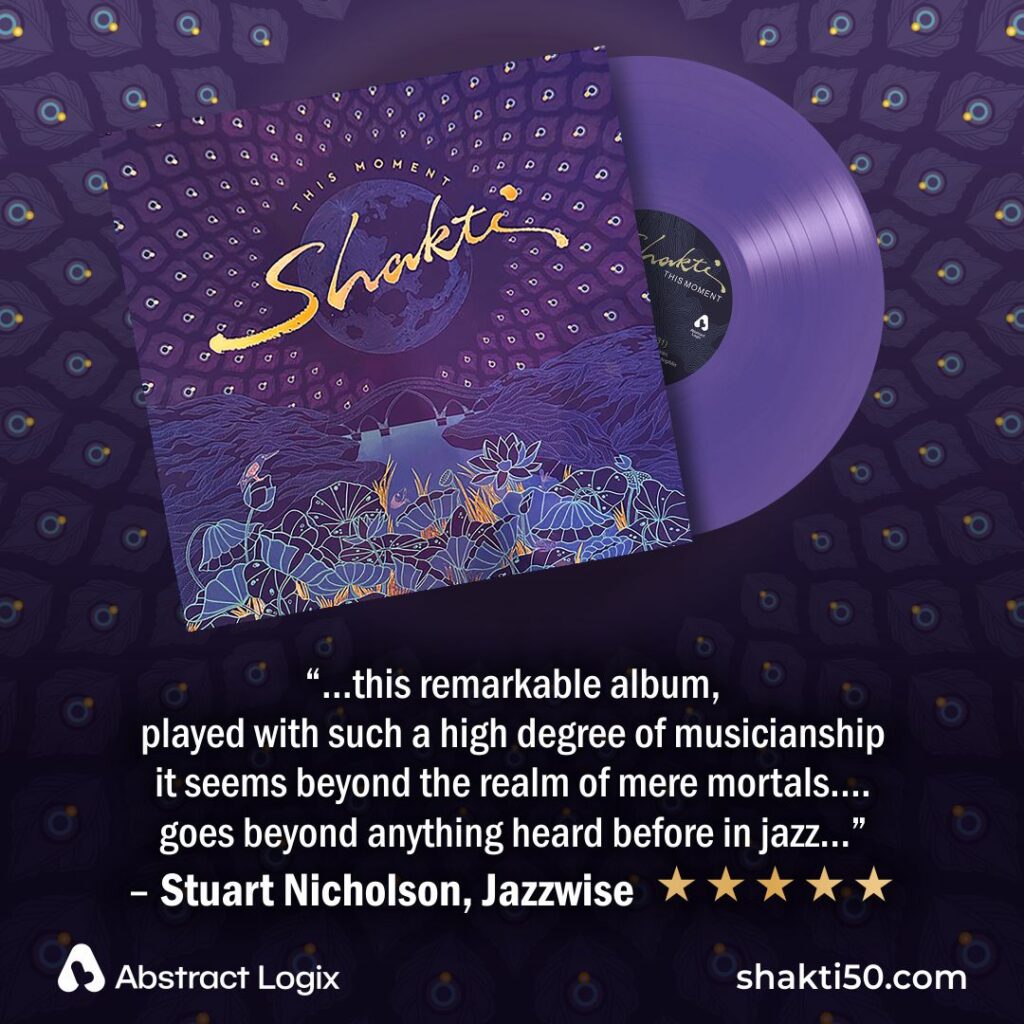
‘THIS MOMENT’ AWARDED WITH GRAMMY

May 7, 2024
Abstract Logix, John McLaughlin, Shakti, Shankar Mahadevan, Uncategorized, V Selvaganesh, Zakir Hussain
Ganesh Rajagopalan, John McLaughlin, Shakti, Shankar Mahadevan, V Selvaganesh, Zakir Hussain

HERE SHE IS.

IN PERSON.

IN WOOD AND METAL.

OUR TROPHY.

WITH YOUR HELP.

ONE FOR THE AGES.

FOR THE MUSIC.

THE BRIDGE BETWEEN CULTURES.

FOR COMING TOGETHER.

THANK YOU TO ALL THE MUSIC FANS.

Make sure you take this piece of history home with you – head to our store and get your copy of the historic, Grammy-winning double vinyl album ‘This Moment’.

GRAMMY™ NOMINEE FOR BEST GLOBAL MUSIC ALBUM – SHAKTI’S ‘THIS MOMENT’

December 17, 2023
Abstract Logix, Bela Fleck, John McLaughlin, Shakti, Shankar Mahadevan, Uncategorized, Zakir Hussain
Abstract Logix, Bela Fleck, Ganesh Rajagopalan, John McLaughlin, Selvaganesh Vinayakram, Shakti, Shankar Mahadevan, world music, Zakir Hussain

Nomination follows rapturously received 50th Anniversary World Tour featuring original group co-founders John McLaughlin and Zakir Hussain

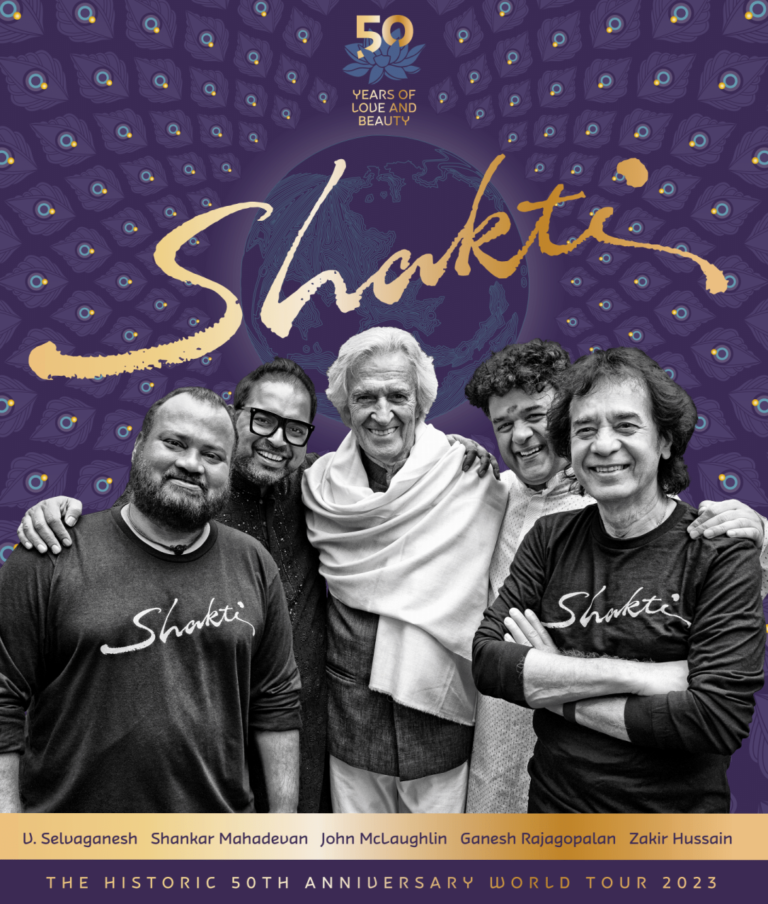
Shakti, the recently reconvened global fusion trailblazers, have been nominated for the 2024 GRAMMY™ Award for Best Global Music Album for This Moment – the group’s first new studio album in more than 45 years, released on June 30, 2023, on the Abstract Logix label. “After our most successful tour ever of three continents, Shakti gets a GRAMMY nomination for our album This Moment…” reacted to co-founding guitarist and composer John McLaughlin. “We are thrilled and delighted beyond words.”

“Our 2023 world tour celebrated 50 years of love and beauty,” Zakir Hussain adds. “Congratulations to my longtime brother in the music, John McLaughlin, and to our brilliant bandmates Shankar Mahadevan, Selvaganesh Vinayakaram, and Ganesh Rajagopalan.”

Shakti recently concluded their triumphant 27-city 50th Anniversary Tour, which featured 17 U.S. performances with opening sets by longtime admirers Jerry Douglas, Bill Frisell, Béla Fleck, and John Scofield. Highlights of the tour – during which the thrilling cross-cultural musical ideas first broached on This Moment was further explored and expanded – included a performance at Nashville’s historic Ryman Auditorium (captured and released as a limited live stream) and a riveting appearance on NPR’s popular Tiny Desk Concerts program. 

Shakti was formed in 1973, as McLaughlin sought deeper musical fulfillment following the success of his immensely influential and successful jazz/rock fusion outfit The Mahavishnu Orchestra. A Greenwich Village music shop owner connected McLaughlin with tabla virtuoso Zakir Hussain, who had been performing with giants of Hindustani music since he was a child. Their initial informal encounters grew into Shakti, an outfit that transcended the boundaries separating Eastern and Western music via dynamic virtuosity and spiritual openness. Over the succeeding decades, Shakti’s powerful albums and tours established them among the key architects of what is today called “World Music,” inspiring generations of musicians to discard arbitrary borders in search of fruitful musical hybrids. “They were a revelation,” recalls Béla Fleck.

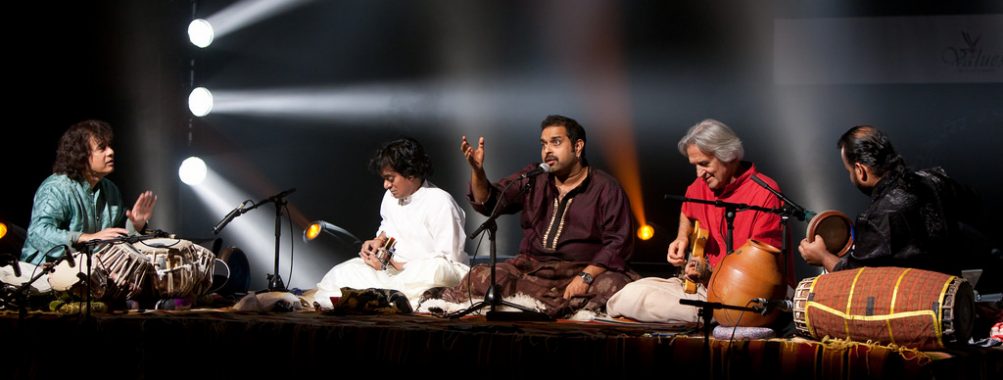
Today’s Shakti, as experienced in concert in 2023 and on This Moment, is composed of McLaughlin (guitar, guitar synth), Hussain (tabla), vocalist Shankar Mahadevan, violinist Ganesh Rajagopalan, and percussionist Selvaganesh Vinayakaram. “Shakti is truly a pioneer in the concept of world fusion,” explains Mahadevan, “where music knows no boundaries and comes together most beautifully from different genres. I am so privileged to be with the greatest maestros – the most evolved musicians that I have ever met.”

“The greatest thing we wanted to celebrate with this album was that it’s considered for Best Global Music Album and not any other category,” said percussionist Selvaganesh Vinayakaram, son of original Shakti member, Carnatic music legend Vikku Vinayakaram, in an interview with Rolling Stone India. “That means this group has that global music value.” 

“How apt to have the band who created this genre of ‘World Music’ be nominated for this honor on their 50th anniversary,” reflects Souvik Dutta – who was inspired by Shakti to found Abstract Logix twenty years ago. “They are the ultimate global band – the brotherhood of John and Zakir uniting in music to bring the world together.”

“This Grammy nomination,” concludes Ganesh Rajagopalan, “is a testament to the evergreen quality of the music of Shakti.”
GLOBAL FUSION ALCHEMISTS SHAKTI ANNOUNCE NORTH AMERICAN TOUR

February 13, 2023
Abstract Logix, Bela Fleck, John McLaughlin, Shakti, Shankar Mahadevan, Zakir Hussain
Abstract Logix, Bela Fleck, Ganesh Rajagopalan, John McLaughin, Selvaganesh Vinayakram, Shakti, Shankar Mahadevan, world music, Zakir Hussain

Co-Founders John McLaughlin and Zakir Hussain Lead Current Lineup On First U.S. Tour In 16 Years

With Special Guests Béla Fleck, Bill Frisell and others on select shows

More dates and special guests to be announced at a later date.

Feb 6, 2023: Following word of the Summer 2023 release of This Moment – their first new studio album in 46 years – revolutionary world music ensemble Shakti will continue to discover and explore the musical common ground bridging East and West on an extensive U.S. tour, beginning August 17 in Boston. Born in the mid-1970s out of the deep artistic and spiritual connection bonding British guitarist John McLaughlin and Indian tabla player Zakir Hussain, Shakti’s cross-cultural musical conversation dissolved boundaries with uncommon passion, grace, and dexterity – awakening subsequent generations of musicians to the possibilities of such hybrids in the process. Alongside McLaughlin and Hussain, today’s Shakti features renowned vocalist Shankar Mahadevan, violinist Ganesh Rajagopalan, and percussionist Selvaganesh Vinayakram (son of original Shakti ghatam player T.H. “Vikku” Vinayakram).

Looking ahead to the performances, McLaughlin equates the endeavor to a homecoming of sorts. “Shakti was born in the USA in 1973,” he reflects, “and is also no stranger to American audiences. We’ve played concerts all over the US from coast to coast and north to south – and everywhere we’ve played, we’ve had wonderful audiences.”

Joining Shakti on more than half of the dates will be another performer dedicated to intermingling and transcending genres, Béla Fleck, who will open the performances with a solo set. “Hearing Shakti was a revelation and I started listening right when they started,” Fleck recalls. “Something about Shakti, and also making music with Zakir, was very relatable – perhaps akin to the acoustic guitar and fiddle. But it wasn’t until playing with Zakir and Edgar Meyer [on 2009’s Melody of Rhythm: Triple Concerto & Music for Trio] that I started having more of a sense of what they were up to. Keeping in mind the virtuosic and energetic level of the band, I’ll be attempting to create a solo set that mesmerizes and excites.”

In addition, renowned guitarist Bill Frisell will also be opening the Shakti concerts with solo sets on certain selected dates.

“Béla Fleck and Bill Frisell are both truly fine musicians whom I’ve admired for decades,” McLaughlin says.

With the recording of their new studio album now complete, the members of Shakti now await the opportunity to continue their pan-global dialogue. “In our initial incarnation,” Zakir Hussain concludes, “we did not always have the time nor the means to explore. Now, with the decades of individual musical experiences we all have poured into this, the result reveals an extraordinary depth and level of interaction within this band.”

Preliminary USA Tour Dates

Show Date  Venue                                                  City, State

8.17.2023 Wang Theatre at Boch Center                  Boston, MA ***
8.19.2023 The Capitol Theatre                          Port Chester, NY ***
8.20.2023 Prudential Hall                                  Newark, NJ *
8.22.2023 Keswick Theatre                                  Glenside, PA
8.23.2023 Wolf Trap                                          Vienna, VA *
8.25.2023 Cobb Energy Performing Arts Center  Atlanta, GA ***
8.27.2023 Koka Booth Amphitheatre                  Cary, NC *
8.29.2023 Palace Theatre                                  Columbus, OH *
8.31.2023 Ryman Auditorium                                  Nashville, TN ***
9.3.2023         Ravinia Festival                                  Highland Park, IL *
9.5.2023         Arlene Schnitzer Concert Hall                Portland, OR ***
9.6.2023        Paramount Theatre                                 Seattle, WA *
9.8.2023        Mondavi Center for the Performing Arts Davis, CA **
9.9.2023        Davies Symphony Hall                          San Francisco, CA
9.11.2023 Irvine Barclay Theatre                          Irvine, CA
9.14.2023 Hill Auditorium                                  Ann Arbor, MI *
9.16.2023 H-E-B Center                                          Austin, TX *

*with Bela Fleck
**With Bill Frisell
***TBD

  • ** w/ Bill Frisell
Vinnie Colaiuta

Podcast with Vinnie Colaiuta and John McLaughlin

June 23, 2021
John McLaughlin, News, Vinnie Colaiuta
John McLaughlin, Vinnie Colaiuta


Bandcamp

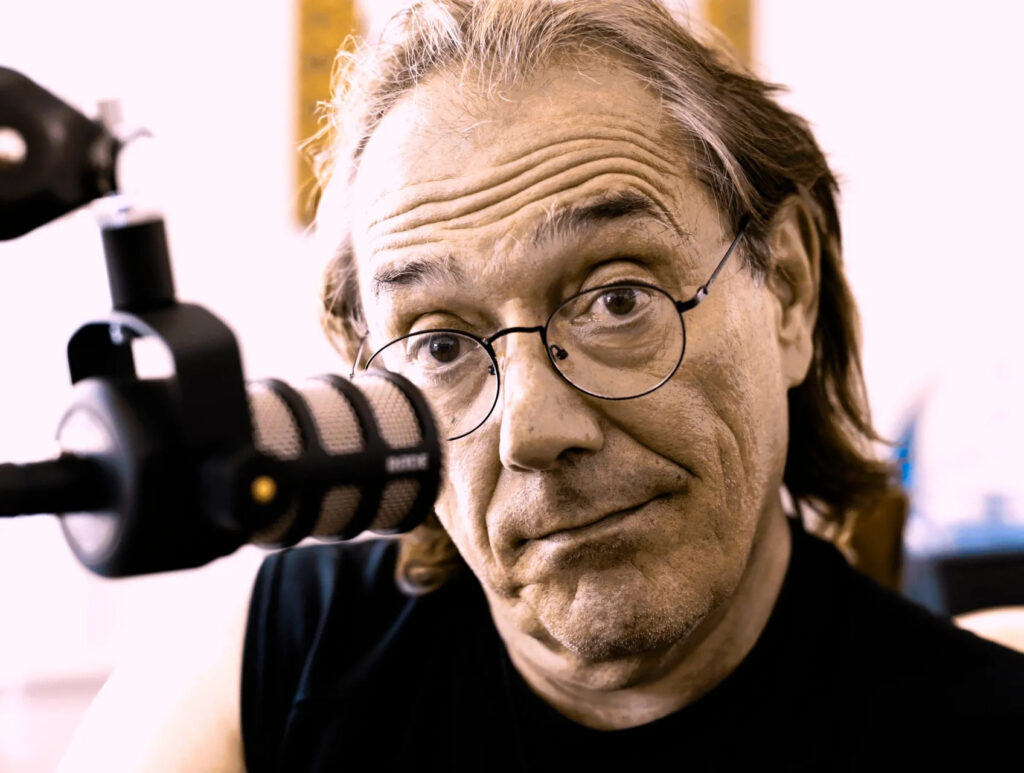
Vinnie Colaiuta invited one of the most influential guitarists of our time, John McLaughlin in his podcast Breakfast with Vinnie.

A living legend of improvised music, with a career now spanning more than five decades, John McLaughlin opens his heart about how music has been a primary focus of his life and about his wonderful journey till now. He also discussed about his new album, “Liberation Time”, which is all set to release on 16th July, 2021 on Abstract Logix.

To listen to the entire podcast click here: https://breakfastwithvinnie.com/episodes?fbclid=IwAR1ZGKd_Ad_z71j4uyIWYKTkJgvRp3jvq_C7IEVeC92YQSXNkgWMf0KyIe8

John McLaughlin

John McLaughlin covers Straight No Chaser by Thelonious Monk for India fundraiser

May 7, 2021
John McLaughlin, News
John McLaughlin

AN URGENT PLEA FROM JOHN McLAUGHLIN:
Guitar icon releases exclusive video to raise awareness and funds for COVID relief in India, asking all to donate to Project Hope today.

John McLaughlin has made no secret of the musical and spiritual debt that he owes to the people and nation of India. Whether explicit (the unprecedented east/west hybrid of his beloved Shakti ensemble) or implicit (the daring rhythmic structures he transmitted via the Mahavishnu Orchestra), India has exerted a gravitational pull on McLaughlin’s life and music, and his gratitude is boundless.

Now, with India suffocated by a rampant outbreak of the deadly COVID-19 virus, McLaughlin is asking all of us to give just a little in support of relief efforts there. To encourage donations to the global health and humanitarian organization Project Hope (www.projecthope.org) — who are providing essential supplies and personnel to the Indian people — he has gathered a group of musician friends in Monaco to film an exclusive version of Thelonious Monk’s immortal blues “Straight No Chaser.” This fiery performance is his humble offering, a beacon beaming out to his many admirers with the hope of helping to offset the terrible blight now ravaging India.

Captured live, the performance features McLaughlin alongside pianist Roger Rossignol, bassist JM Kiki Aublette, and drummer Nicolas Viccaro, investing Monk’s timeless, knotty blues theme with an innovative spark and infectious abandon. Through his improvisation, alternately soaring and keening, McLaughlin delights in paying tribute to Monk’s deft rhythmic constructions and cunning use of dissonance. His compatriots are with him at every step, resulting in a conversational, refreshingly human treatment of this timeless standard.

“The world is in dire straits,” McLaughlin implores, “but India is just catastrophic: People dying outside hospitals because there are no beds, there is no oxygen. We recorded this video thinking of them. It is our gift to you in the hope that you will make a small gift.”

John McLaughlin

John McLaughlin announces new album Liberation Time

April 28, 2021
John McLaughlin, News
John McLaughlin

Preorder the album | Get Free download

Bandcamp

Recorded remotely during lockdown, new album examines the pandemic era with a provocative mix of catharsis and reflection.

A living legend of improvised music, with a career now spanning more than five decades, John McLaughlin is no stranger to translating tumultuous moments into compelling, thoughtful audio art. Witness his searing contributions to Miles Davis’s infamous Jack Johnson sessions, the explosively pioneering rock/jazz hybrid he helped create as a member of the first edition of Tony Williams’s “Lifetime”, or the expansive explorations encompassed by his own music — be it the rhythmic revolution of the Mahavishnu Orchestra, the unprecedented east/west fusion of Shakti, or the thrilling telepathic interplay his current outfit, the 4th Dimension.

With his newest album, “Liberation Time”, McLaughlin draws from one of humanity’s most fraught, uncertain epochs to produce music that gracefully reflects the uncertainty, vulnerability, and slowly awakening joy of our times. A direct response to the mandated restrictions imposed by the spread of Covid-19, the album is — unusually for McLaughlin’s recent projects — not the work of one fixed ensemble. With physical proximity no longer a prerequisite, McLaughlin drew upon decades of experience as a bandleader to select musicians best suited to each composition.

“As the Spirit Sings” introduces the album by contrasting churning rhythmic tension (stoked by drummer Vinnie Colaiuta and bassist Sam Burgess) with McLaughlin’s soaring guitar figures — all underpinned by Gary Husband’s subtle, supportive piano. The knotty post-bop figures of “Right Here, Right Now, Right On” mark one of the most jazz-inflected performances McLaughlin has laid down in some time, featuring Nicolas Viccaro (drums), Jerome Regard (bass), Julian Siegel (tenor saxophone), and Oz Ezzeldin (piano). The sense of brotherhood that bonds McLaughlin’s current 4th Dimension ensemble (McLaughlin, Husband, bassist Etienne Mbappe, and drummer Ranjit Barot) is on full display during “Lockdown Blues,” a playful refraction examination of blues tropes first released last summer to benefit the Jazz Foundation of America.

With vaccination campaigns now in full effect and a more promising tomorrow coming into view, “Liberation Time”’s title track can be felt as visceral anticipation — a rousing glimpse into an unbound future rich with possibilities. And while much of Liberation Blues revels in the sort of spontaneous interplay that has been denied by Covid restrictions, some of the album’s most touching moments feature McLaughlin alone at the piano — an instrument he has not recorded on since his 1973 collaboration with Carlos Santana, “Love Devotion Surrender”. 

“Liberation Time” is a product of its times, and yet it looks both forwards and backwards — at once drawing upon memories of better days yet reaching for a new dawn. Looking back at the album’s transcontinental sessions, McLaughlin concludes, “The wonderful thing about music is that you put the headphones on and you are all in the same room.”

John McLaughlin

John McLaughlin and the 4th Dimension offer first new recording in five years to benefit the Jazz Foundation of America during Covid-19 Crisis

January 3, 2021
Featured, John McLaughlin, News, The 4th Dimension
John McLaughlin, The 4th Dimension

The blues may be the only thing even more universal than the current global pandemic we are all operating through. With this in mind, pathbreaking guitarist and bandleader John McLaughlin has convened his longstanding band the 4th Dimension — Gary Husband (keyboards), Etienne M’Bappe (bass), and Ranjit Barot (drums, konnakol) — via the Internet to record “Lockdown Blues”, the multifaceted ensemble’s first new studio recording in five years. Although each performer contributed his part remotely from far-flung locales (McLaughlin: Monaco, Husband: London, M’Bappe: Paris, Barot: Mumbai), their deeply felt connection transmits clearly through high-speed data lines as they tackle a rigorous, propulsive new McLaughlin composition rooted in the blues, but enlivened and disrupted by his signature rhythmic intricacy.

McLaughlin convened the 4th Dimension to help raise awareness and funds for the Jazz Foundation of America, who has supported jazz music and jazz musicians for over 30 years. “The pandemic has thrown hundreds of thousands of musicians out of work,” McLaughlin reflects, “and nobody knows how long.” With this in mind, the Jazz Foundation of America has recently established a COVID-19 Musicians’ Emergency Fund to give musicians and their families money to help cover basic living expenses.

A video of the 4th Dimension performing “Lockdown Blues” is available to view on YouTube, Facebook, Instagram and the audio recording can be downloaded free on Abstract Logix Bandcamp page: https://abstractlogix.bandcamp.com. Donations can be given directly to the Jazz Foundation of America at www.jazzfoundation.org.

“As a band, we’ve been together so long we’re family,” McLaughlin concludes. “But in fact we go further back: Humanity is the only family, and we believe the only way humanity will survive is if we care enough for each other. We hope that whoever sees or hears this will care also. So if you donate something — even something really small — thank you.”

Interview with the Founder & CEO of Abstract Logix

February 6, 2018
Abstract Logix, Jimmy Herring, John McLaughlin, News, Souvik Dutta
Abstract Logix, Bruce Hampton, Jimmy Herring, John McLaughlin, Souvik Dutta


Fresh off a tour with the 2018 Grammy award-winning guitarist John McLaughlin, Souvik Dutta, CEO of Abstract Logix, gives us a behind the scenes look at the jazz legend’s historic “American Farewell Tour” & we discuss Steem-powered music.

You can read the piece here.

Buy

Itunes-note 
Amazon  Bandcamp

Trading Licks: Wayne Krantz Interviews John McLaughlin

November 8, 2017
John McLaughlin, News, Wayne Krantz
John McLaughlin, Wayne Krantz

Two Abstract Logix labelmates spent some time together this week when maverick guitar craftsman Wayne Krantz sat down to interview maestro John McLaughlin. They discussed influences, history, and more.

WK: You’re a citizen of the world. Do you consciously identify as a Brit anymore?

JM: There are certain aspects of a culture you grow up in that stay with you for life. Having spent the greater part of my life living outside the UK, the only cultural aspect that remains after all these years is the British sense of humor, which is completely wacky, irreverent and very culturally specific.

WK: Where do you feel your professional ambition as a bandleader came from?

JM: I would say from Miles Davis. Playing with Miles both in the studio and in concert was a revelation to me. Miles was the greatest; he knew how to get the best out of his musicians, and could even get music out of them that they themselves didn’t know was possible. When Miles recommended me to form my own band in the fall of 1970, naturally my role as a leader was based entirely on my experience with Miles.

WK: What did you practice today?

JM: At home there’s always a guitar near at hand, so I play everyday, not because I have to practice something, but simply because I love to play. I eat to survive, but it’s pretty much the same with the guitar. That said, this past year had been oriented towards the tour I’m currently making in the US, so a lot of work has been in the relearning the Mahavishnu music from the early 70’s.

WK: Do you believe in jazz education?

JM: Absolutely.

WK: Do improvisation and composition have different values?

JM: The values we put on ‘things’, can vary drastically from person to person. It’s absolutely personal. For one person improvisation is critically important and composition far less: for another person the exact opposite can be true.
At the beginning of my musical education in jazz, great improvisation was the supreme goal. It was only later, after beginning to analyze the works of Monk, Mingus, Miles and Coltrane, that compositional ideas began to appear in my mind. But it was never my intention to compose music.

WK: Do you feel you’ve ever sacrificed anything musically for professional success?

JM: In between the years 1966 to 1967 I became a studio musician in London. Of course the music was 99.9% pop music, most of which I didn’t like very much, but it was the first time I had money in my pocket. My tenure as a studio musician lasted about 18 months, and I quit the studios to concentrate on my music. I became quite poor again, but more importantly, happy.

WK: Did you ever see the Beatles play live?

JM: No, only on video.

WK: Did Jimi Hendrix have significant impact on the jazz musicians of his day?

JM: I wouldn’t say that Jimi had an impact on jazz musicians, on the other hand, his impact on guitarists can not be overestimated. And as a consequence, with the advent of jazz rock fusion, his impact entered the world of jazz.

WK: After defining modern jazz interaction with Miles Davis, Tony Williams opted for a much less interactive approach to his rock projects. Did he ever talk about that?

JM: I don’t really agree with your statement. Tony was always an interactive player, that’s how he played. He listened to all the soloists. Tony was a master of contrast and dynamics, and as such was misunderstood, especially in the group Lifetime. The concept of less interactivity in playing could never occur to Tony, so this kind of conversation could never happen.

WK: When did you first become aware of Allan Holdsworth?

JM: I knew of Allan before I left the UK, but met him only later in New York after he had replaced me in Lifetime. Allan was a phenomenon, an amazing guitar player who introduced new concepts to guitar playing.

Buy

Itunes-note 
Amazon  Bandcamp

John McLaughlin, Zakir Hussain and Shakti: The Palestine Concert

July 14, 2017
John McLaughlin, News, Shakti, Zakir Hussain
John McLaughlin, Shakti, The Palestine Concert, Zakir Hussain

Buy

Itunes-note


Amazon


Bandcamp

Though far removed from the occupied Palestinian territories, the Akha people of South East Asia have a saying about music that strikes a universal note; a village without music is not a village. Back in the 1930s and 1940s there was a Palestine Philharmonic but now it’s called the Israeli Symphony Orchestra, just one more example of the cultural occupation that Israel exerts on Palestinians. The conditions that Palestinians are forced to live under mean that, like the Philharmonic, there is no longer a Palestine. Nevertheless, the Palestinians voice and aspirations for statehood cannot be ignored, and neither too, can the flame of music be extinguished there. Remember Shakti’s concert at the Ramallah Cultural Palace in aid of and in solidarity with Al Mada, was a reminder of the power of music to inspire, to empower and to heal.

There was a wonderful symbiosis about the coming together of Palestinian organization Al Mada and John McLaughlin and Zakir Hussain’s legendary group, Remember Shakti. Formed in 2009 by Executive Director Reem Abdul Hadi and Artistic Director Odeh Turman, Al Mada is dedicated to improving the quality of people’s lives in the occupied Palestinian territories, not in the physical sense, but by lifting the human spirit through the medium of music and art as therapy. McLaughlin, perhaps not by design, has been doing something not too dissimilar for more than forty years, with music so powerful, and often so beautiful, that it is, in its own way, inspirational and transformative.

Remember Shakti’s concert was a fundraising event in support of Al Mada’s work with Palestinian children, youth and adults. Inspired by pianist / conductor Daniel Barenboim’s efforts to improve understanding between Israelis and Palestinians, McLaughlin became aware of Al Mada’s pioneering psycho-social interventions in the West Bank and responded immediately; when Jazzahead! honored him with the 2010 Skoda Award for services to jazz, McLaughlin donated the 15,000 Euros to Weltfriedensdienst, the German World Peace Service, which is co-founder of Al Mada. WFD is also one of the longest serving NGOs in the occupied Palestinian territories, having operated there since 1968.

However, helping highlight the 64-year plight of the Palestinian people was an equally important aspect of this historic concert, as Jean Gough, Director of UNRWA – partners with Al Mada in its mission to improve lives – explained: “In Palestine more than half of the people are below 18 years. There is a lot of talent in these young people, a lot of power that they bring forward, today and for the future. However, we also realize that given the conditions, there is a lot of violence facing children; on the streets, sometimes they face violence at home, and violence in the institutions. They are also affected by the violence of the conflict. ”

UNRWA is responsible for two million children across the Palestinian territories and although the grinding violence and oppression they suffer is known to a greater or lesser degree the world over, Gough’s statistics are sobering: “In 2011 there were 20 Palestinian children killed in Gaza and the West Bank due to the conflict, and more than 450 children were injured. There has been an increase in attacks on schools, 48 cases were reported, which is a 50% increase on 2010. We also see more demolitions happening – more than 600 children have been displaced due to house demolitions. All of this brings great stress to the lives of children and we have a duty to find solutions if we can. It’s important that we speak on behalf of these children.”

This is where Al Mada and music comes in. Al Mada reaches out to the vulnerable and the marginalized, which includes children, youth at risk, women and girls affected by domestic or sexual violence, children in conflict with the law, special needs children and adults, traumatized children, and anyone suffering from stress. Its center in Ramallah has a state-of-the-art recording studio and a music therapy room, furnished with beautiful cushions and an array of percussive and stringed instruments. Meditation, relaxation sessions and training also take place here. Music therapist Buran Saada has been with Al Mada from the beginning of its journey and talks with passion about the needs of Palestinians and the effectiveness of the music therapy programs. “They need to express their feelings and their daily conflicts,” she explains. “There are no age limits for people who want to take music therapy and they come from all backgrounds. Everyone can take a music therapy session; people who are displaced, stressed or who need to express themselves or to feel in a safe environment and to feel better in themselves.”

Much of Al Mada’s work is done in the West Bank’s 19 official refugee camps, which accommodate around 200,000 Palestinians. The camps are clearly not as well appointed as the music therapy room at Al Mada’s center, but for Buran this is not a disadvantage. “I prefer to go to the camps to work in the environment they live in,” Buran explains. “It doesn’t matter how beautiful the room is. It depends on the dynamics of the group; how they are with each other. You can make them feel comfortable in a garden. Every group has its unique character, and it depends on the personality of the people.”

A musical background is not necessary to participate in the therapy sessions. “If they know music before it can make them more comfortable with the instruments, but just that,” says Buran. “To an outsider it maybe sounds like noise at first, but it’s amazing to feel their emotions and expression through the playing. “

Buran is one of just three music therapists at Al Mada, but an essential part of their work is training people in other organizations to bring music therapy into schools, psycho-social programs and clinics across the Palestinian territories. So far, more than 100 social workers, counselors and educators have graduated from Al Mada’s 40-hour training course in basic music therapy, thereby helping reach many more Palestinians. “This is the main idea,” explains Buran. “I close the circle I open and the psycho-therapist continues with them. It’s not just about playing music. The psycho-therapists and educators are very open to the idea and trust in the effectiveness of music therapy. We have had many success stories and it’s very exciting to see that.”

The success of Al Mada’s music therapy program is notable, according to data collected by the UNRWA office in Jerusalem. Children have reported improved feelings of well-being as a result of their participation in the music therapy programs, and that they are able to think more clearly. Significantly, they have expressed greater feelings of hope and motivation for the future. Parents for their part have noted that their children are less stressed, less nervous, and closer to them than before. Some parents stated that their children stopped wetting their beds following music therapy sessions. Parents have also observed improved communication in their children, improved performance in school with their studies, and an improvement in their social relationships.

Clearly Al Mada’s music program is one worth supporting, and this is why John McLaughlin brought Remember Shakti to Ramallah, to promote its work and show solidarity with the Palestinian people. “It is my conviction that music is one of the most powerful healing processes in the world,” says McLaughlin. “Now while it is also true that there are many instances of music therapy, music itself is a natural cohesive power that unites peoples. A world without music is frankly inconceivable.”

McLaughlin has been asked many times what the message of the concert in Ramallah is: “What is the message in music? Well, what message do you see in a painting? It really doesn’t have a message, does it? The only message is we are here because we care. We have played in most other countries and we want to play in Palestine.

“The Palestinian situation, not just for the children but for all the Palestinian people, we all know about to some degree or other. It’s my personal feeling that the Palestinian situation is not broadcast enough. More awareness and attention needs to be brought to Palestine, and if we as musicians can bring a little more awareness so much the better.

The love and joy that is in music is the only message we can bring, and bring a smile to the faces of the Palestinian people, because we’re all human, we’re all brothers and sisters. This is really the message. However, Zakir and I and the musicians are under no allusions about changing the political situation,” states McLaughlin. “This can only happen in the long term.”

On the question of encouraging children who perhaps doubt their musical abilities, to embrace music in their lives, McLaughlin is clear: “First of all you have to have an institutionalized encouragement; without the encouragement they will doubt themselves. But children by nature are very positive, aren’t they? They believe anything is possible. This is the marvelous thing about being a child and this is why it’s so important that work being done for children takes place.

“This encouragement needs to be affirmed and reaffirmed on a daily basis. You need the presence of teachers, you need instruments, you need access to the different methods of music teaching that exist, and there are many, and you need enthusiasm. Enthusiasm is probably one of the greatest of the spiritual qualities.”

Zakir Hussain has no doubt as to the innate musical ability of all children: “Kids are actually born with Mozart-like qualities to be able to relate to and recognize tone, tempo and rhythm. If you look at the southern part of the United States where they use some kind of a washboard to play music, or in Africa where they use a piece of string on a little stick in a bowl of water to play bass, or just a one-string guitar. In India you have kids playing on the road with tin cans; they find ways to make organic instruments out of whatever they can find and express themselves. They have the ability inside of them. The thing is to be able to create the environment around them to make them tie the knots together, that what they are thinking, what they are hearing in their subconscious mind does actually exist.”

“Music,” notes Hussain, “is something that has been blessed and given as a boon by the God that exists, to all of us. The first thing is to recognize and to note rhythm; some of us have turned those into war drums but a lot of us have made it into instruments of love and vibrations of the good kind.”

Remember Shakti’s concert in Ramallah was the embodiment of joyful communication, and the love and good vibrations flowed for two unforgettable hours. At the concert’s end, and after a standing ovation, eight children from several of the refugee camps presented the musicians with mementos and tokens of thanks.

Outside the Ramallah Cultural Palace, there was a buzz about the people exiting the hall, clearly on a high from the energy and emotion of Remember Shakti’s performance. Three children aged 8 and 9 from the Amari refugee camp, Duha, Rahwan and Asrar al Zaman (the secrets of time, in English – a name that could have sprung from the poetry of Mahmoud Darwish) gave their reaction to the concert. “I felt very good when I was invited to attend,” said Rawan. “It was very beautiful. I’m very pleased I came to the concert,” said Doha. Remember Shakti’s concert will hopefully encourage these children to continue playing music. All three now play music – guitar and piano – following their music therapy sessions with Al Mada, an experience that Asrar al Zaman described as giving her “a very pleasant feeling.”

McLaughlin describes the concert in Ramallah as the most difficult concerts ever to pull off. After several years of organizing, the music itself was over in a flash. At once, we are reminded of the ephemeral nature of music, and of its lasting power. Al Mada, and children like Doha, Rawan and Asrar al Zaman can take further encouragement when McLaughlin says: “The Palestinian people need us just as we need them. I would hope, really sincerely, that now we’ve made it one time that we can come again.” Hopefully, McLaughlin and Remember Shakti’s concert of solidarity will serve as inspiration to others to follow suit. It has certainly provided a measure of inspiration and hope for Al Mada, its supporters and its beneficiaries.

For more information on Al Mada visit its website at:www.al-mada.ps

Latest album

Latest NEWS

SUBSCRIBE

Please Subscribe your mail to get notification from AbstractLogix.


Facebook-f


Twitter


Instagram


Youtube

Copyright © 2021 ABSTRACT LOGIX

Facebook-f


Twitter


Instagram


Youtube

Copyright © 2021 ABSTRACT LOGIX

John McLaughlin: “See clearly … feel deeply”: Improvisation and Transformation

July 14, 2017
John McLaughlin, News
John McLaughlin

Buy

Itunes-note


Amazon


Bandcamp

JOHN MCLAUGHLIN: “SEE CLEARLY … FEEL DEEPLY”: IMPROVISATION AND TRANSFORMATION
BY: DANIEL FISCHLIN

On the cusp of a North American concert tour in late 2010 and hot off the release of “To the One”, his musical meditation on Coltrane’s A Love Supreme and his own lifelong spirit-quest, celebrated guitarist John McLaughlin agreed to a CSI request for an interview focusing on improvisation and spirituality. In addition to being a prodigious musician in every respect, McLaughlin has had an exceptional, if not unparalleled, trajectory through the crucible of twentieth and twenty-first century music.

His personal musical history encompasses early work with Miles Davis on the seminal recordings “Bitches Brew” (1970) and the earlier “In A Silent Way”(1969), both major moments in the history of jazz and its relation to electric instruments and to other musical genres including rock, funk, and world music. McLaughlin even merits an eponymously named track on “Bitches Brew” (track 4)—he also, besides playing with the likes of Dave Holland, Herbie Hancock, Jack DeJohnette, Joe Zawinul, Chick Corea, and Wayne Shorter on the Davis sessions, worked closely with the influential American jazz drummer Tony Williams in The Tony Williams Lifetime, which fused virtuosic playing with genre-breaking elements of rock, R&B, and jazz.

McLaughlin went on to lead the Mahavishnu Orchestra from 1971 to 1976 (and then later from 1984-87) in a groundbreaking synthesis of extraordinary musicianship and new sonic explorations, before making the leap to world music in the East-meets-West (and North meets South), hybridized super-group Shakti—all this before he had turned thirty-five. In this period, he played with virtually every major figure—including bassists Rick Laird, Jack Bruce, Billy Rich, and Jaco Pastorius—in a scene that spanned jazz, rock, and other emergent forms that have come to be called fusion. He has jammed with Hendrix; played trio concerts with Paco de Lucia and Larry Coryell (and later Al Di Meola); composed and recorded symphonic work, with both the Los Angeles Philharmonic and the London Symphony Orchestra; and recorded with drummer Buddy Miles and organist Larry Young. In 1973, he partnered with Santana to create the remarkable “Love, Devotion and Surrender”, on which McLaughlin also plays the piano. He also has an arms-length list of credits as a sideman for luminaries including Carla Bley, Miroslav Vitous, Dexter Gordon, Joe Farrell, Wayne Shorter, and even the Rolling Stones, among many, many others.

This truncated listing barely gets at the significant number of Indian classical musicians with whom he has worked over many years of substantive activities involving the protracted study of Indian music––from L. Shankar (violin), Zakir Hussain (tabla), Thetakudi Harihara Vinayakram (ghatam), and Ramnad Raghavan (mridangam), in early incarnations of Shakti; to U. Srinivas (mandolin), V. Selvaganesh (percussionist and kanjira virtuoso—also son of original Shakti member Vikku Vinayakram), Shankar Mahadevan (vocals), Shivkumar Sharma (santoor), and Hariprasad Chaurasia (bansuri). This partial listing only hints at a lifelong practice of encounter with some of the most influential Indian musicians of the recent past.

Fellow guitarist Jeff Beck ranks McLaughlin as the “best guitarist alive” (in an interview in 2010 published in Uncut magazine) and fellow jazz great Pat Metheny calls McLaughlin “one of the most significant figures in the modern history of the guitar,” going on to state that it is usually enough for someone to affect the evolution of their instrument once in their career—John has done it at least three times. First, with the amazing and refreshing conceptual leap that was the record “My Goal’s Beyond” where he in one record indicated a way of playing that spawned an entire subgroup records by guitar players. The second, and probably most important, was the Mahavishnu Orchestra—along with Weather Report, the next giant leap in the evolution of jazz ensemble playing since the breakthroughs of Ornette Coleman’s quartet, the John Coltrane quartet, and the Miles Davis quintet of roughly a decade before. And then, Shakti, where he became the first Western musician to successfully function in an environment that had attracted but eluded western improvising musicians for decades. He is a giant—one of my favorite musicians and composers ever.

McLaughlin’s most recent work on 4th Dimension band member Gary Husband’s latest solo effort, “Dirty & Beautiful” (Abstract Logix, 2011), is a classic example of extended soloing across multiple musical ideas, feelings, spaces, and sonic textures that are a product of this unique life history in improvisatory music king.

See clearly, feel deeply indeed: it is a wild understatement to say that McLaughlin’s work continues to grow in its expressive power and its distinctive musical insights.

The boxed set of live recordings documenting “McLaughlin’s extended association with the Montreux Jazz Festival” (17 CDs that span 1974-1999) stand alone, as Festival founder Claude Nobs acknowledges, as a testament not only to the “creative power” of McLaughlin and his fellow musicians, but also to the significant range of performance and improvisatory contexts that have made McLaughlin so influential. McLaughlin’s 2004 release, through Mediastarz, of  “This Is The Way I Do It” , a 3-DVD set of instructional practices related to improvisation, is, as Walter Kolosky notes, a revolutionary way of teaching improvisation to a much wider public. In short order, “This Is The Way I Do It” has established McLaughlin as a remarkable pedagogue, not only for guitarists, but also for a much wider array of instrumentalists and musicians keen to better understand the musical and technical challenges posed by improvisation.

McLaughlin has been at the epicenter of new explorations in jazz and early explorations in the musical synthesis of world music, and has lived through the birth, reputed death, and rebirth of fusion. Along the way, he has played with a veritable who’s who of musicians from all over the globe, all while producing a wide-ranging body of compositions and performance activities that have made him the embodiment of improvisational exploration and achievement in multiple musical contexts. Finally, over and above these activities, he has been active and highly influential in developing pedagogies based on his own improvisatory strategies.

Having just turned 69 in January 2011, and with a significant body of new and forthcoming work and a new recording partnership with progressive music entrepreneur Souvik Dutta’s Abstract Logix label, McLaughlin’s creative output and musical intensity remain an undiminished, exceptional example of artistic longevity, sustained growth, and innovative exploration.

It is in these contexts that this interview with McLaughlin took place. I had long understood that McLaughlin, in addition to his musical output, has been a consistent voice in debates over musical meaning. By virtue of the uniquely rich body of experience he has in crossing musical borders and cultures, McLaughlin has some very direct ideas about the issues we ended up discussing below.

The extended interview covers everything from deeply held understandings of the transformational power of music to improvisation as a basic underlying aspect of all reality, the intercultural influences that have profoundly marked McLaughlin’s own relations to music, and a spiritual vision of the clarity in action that improvisation can bring into presence, musical and otherwise, as a function of discipline and humility.

McLaughlin’s articulate, thoughtful, and patient responses to the range of questions I asked leave much food for thought, especially in those places where he challenges reductive notions of what improvisation means. Music, as McLaughlin made explicitly clear in our interview, has the power to transform awareness in an instant while crossing expressive borders in ways that are liberatory, spontaneous, and non-discursive. He argues for embodied practices of being in music that transcend awareness while reinforcing the powerful connections that improvisatory music can make present. Honesty, discipline, freedom, creation, connection, merit, humility––all blend as aspects of the state to which improvisation strives. In this mix remains McLaughlin’s mindful insistence that improvisation itself cannot be reduced or contained in discursive form.

In a December 2010 interview on Al Jazeera with Riz Khan, McLaughlin discusses at length some of his spiritual influences, from early encounters at the London Theosophical Society library with books by Hindu philosopher Sri Ramana Maharshi (1879-1950), whose practice of silence emblematized his state of moksha (spiritual release), to the influence of English philosopher Douglas Harding (1909-2007), whom McLaughlin considers to be a analogue of Maharshi. Having come from an agnostic family where God was “just a word,” McLaughlin has spent years exploring matters of the spirit, from these early encounters to later encounters with Sufism (the Islamic mystical practice of coming into the presence of the Divine), five years as a follower of Indian spiritual teacher Sri Chinmoy (1931-2007), and a profound experience at a Trappist monastery that changed his spiritual direction away from Chinmoy.

In the interview with Khan, McLaughlin notes how Miles Davis served as a “guru to me” and recalls that it was Davis who, sometime in 1970, told him it was time for him to form his own band, a directive that led to the creation of the Mahavishnu Orchestra and a contract with legendary American producer Clive Davis at CBS—all this to prove to Miles that he was indeed “right” about it being time for McLaughlin to fly on his own. McLaughlin remains modest about this journey: “the spiritual aspect of music [. . . is] all so much blah blah in the end because everyone is spiritual, we’re all spiritual beings [. . .] nobody is more spiritual than anyone else [. . .] I’m just a guitar player and the music is the message. There’s no other message.”

I’ve been listening to McLaughlin for most of my life and still remember the shock of discovery when I heard T. H. Vinayakram’s opening morsing notes blending with McLaughlin’s guitar on “Mind Ecology,” the first cut on Shakti’s 1977 album “Natural Elements”. And earlier, like any young teen with a taste for unusual sounds, I had been floored by the Mahavishnu Orchestra’s powerful blend of melody, dissonance, fearless musical boundary-crossing, and spinetingling explosions of energy and creative anarchy.

Anything seemed possible—and it’s an ineluctable feeling I’ve carried forward from those days. The interview that follows tries to get at the ways in which McLaughlin articulates musical and life principles that are inseparable—and how these have shaped a musical practice where the potential and the impossible fuse in the here and now of improvised sound. Anything, it turns out, is still, always possible.

Daniel Fischlin: You recently made a substantial donation to the Palestinian association Al Mada for Arts-based Community Development and its Music Therapy Centre. The money is to be used to help women with physical disabilities, youth-at-risk, and traumatized children through music. And I’m aware of your efforts to organize concerts with Zakir Hussain in Gaza to help raise further funds to support Palestinians struggling with poverty, oppression, and systematic state violence. For all the talk of “spirituality and metaphysics,” it seems to me that spirit is also about how you manifest your presence in the here and now. Would you comment on this, as well as on music’s power to heal, to transform, and to express solidarity in manifest ways that make a real difference in the world?

John McLaughlin: This donation was made spontaneously. As aware people, we see what is going on around us. We feel what certain events do to us, and we react accordingly. To quote the old hippy slogan, “If you’re not part of the solution, you’re part of the problem.” This is very relevant to me and my way of looking at the world.

The phrase “talk of spirituality and metaphysics” is precisely that: just talk. We are all spiritual beings, without exception. Once you have identified with the rest of humanity, your actions will follow.

Music is to me the most marvelous and wonderful power on Earth. I have seen first-hand the profound and beneficial effects music has had on people including myself. There is no such thing as “bad music.” There is only music that is more or less well played. We all know that music can penetrate into the deepest part of our being. At this level, music becomes magical. This is only to remind you that although all music is good, at a certain point, musicians have a responsibility to be worthy of the privilege of being a musician with the power that this entails.

Music is capable of transforming a person’s awareness in a moment, and, I believe, has been doing this since time immemorial. One example of the solidarity you mention is the reunification of Germany. In my opinion, rock music and the culture that grew around it since the 1950s was an essential element in this revolution in society. Music has always crossed borders easier than people, and its corresponding effect can be seen in this momentous event.

Daniel Fischlin: Again, please feel free to redirect or reshape the question to suit what you want to communicate—but I think this is an important issue and one that the ICASP project has been dealing with via work done using improvisation with differently-abled children, homeless people, and disenfranchised groups (especially new immigrants to Canada)––all involving music as a means to addressing very real social problems. Comment?

John McLaughlin: We are drifting out of the sphere of music in this paragraph. Homeless and disenfranchised peoples remind me of the quote by Vivekananda: How can people think about God when they are hungry? To speak about, or even play music to people who have no food or shelter is perhaps helpful in some small way, but the fundamental amenities of life are a necessity for all people. To speak about music, or about God for that matter, you need a full belly, clothes, and shelter. I am sure you are doing great things with the people you cite, and on condition they have these basics, then the music can really help in many situations.

Daniel Fischlin: I’ve often thought about musical improvisation and the unnamable as connected . . . a way of putting into sonic practice the most elusive and beautiful, challenging aspects of being … There’s a very strong sense over the course of your life in music that when you take to the stage there is a rich, integrated practice and holistic awareness / mindfulness of experiences and reflections that are not just musical. Could you reflect on music as a form of creativity that brings these relationships into being, literally performs them and gives them voice?

John McLaughlin: Improvisation is, simply put, being and living this very moment. No one can hide in music, and improvising in music is to be truly in this very moment and being completely yourself, with all your qualities and faults.

It is probably the most honest state for a human being to be in, whether in music or life. The great thing about improvisation in general is that the listener is taken by the very spontaneity. This is our most natural state.

I don’t feel qualified to speak about holistic awareness and other states of mind. To me, when we are completely spontaneous, we stop thinking and only act. This is the ideal state for any kind of creative work, whether musical or other. I don’t really know about bringing relationships into being either, sorry . . . what I do know is that people who are in an environment of spontaneity express deeper aspects of their own being. For the most part we function on a discursive level of awareness. To act spontaneously leaves this state behind and allows the deeper aspects of our nature to flow naturally.

Daniel Fischlin: By the same token, you are often associated (as in Walter Kolosky’s book about the Mahavishnu Orchestra—“Power, Passion and Beauty”, 2006—and especially in other musicians’ comments) with musical collisions, angularity, radical explorations of dissonance. In your musical practice, what do you see as the traps around improvisation . . . the idealizations or truisms about improvisation that need constant rethinking through unexpected collisions and musical provocations?

John McLaughlin: I am convinced that to be honest with myself in music as in life will never lead me astray. Being honest with yourself in art can lead you to some strange places and discover surprises about yourself, even strange things. We are very mysterious beings in a constant state of discovery. I do feel that we must pursue these aspects of our being, since they are there for some reason or other, or perhaps for no reason at all. The only “trap” I see in improvisation in music is when restraints are abandoned. Without these restraints, which can be in the form of complex harmony or sophisticated rhythmic cycles, we can easily drift into self-indulgence.

I actually feel very strongly that perfect discipline equals perfect freedom. Of course, it is essential to forget everything you’ve learned once you start playing. This is no easy task and requires dedication and humility. In any event, the first lesson one learns when trying to improvise is that one is unbelievably inarticulate and incapable of saying anything of merit. This feeling can and does continue throughout life, incidentally. So humility is really the first lesson.

Basically, if you’re playing, you’re not thinking and if you’re thinking, you’re not playing.

Daniel Fischlin: Over the years, there’s been a remarkable intensification of your improvisational language (to my ears). Ideas are more extended, phraseology is even more remarkably fluent and unpredictable, ideas transcend notes . . . But I’m also struck by how there’s a continuity between earlier recordings like your work on Bitches Brew and more recently on To The One (with the 4th Dimension and its deeply-felt tribute to Coltrane’s “A Love Supreme” ) … How has improvising changed for you over time, and to what degree is this change the result of your unique history in experimenting with cross- or trans-cultural forms of music?

John McLaughlin: However I am at this moment of time is due directly to my past and my experiences in music and life. If there’s one thing certain in life, it’s that we change. You can see it in nature, and we’re part of that: everything is evolving in some way or other. It’s only natural that we change. Since this is so, it’s inevitable that our work / art changes. Not only can it not be stopped, on the contrary, it should be encouraged. How I feel today is not quite like I felt yesterday. There is only a small change, but over a period of six months or six years, the change is considerable. However, as I mention above, what I do is founded on what I did, so it is inseparable from it. Even though we work every day bringing our creative mind up to date with our imagination, we can only move with what we have at our disposal.

The imagination is an essential tool. It allows us to hear/see what is, in fact, unseeable and unhearable. The imagination can be stimulated by almost anything, and the musical imagination certainly by other cultures’ music, and philosophy for that matter. Why I have been fascinated by jazz, blues, and rock in addition to the music and culture of India is a mystery to me. Only it is so. Of course, if you hear or feel common ground, which is the case with me, you gravitate towards it naturally. A similar movement happened in the early twentieth century when painters began absorbing and being greatly influenced by African art. It entered the mainstream of modern art. The same happened to me and many others.

In my case I felt that I should learn and know the rules of Indian music in order to play with these marvelous players.

Over time, and it is now over forty years that I’ve been collaborating with my Indian colleagues, the influences become part of you, not even second nature, but an integral part of you. These influences have their own way of coming through your work, sometimes without being noticed. In the end, they all add to the palette of colors you use to create and play.

Daniel Fischlin: From your early work with Tony Williams, Miles Davis, through to the Mahavishnu Orchestra and Shakti, and then your ever-evolving work in any number of other circumstances, there’s always been a profound respect for cultural difference, but also a profound opening into the creative discipline required to engage with musicians from other cultures. Can you speak to the importance of this musically, but also in a broader way as a generalized social practice?

John McLaughlin: If the situation were inverted and an Indian musician came to me to play together in a western environment and began playing a Raga and a rhythmic cycle that I didn’t know, it would be a bit strange. I feel it incumbent, therefore, that if I wish to play with these players, only out of respect, I should know their music and traditions. This is only the beginning, for how am I supposed to get any true empathy and deep interaction—in short, satisfaction—if I don’t really know how to play with them? In social terms, I would compare it to learning more languages. Only through language or music can we enter into the mind and heart of a foreigner and consequently identify with them, their culture and traditions.

Daniel Fischlin: I’m interested in how you might look back on your experiences as a British musician loosely associated with the British 60s free improv. scene—Tony Oxley, for example, was on your first solo record, “Extrapolation”, if I’m not mistaken. What do you think of that scene now, post Derek Bailey? Has the culture around improvisation changed to your mind? I’m especially thinking of comments made by Bailey about improvisation as a core human necessity, ubiquitous but marginalized by mainstream producers of cultural content—and I’m thinking of a comment recently made at the Guelph Jazz Festival colloquium by AACM member and founder Muhal Richard Abrams, who emphatically stated that “improvisation is a human right.”

John McLaughlin: When I look back on my experiences in the UK around the 1960s, I am very grateful that I had those experiences—even the disagreeable ones. Don’t forget that I had quite a number of different jobs just keeping body and soul together. The 1960s was a fantastic decade—one of the most creative—and I’m really happy that I was there to witness all that fantastic music being born: whether from Coltrane, Miles, the Beatles, James Brown, Cecil Taylor, Sly and the Family Stone, and Jimi Hendrix, to name just a few.

Regarding the comments by Derek Bailey and Muhal Richard Abrams on improvisation, I don’t see it at all like them.

To me, improvisation is neither a right nor a necessity—it is our natural state of being. It is the way of acting without thinking. This applies equally to music and life.

Daniel Fischlin: Did you and the other members of Shakti see what you were doing as a fusion of styles and cultures? How much discussion went on about what it meant to share music across cultures and musical practices?

How much did you study / emulate Indian classical music in order to make the band work versus how much did the Indian musicians have to play outside of their traditions? How was that negotiated, if at all? I know the music speaks for itself and always will, and am interested in the social and philosophical contexts that helped shape the music, if at all.

John McLaughlin: I’m sorry to tell you that there were no social contexts, but perhaps some vague philosophical context that helped shape the music of Shakti. Before the birth of Shakti, I had become increasingly fascinated by the common ground shared by the Indian and jazz traditions. These two traditions were fused in the beginning by Miles Davis and then to a greater degree by Coltrane. By the end of the 1950s, Miles had conceived the modal jazz form, which was a revolution itself. Briefly, this concept involved the increasing use of the western modes in a simple harmonic background. Indian music could be considered a relative of modal jazz, although much more sophisticated both in linear, and rhythmic terms.

On discovering Indian music, I became aware of the stupendous talents in improvisation that lived and worked in Indian music. Since I’d grown up bathing in the music of Miles and Coltrane, and particularly since I’d discovered the “spiritual” dimension in Indian music, it was inevitable that I be drawn to this music. Don’t forget that Coltrane, in one recording, “A Love Supreme”, integrated the spiritual dimension into jazz music.

This was a new jazz that was itself drawing upon the traditions of India. I just went one step further by studying with Dr. Ramanathan at Wesleyan, and later with Pandit Ravi Shankar privately. I would remind you that it is no coincidence that Coltrane’s son is named Ravi. I had met Zakir Hussain in 1969, became friends, and subsequently [met] violinist L. Shankar, who was the nephew of Dr. Ramanathan’s percussionist Ramnad Raghavan, who appeared in the first edition of Shakti. There was such joy in playing together (a joy that exists to this day) that the writing was on the wall for the end of Mahavishnu and the birth of Shakti.

Daniel Fischlin: Discipline, musically and spiritually, are cornerstones of your creative life practice in music. Can you reflect on how discipline, spirit, and improvisation interconnect for you?

John McLaughlin: I don’t separate spirit from existence. It can only be separated intellectually. When you improvise, what are you saying/singing? You sing about your life and your relationships with the beings around you, the Earth and the cosmos itself—the all. To say or sing anything, you need to have an idea at least of who you are and what existence is all about. Then you can begin to say what it all means to you through the music.

To really improvise means you must be free. Free from the restrictions playing an instrument places on you, free from your own knowledge, and then just be. However, in order to be free in music, you need to have learned a great deal of music theory [and] forgotten it all—to see clearly and to feel deeply. In moments of true inspiration, you will merge with the music and the music will become you. Here, you will be totally free and able to simply BE MUSIC. This is a wonderful place to be, and in fact people know exactly what this state is since it really is what they are waiting for in a concert.

Daniel Fischlin: I’ve used the term “transcultural” to describe all the musical border-crossing you’ve done in your life.

The commitment and respect you’ve shown to other styles of music anticipated “world music,” paved the way for thinking across musical and cultural divides (like few musicians of your stature before you), and imagined vast and compelling ways of engaging musically with each other across cultures. Can you reflect on what being transcultural in music means . . . especially for younger musicians whose sense of this may be more defined by the current business of world music than perhaps by the underlying ethics of being with others in difference that your practice (to me) represents.

John McLaughlin: There are so many wonderful and marvelous musicians/singers on this planet; for a musician not to know them seems to me to be such a shame. In this day and age, where we live in a real global village in terms of communication—sharing of culture, whether music, poetry or art—we are all global citizens. This beautiful and now somewhat fragile planet is our only home––humanity’s. It is clear that we will be forced one way or another to take care of each other in order for the race to survive. Instead of waiting, I believe we should be taking care of this now.

This question is quite relevant to your first question. That said, there is a qualitative difference in the world of the 1960s and the twenty-first century. Before, it was easy to find employment. Today, even with the Baccalauréat, you can wait a long time before getting employment. The music world is suffering the same disorder. Many musicians are suffering from lack of support—and simply lack of money. As a result, the temptation to move into the commercial field becomes more attractive, and the ethics less worrisome.

Daniel Fischlin: I was thinking of Miles Davis sitting in with Charlie Parker as a young 19/20-year old on those historic recordings from the mid-1940s, and of the parallel life-changing journey you made to New York as a young man to play with Tony Williams and Miles. As part of thinking these questions through, I re-listened to the complete “Bitches Brew” sessions and was yet again struck by how revolutionary the music was and is (there are elements of Indian music, of fusion, of free playing sustained by remarkable extended forms, along with of course so called cool jazz and blues) . . . you were already crossing cultural, musical, and other borders in ways you’ve continued to do since . . . What did those early experiences teach you about musical border crossings? How would you situate improvisation as a tool for shaping new forms in this cross-cultural context? Is it fair to use a term like community in describing what happens when improvisational practices open up new creative spaces across cultures?

John McLaughlin: In the end, everything is improvisation. Even the greatest classical works began as improvisations and then become written down and crystallized. Is there anything in this world that doesn’t begin as an improvisation? When we meet someone, we improvise, they improvise. Whether it is cross-cultural or mono-cultural, we are all improvising constantly. This is the way of consciousness.

Daniel Fischlin: One of the things that’s key to the Improvisation, Community, and Social Practice research project is the importance of improvisation in exploring and defining community (even when that involves dissonance and tension—no idealized sense here of community). Musical improvisation was also a key aspect of Black culture’s creative response to oppression, segregation, and white supremacy . . . How do you situate your understanding of improvisation as a musical practice within a wider set of social implications (if indeed you think these exist)? Is music pure of (or removed from) these social contexts?

John McLaughlin: I’m not sure what you mean precisely by exploring and defining community. Communities seem to me to define themselves according to the innate tendencies of the people who constitute the community, and of course the exterior pressures placed on the community by the economic and cultural criteria surrounding them. I’m not sure in which context you are placing improvisation into this situation.

Daniel Fischlin: There’s a widely cited comment you made about improvisation that reads as follows:

To really improvise, to say something you feel at this moment, is the most difficult thing in the world. If you play what you know, then it’s not real. To truly improvise requires you not to know anything, in a sense. It’s a very difficult and obtuse point. You want to have your knowledge available to you, but the most beautiful thing is to play something for the first time in your life. In this state of mind you see everything before you, every possibility, and you feel you have the ability to move down any avenue you wish—all are suddenly open to you. Music opens the avenues, places you’ve never been. That can happen in your imagination, but when it occurs in music it’s wonderful, because it happens not only inside, but outside at the same moment. It’s magic. (“TOUR 1980”)

Can you reflect on this thought that brings together the material reality of music with the inner spiritual reality that illuminates the sound in being? I’m especially interested in love, devotion, and surrender as key components of being in an improvisation, of improvising in being . . . transcending presence and memory but also heightening these in the moment of forgetting and unknowing. Is spirit an improvisation? Is improvisation spirit? How free is free improvisation? How might you modulate what you say in the quote above given the musical journey you’ve been on since you made this comment?

John McLaughlin: Several questions wrapped up into one . . . Firstly, I don’t think I can comment on my own quotation. It was spontaneously said (improvised), and it stands on its own. “Love, Devotion and Surrender”, in addition to being the title of a recording made by Carlos Santana and me, are signposts on the way to perfect enlightenment.

Love and devotion are easier to understand than surrender, since in the Western world the word “surrender” has connotations of weakness and giving up hope: “The soldiers surrendered!”

The final step to enlightenment is surrender. We are not here for a discussion of enlightenment, but briefly it means surrendering the ego and self-will to the Infinite. I cannot consider these aspects as “components of being in an improvisation,” to quote you, but the emancipation that total surrender gives means you are free. Once you are free, you can only be spontaneous, and as a consequence, you are improvising continuously. In this context, the question “how free is improvisation?” is self-explanatory. The comment you cite from me is as valid now as it was when I said it.

Daniel Fischlin: What are your thoughts on the various approaches out there to instant composition/creative musicking/free playing (as exemplified in say the Instant Composers’ Pool [ICP] in Holland, or the Association for the Advancement of Creative Musicians [AACM] in Chicago, or people like William Parker and Hamid Drake)? What do you see as the future of improvised music across the many genres you’ve played in—especially in terms of the market pressures that seem to be so at odds with the spirit in which creative improvisation happens?

John McLaughlin: Unfortunately, I don’t know the people you mention. I have already spoken about what improvisation means to me earlier in this interview, so it must be quite clear to you that my personal view of improvisation is indivisible from internal discipline and exterior restraints. Whenever these aspects are present, I believe there will be good improvisation. You have also mentioned the word “trap,” and it is sometimes relevant in improvised music when self-indulgence enters.

Daniel Fischlin: Are there identifiable elements of technique and improvisation that catalyze a collective spiritual dialogue and bridge various cultural divides?

John McLaughlin: There is only one important element in bridging cultures—Love. If you truly love a particular culture, and you are prepared to work in order to understand the discipline in that culture, love will find a way for you to enter it fully.

Daniel Fischlin: The relation between spiritual energy and sound is something you’ve explored all your life. Intimacy and public practice, ephemeral presence and deep-rooted truths come together in musical performances that give voice to that connection. Would you reflect on this relationship and especially on the connections among improvisation, musical voice, and spirit? I’m especially thinking (for some reason) of a koan-like question from Stephen Mitchell’s “The Second Book of the Tao”: “I just said something. But did what I just said really / say anything, or not?”

John McLaughlin: I think I’ve really covered this earlier. As far as your quote from Stephen Mitchell, if it means something to himself and others, yes; if not, no.

Daniel Fischlin: Why improvise?

John McLaughlin: You know the answer to this question.

Daniel Fischlin: The great veena player Sundaram Balachander was a master of South Indian Carnatic music, but also had a deep understanding of Hindustani classical music. I can’t help but hear in your own playing echoes of Balachander’s playing, but also of his syncretic knowledge of North and South Indian music that came together in Shakti. Can you talk about your relationship to Balachander and situate your own improvisational instincts and training in relation to his work?

John McLaughlin: I’ve loved Balachander for over 40 years. He has had a wonderful influence on me. So many people have affected me in so many different ways, that I’ll never be able to pay back my debts. In terms of improvisation, his influence was directly related to his marvelous rhythmic sense, and in Alapana also. However, I am a Western musician and improvise through a Western discipline, in spite of my years of Indian music studies.

Daniel Fischlin: Your most recent recording, “To The One”, cites Coltrane’s influence—and I can’t help but think of Coltrane’s own explorations of Indian music in the 60s and of Miles Davis’s experimentations with Indian music in “Bitches Brew”. Can you talk about how you came to the study of Indian music and how Coltrane and Davis influenced (if at all) your approach to intercultural sonic explorations?

John McLaughlin: I believe I covered this question earlier. But I would add briefly that once you are under the influence of someone, the influence continues and evolves along with the person who is influencing you. So for example, the influence of Coltrane in 1959 continued through till the end of his life, even though the musical influences were sometimes dramatically different.

Daniel Fischlin: Coltrane said in an interview that music “does express just what is happening,” and he added that it expressed the “whole of human experience” (Nisenson 179). I may be wrong, but he was linking the spiritual, transcendent aspects of music with its real, material realities, like the struggle for civil rights and so forth. How do you think of the relationship among music, spirit, and daily reality (political, economic, and so forth)?

John McLaughlin: Again, we can consider things and events separately, but we should remember that in reality everything is connected. For example, any kind of world without music is inconceivable.

I would go further to say that without the transcendental side of humanity, humanity would not exist. In this sense, music will and does have far-reaching effects on humanity. Even the politicians.

Daniel Fischlin: Sharan Rani, the great female sarod virtuoso and improviser, said, “There is only one ambition of my life and that is to remain totally immersed in music and to reach that point where through my music I can feel one with the divine.” Your own relationship to music seems to be very much aligned with such a comment. What does achieving this kind of immersion tell us about the importance of music? Why do virtuosity, improvisation, and the divine seem to be so interlinked?

John McLaughlin: Music is one way of emancipation, spiritual freedom, enlightenment, being saved—call it what you will. Your question “Why” does not belong to the transcendental world. One cannot ask “Why Art”?

The transcendental world to which Sharan Rani aspires is the answer to all questions without exception. We are all on the path to transcendence in some way or other. It’s really just a matter of time.

Notes

i. I thank John McLaughlin and his wife Ina for their generosity and courtesy in facilitating this interview at an incredibly busy time in their lives. Thanks, too, to Lewis Melville and Rob Wallace for their thoughtful insights in developing the questions for this interview.

ii. Recall Davis’s use of sitarist Khalil Balakrishna and tambura and tabla player Bihari Sharma, both of whom can be heard on “The Complete Bitches Brew Sessions”, 2004.

iii. Self-realized master whose complete surrender is a measure of his spiritual liberation.

iv. Swami Vivekananda is well known for his critique of poverty and human misery, reminding his followers that the illiterate, the poor, and the ignorant are “blood brothers” with all other human beings. As the principal disciple of nineteenth century mystic Sri Ramakrishna Paramahamsa, Vivekananda founded the Ramakrishna Mission in 1897 and played a major part in the introduction of Hindu philosophies of Vedanta and Yoga to both Europe and America. Vivekananda also raised interfaith awareness and helped Hinduism achieve the status of a world religion at the end of the nineteenth century. Vivekananda argues that “The goal of mankind is knowledge [. . .] Now this knowledge is inherent in man. No knowledge comes from outside: it is all inside. What we say a man ‘knows’, should, in strict psychological language, be what he ‘discovers’ or ‘unveils’; what man ‘learns’ is really what he discovers by taking the cover off his own soul, which is a mine of infinite knowledge” (Sen 198).

Latest album

Latest NEWS

SUBSCRIBE

Please Subscribe your mail to get notification from AbstractLogix.


Facebook-f


Twitter


Instagram


Youtube

Copyright © 2021 ABSTRACT LOGIX

Facebook-f


Twitter


Instagram


Youtube

Copyright © 2021 ABSTRACT LOGIX

John McLaughlin and The 4th Dimension: Live in Oslo, Norway, November 20 and 21, 2012

December 1, 2012
John McLaughlin, News, The 4th Dimension
John McLaughlin, The 4th Dimension

Buy

Itunes-note


Amazon


Bandcamp

John McLaughlin and The 4th Dimension played two concerts (both sold out in advance) at Nasjonal Jazzscene Live in Oslo on November 20 and 21. The concert´s first number was Guitar Love from the new album, “Now Here This” followed by Little Miss Valley and Abbaji dedicated to the father of Zakir Hussain in Shakti, the late and great tabla player Allah Raka. In the middle of this number The One Truth Bands´ Love and Understanding featured the 4th Dimension on vocals. This was followed by a high octane version of Hijacked featuring Etienne Mbappe on five string bass guitar, a magnificent piece. His solo was very different from the one by Dominique DiPiazza on the album “Que Alegria”. The concert featured some drum duets with Ranjit Barot and Gary Husband (switching from keyboards). In addition Ranjit Barot was featured on vocal (konakol) and drums. The band played Maharina and Light at the Edge of the World. As encore the band played A Love Supreme with the members of the group chanting A Love Supreme – Supreme, Supreme. All in all these were two magnificent concerts – highly recommended.

Latest album

Latest NEWS

SUBSCRIBE

Please Subscribe your mail to get notification from AbstractLogix.


Facebook-f


Twitter


Instagram


Youtube

Copyright © 2021 ABSTRACT LOGIX

Facebook-f


Twitter


Instagram


Youtube

Copyright © 2021 ABSTRACT LOGIX

  • 1
  • 2
  • »

Recent Posts

  • GLOBAL FUSION PIONEERS SHAKTI NOMINATED FOR TWO 2026 GRAMMY™ AWARDS
  • Shakti – ‘Mind Explosion’
  • ‘THIS MOMENT’ AWARDED WITH GRAMMY
  • GRAMMY™ NOMINEE FOR BEST GLOBAL MUSIC ALBUM – SHAKTI’S ‘THIS MOMENT’
  • GLOBAL FUSION ALCHEMISTS SHAKTI ANNOUNCE NORTH AMERICAN TOUR

Recent Comments

  • irontemplates on Guns and Plants: Stardust
  • irontemplates on Carla & Bones: Trailblazers
  • irontemplates on Mantis: Glam Porn (Vinyl)
  • irontemplates on Love Elexir
  • irontemplates on Sweater The Rise

Archives

  • November 2025
  • June 2025
  • May 2024
  • December 2023
  • February 2023
  • May 2022
  • February 2022
  • June 2021
  • May 2021
  • April 2021
  • March 2021
  • February 2021
  • January 2021
  • July 2019
  • May 2019
  • February 2019
  • September 2018
  • August 2018
  • July 2018
  • February 2018
  • January 2018
  • November 2017
  • October 2017
  • September 2017
  • July 2017
  • November 2016
  • August 2015
  • May 2015
  • January 2015
  • November 2014
  • October 2014
  • August 2014
  • June 2014
  • February 2014
  • July 2013
  • May 2013
  • April 2013
  • February 2013
  • December 2012
  • September 2012
  • July 2012
  • June 2012
  • March 2012
  • May 2010
  • April 2010
  • December 2009
  • October 2009
  • August 2009
  • July 2009
  • May 2009
  • December 2008
  • November 2008
  • October 2008
  • August 2008
  • April 2008
  • February 2008
  • November 2007
  • October 2007
  • September 2007
  • April 2007
  • March 2007
  • February 2007
  • January 2007
  • December 2006
  • October 2006
  • September 2006
  • July 2006
  • June 2006
  • May 2006
  • April 2006
  • March 2006
  • February 2006
  • January 2006
  • October 2005
  • September 2005
  • August 2005
  • June 2005
  • May 2005
  • March 2005
  • January 2005
  • December 2004
  • September 2004
  • August 2004
  • July 2004
  • June 2004
  • May 2004
  • April 2004
  • March 2004
  • January 2004
  • December 2003
  • November 2003
  • September 2003
  • July 2003
  • June 2003
  • May 2003
  • April 2003
  • February 2003
  • January 2003
  • November 2002
  • October 2002
  • June 2002

Categories

  • Abstract Logix
  • Adam Nitti
  • Alex Machacek
  • Alex Skolnick
  • Allan Holdsworth
  • Andrea Marchesini
  • Anil Prasad
  • Avi Bortnick
  • Barry Cleveland
  • Barry Richman
  • Bela Fleck
  • Ben Monder
  • Bill Bruford
  • Bill Connors
  • Brett Garsed
  • Bunny Brunel
  • Chad Wackerman
  • Chris Beckers
  • Chris Poland
  • Chris Taylor
  • Chuba Aomori
  • Cindy Blackman
  • Colin D'Cruz
  • David ‘Fuze’ Fiuczynski
  • Debashish Bhattacharya
  • Dennis Chambers
  • Dewa Budjana
  • Dominic Miller
  • Dominique di Piazza
  • Ed DeGenaro
  • Ehsaan Noorani
  • Featured
  • Featured – John
  • Frank Gambale
  • Fresh News
  • Garaj Mahal
  • Gary Husband
  • Gary Wills
  • General
  • George Brooks
  • Gerald Gradwohl
  • Gergo Borlai
  • GIRLS DON’T LIKE REAL JAZZ
  • Gregg Bendian
  • Hadrien Feraud
  • Henry Kaiser
  • Hiromi
  • Hugh Ferguson
  • Ian Patterson
  • Jack DeJohnette
  • Jahloon
  • Jeff Babko
  • Jeff Berlin
  • Jeff Coffin
  • Jeff Richman
  • Jeff Sipe
  • Jennifer Batten
  • Jimmy Haslip
  • Jimmy Herring
  • John Czajkowski
  • John McLaughlin
  • John Molo
  • Jonas Hellborg
  • Keith Carlock
  • Ken Talve
  • Kevin Scott
  • Kirk Covington
  • Mandolin U. Shrinivas
  • Marc Rossi
  • Mark Egan
  • Mark Mondesir
  • Matthew Garrison
  • Mattias IA Eklundh
  • Michael ATONAL Vick aka VVV
  • Michael Landau
  • Mike Seal
  • Mitchel Forman
  • Nat Janoff
  • News
  • Ney Mello
  • Nguyen Le
  • Nima Rezai
  • Ohm
  • Oz Noy
  • Ozone Squeeze
  • Pandit Debashish Bhattacharya
  • Pat Martino
  • Paul Hanson
  • Percy Jones
  • Peter Fernandes
  • Prasanna
  • Rai Thistlethwayte
  • Rakalam Bob Moses
  • Ranjit Barot
  • Ray Gomez
  • Rez Abbasi
  • Richard Hallebeek
  • Rob Levit
  • Scott Henderson
  • Shakti
  • Shane Theriot
  • Shankar and Gingger
  • Shankar Mahadevan
  • Shawn Lane
  • Souvik Dutta
  • Stanley Clarke
  • Steve Khan
  • Steve Smith
  • Steve Topping
  • Stu Goldberg
  • Surinder Sandhu
  • T Lavitz
  • Terri Lyne Carrington
  • The 4th Dimension
  • The Mahavishnu Project
  • Tom Guarna
  • Tony Grey
  • Tony Smith
  • Trilok Gurtu
  • Uncategorized
  • Ustad Zakir Hussain
  • V Selvaganesh
  • Vernon Neilly
  • Vinnie Colaiuta
  • Walter Kolosky
  • Wayne Krantz
  • Wayne Shorter
  • Zakir Hussain

Meta

  • Log in
  • Entries feed
  • Comments feed
  • WordPress.org

SUBSCRIBE

Music news delivered to your inbox

Follow Us


COPYRIGHT © 2023 ABSTRACT LOGIX