• RELEASES
  • VIDEOS
  • ARTISTS
  • NEWS
  • ABOUT
  • STORE

Ranjit Barot

Ranjit Barot: From Floating Point to Meeting Point

July 14, 2017
News, Ranjit Barot
Ranjit Barot

Buy

Itunes-note


Amazon


Bandcamp

The phrase World Music should suggest a wide-ranging music form that encompasses the music of cultures from around the planet. But it really depends on what part of the world you’re talkin’ about. In my opinion, the phrase is really a generic term used to easily label any music made outside of the U.S.A. or Europe that isn’t in 4/4 time or sung in English.

Let’s be honest: the majority of music listeners in the West have a problem counting beyond 4. This is quite the opposite with the music of India, where odd time signatures are played as naturally as breathing. But odd time feels very…well…odd in the West. So a rich, rhythmically-based musical language becomes pigeonholed and stereotyped merely on the almost fearful assumption that it’s too hard and cannot be easily assimilated into western popular music. Some one-off East meets West projects have had some success serving as Indian Music 101 primers. But an original music form that truly integrates East and West has yet to develop from these experiments.

Playing within the Indian raaga system requires some degree of study. But the prospect of a cultural reversal in the West that incorporates learning the Indian system along with western harmony is not going to happen any time soon. A true and lasting synthesis of North or South Indian forms with western harmony will have to originate from the East.

And it has.

Ranjit Barot: “Bada Boom” (Abstract Logix 2010)

The flower of a new generation of Indian musicians who are at home in both worlds is starting to bloom. And their music is slowly – yet surely – gaining a foothold in the West. Ranjit Barot is at the forefront of the musical evolution (revolution?) that is happening in India. And with the release of “Bada Boom”, his debut recording as a leader on Abstract Logix Records, the lines between East meets West are not merely blurred, they’re erased altogether.

Ranjit Barot employs his talents as drummer, composer, arranger and producer with maximum effect on “Bada Boom”. It is a work that is grand and sweeping in its scope and vision; yet at the same time focused and succinct in its execution and musicality.

My first interview with Ranjit, “Duality On The Drums”, was conducted after the release of John McLaughlin’s “Floating Point”, on which Ranjit’s drumming played a significant role. Although this interview was done in the wee hours of Bombay time shortly before the release of “Bada Boom”, Ranjit was again animated and engaging – much like his music. Additional biography, touring schedule, and equipment information is available at www.ranjitbarot.com.

Astronomer Edwin Hubble discovered that the universe is expanding. Some believe this expansion was caused by The Big Bang. Today, our musical universe is expanding thanks to musicians like Ranjit Barot and his music on “Bada Boom”.

RS: Congratulations on “Bada Boom”, Ranjit. It is a beautiful work of Art.

RB: I’m glad you feel that way, because I feel like that. It’s been such a fantastic journey for me. It’s been wonderful. I think because of my association with Carnatic music and Indian classical music; the jazz and jazz-rock world; and my love for songs and songwriting which feature lyrics and melodic things – there had to be an element of storytelling in it. I wasn’t trying to write a jazz-rock / Indo-jazz rock chops-fest album. I wanted it to be a thing of beauty. I’m happy with the way it turned out.

RS: Well, it connected with me right away.

RB: Thank you. Thank you, man.

RS: I think “Bada Boom” has the potential to knock down some of the barriers that exist between eastern and western music.

RB: Souvik introduced me to a gentleman named Randy Allar, who runs a radio show, and I spoke to him recently. He downloaded a song that Souvik sent and he said, I listened to ‘Dark Matter’ and I have to say first off it wasn’t my kind of music.

RS: [incredulous] Whaaa?!

RB: He said, I had to listen to it a couple of times, and then it hit me. Then he said, Wow! The Indian vocals with the horn arrangements, it flattened me. Those were his exact words. So, I’m curious to see how people react to it. But I know that most people who have a good ear, and who have a good musical diet of the world, should come back loving it.

RS: So to the listener it becomes just music, rather than eastern music or western music?

RB: Right, absolutely. It’s funny, when I’m speaking to you and I’m getting this kind of reaction, it’s extremely – I’m happy and it’s gratifying – but I’m curious to see how the western world will receive something like this. You know, there’s good music and there’s bad music. Just like there’s good food and bad food. If somebody asks me What kind of food do you like? I like good food. I don’t care where it comes from.

RS: You have a great line-up of guest musicians on the album.

RB: We were joking in the studio the other day and I was saying if I ever have to open a record label, I would have to call it Greedy Bastard Productions [chuckle]. When you go through the album, the personnel is varied on every song. There’s no real core band. Every song has a different rhythm section and a different soloist on it. It was like a perfect casting; everyone was perfect for that song. I was really lucky – it’s not like I threw tens of thousands of dollars at people. Pretty much every musician that I casted on the album was available to play and wanted to play. They played because they love the music. And what everyone brought to the table was just incredibly, incredibly inspiring. It wouldn’t have happened without these guys, man.

RS: Yeah. But it’s your vision, though.

RB: It is. It is. That’s absolutely true. But they are the ingredients I needed. Having all these heavyweights on board was not just because they are heavyweights. Really, I don’t know anybody else who could have played and done justice to this music like this. I couldn’t have done it without these musicians. Yeah, I was really lucky.

RS: We last talked in 2008 after you did “Floating Point” with John McLaughlin. What were you doing prior to creating “Bada Boom”?

RB: Umm, really simple things. Like picking which school is my daughter going to go to? She was in this small little international school, and we had to move her. You know, living life, man.
The germ of an idea started in my mind because “Floating Point” got me some recognition and got me exposed to a larger audience than just my hometown. Souvik visited India a couple of times with Wayne Krantz. We spoke on both occasions of the possibility of me doing something with Abstract Logix. We all met at my studio in Bombay. One of the first tunes I did was T=0. It was a sketch and I had just put my drum part down. I played it – I mean, just the drum take and the melody, man – and Souvik said, Yeah! This sounds like the record!
It gave me a little confidence to know that if I took this up; got the personnel on the record that I wanted; and I spent the money that it would end up getting released with someone who knows what he’s doing. As opposed to me just doing it and then shopping it, and trying to look for people who would release it. I knew Souvik was pretty much on board. Souvik also introduced me to Matt Garrison and Scott Kinsey. I kind of started the process from there. I just did one song at a time.

RS: After working in India’s music industry as a musician and producer, you would think it would have been easier to get your music released there.

RB: India is a rough place on a commercial level, man. It’s going through this whole economic industrial upswing. Which is okay, it’s fine. But it comes with such baggage and such narrow parameters. It’s hard for me to find a voice in that space; it’s really hard. Indian music has become closely associated with Bollywood. There’s kind of a power struggle with the producers. It’s almost like they sort of narrowed the playing field – let’s really make music so dumbed-down that everyone can participate. And then if everyone can participate we can pick and choose who the players are. You don’t need giants any more. You don’t need people who are making big grandiose arrangements and symphonic things.
So when you’re working in a commercial world waiting to be commissioned, you’re almost never allowed to express the full bandwidth of what is possible. It’s either you’re scoring to a film or you’re producing a song; or you’re doing something within strict parameters that are allowed – that are sort of imposed – on your creative process. There’s a bunch of stuff that you want to do, but there’s no outlet for it. And what happens is it sort of percolates and it stays there. It’s waiting to be released in some form or the other. I think when I did this album there were some residual things left over from that which manifested itself in the arrangements of some of the songs.

RS: So you needed a way to express yourself musically outside of the establishment?

RB: Yeah. And also, I just decided because of that little momentum I got from being on John ji’s [pronounced like gee, ji is used as a sign of respect] album I had some sort of, how shall I say, one foot into the western world. Souvik was being so supportive; you had done that interview with me; there was a little bit in Modern Drummer. And suddenly, it’s not like people knew me; but at least I wasn’t a complete stranger. I used that opportunity to say, Well you know there’s all these other people in the world that I can speak to and why don’t I do that? If people in my city don’t want to hear it, too bad, you know. And it’s not like they don’t. All the musicians and all the people who are in the know here, whoever I shared it with in the studio and stuff, I mean they’re all loving it.

RS: So how did creating “Bada Boom” come about?

RB: It started with a couple of ideas that were running around in my head. I did a one week writing session at the studio with my friends Amit Heri, Harmeet Manseta, and Palakkad Sreeram; a wonderful musician in South India who sang on Dark Matter and played flute on T=0. I threw every one down, just chucked a couple of ideas, and we played. Two or three songs were born out of that session.

RS: Really!?

RB: Yeah. Like T=0, that flute opening is a traditional sort of lullaby around India that a mother sings to her child. In fact, the song was called Lullaby first, and then it changed to T=0 because of the whole concept of The Big Bang. We’ll get into how I got into the titling, later. Once that flute melody was down and we harmonized it, we took a rhythmic structure and extrapolated on that. That song was born in that session. And a couple of little ideas for Dark Matter came from there; just rhythmic things.
It was just a way for me to try not to write in a vacuum. To try and bounce ideas off people; musicians that I respected and liked. When you’re trying to do an album like this which takes a western harmonic approach to coloring Indian melodies, some you can compose straight off. But there’s a lot of music in India which is contrived of in an urban setting. There’s no access to a radio station – everything pretty much on the air waves has gotten commercialized and urbanized. There’s no specialty station. It’s not like I can zero into something and just say I want to hear South Indian folk music. It’s just not there. It’s either film music, or film music; basically.
Some people, like Sreeram, are a huge reservoir of information. He’s archived all these incredible folk melodies and traditional melodies. And I wanted to expose myself to a lot of this information. After that week, I was kind of energized enough. I had a direction to follow. I knew where this album was going.

RS: You have electronic instruments mixed in with traditional instruments like the veena and nadaswarm, for example. Trying to decide the instrumentation must have been a challenge.

RB: True. I have to say that, again coming back to John ji, when we did “Floating Point” that was not just a big experience for me to play drums. Here was somebody from the western world very comfortable with Indian instruments; he understood how they could fit into his arrangements. To see him work and to see the way he approached them – I learned a lot from that session, man. I learned a lot. Although I’m from this country and all those instruments are familiar to me, there was some information I took away from that session which enabled me to re-look at these instruments again. Though my approach was a little different.
Like if you take the first tune Singularity, the Indian solo at the top, the veena, which is like a big South Indian sitar. The lady playing is Punya Srinivas. I had seen her on another project years ago, on a gig. And I was blown away, man. She was playing veena, but at that particular gig she was phrasing like John Scofield, man! I couldn’t believe that this is an Indian woman sitting and playing this instrument because normally Indians – I was having this discussion with Charles Lloyd at a workshop that we did here with Zakir Hussain and Eric Harland. And I was mentioning how difficult it is for Indian people to play loose; without strict time.
Indians are very, very time defined. You can play with the rhythm; and you can play behind the beat; and you can kind of keep it lazy. But not completely loose like a drum set player would do. But this lady she was playing really like Scofield. That’s the closest comparison I can find to her phrasing. So I filed her away in my memory. And when it came to playing this song, I knew I had to call her. It’s stuff like that, when you go for a gig; when you go to a concert; or you hear something; or somewhere somebody plays you something; or a classical record; and you go, Well, I’d like to see them with a western rhythm section.

RB: A lot of the Indian music system is very modal. We wrote a set of changes, and I could see when she came into the studio that she was straining and listening to these changes. And I thought well maybe they were throwing her off and maybe I shouldn’t use that track. But she said, No, no, no. Leave it on. And she’s almost playing through changes, man. The Indian raga system is: you take a song, you take one rag, and you play it; you improvise on that scale. Well, she is playing about three or four different rags, and three or four different modes, to kind of connect to the changes that the piano player is playing. That was just absolutely fantastic for me, because that’s rare for an Indian musician to do that.

RS: Especially on a traditional instrument like the veena.

RB: Yeah. That’s a tough one. And she just…it was phenomenal!

RS: The production on “Bada Boom” is just amazing, Ranjit! No one will believe that most of the album was constructed from sound files sent as email attachments when they first hear it!

RB: I have to tell you – not to detract from anybody’s performance or anything – but man, it’s a testament to my editing ability. It sounds like everybody is in the room together. All the songs do not sound disjointed or sound like things that are just superimposed upon one another. I had to try and achieve that because there were days when I’d be waiting a week for a bass file to come in from the U.S. And I couldn’t work further on the track until I had that down – Oh, but that hasn’t come in. Or, I have to do this musician now because he or she will not be available next week. So it was a lot of juggling.
Then I was trying to see – Okay, I think this is what Dark Matter is going to go for, and based on that I’m going to make sure that I get this kind of performance out of this musician. There was also a lot of that. It was not like I could have all of the information available to me at the same time. There were some things that happened together in the studio. Like the drums and percussion section and the gospel choir in Revolutions.

RS: What about your drum parts? Did you send out the final takes, or did you re-do them when you got the files back?

RB: I was sending out sketches for them to play their part and send back. Some had my drum takes on it. Some just had a guide or shaker on some things. Because it was important for me, on some tracks, to play drums at the end. It was a tricky one!

RS: I can imagine! Normally you think of laying down drums as part of the basic tracks, first.

RB: Yeah. But again, I was lucky because I’ve done so much studio work that I’m not at all daunted by the process at all, man. I’m an old studio hand, you know. I’ve cut my teeth on that shit. I know exactly how everything works. I know how to make things fit. I can edit the shit out of a track! I’ve got that under my belt.
So doing an album of this nature, if you don’t have that aspect of it together, it will end up sounding completely different.

Barot: “Origin” featuring Wayne Krantz, Matt Garrison, Scott Kinsey, Bala Bhaskar, Arto Tuncboyaciyan
Available at abstractlogix.

RS: So you basically had to compose and arrange on the fly in some instances?

RB: I had to. I had to. And I actually kind of enjoyed that. I like the fact that I would start a song a particular way and then I’d receive a track from someone that would push me, and I would hear a new arrangement around that. Or a new production aspect or something that deviated from what I had pre-planned. And I kind of liked that. I like for things to be evolving continuously. Actually, until we mixed the tracks, it was kind of cooking until then. Because what happens is that the minute you become tired of what you’re doing and what you’re listening to, that fatigue will translate to the audience. And that kind of keeps it fresh, and keeps it still edgy.

RS: But doesn’t that interfere with your final vision of the music? You start off in a direction and have to keep changing things. How do you get to the point that you originally wanted to realize?

RB: I don’t think the core concept changes. I don’t think that changes. The core concept remains the same; the primary motifs that you’re building on; the melodic aspects; the improvisational aspects. The little, little things will change. Like Dark Matter when that horn section came. There was no horn section on that. That was arranged and was supposed to be a little different; I’d done that in the studio. I was playing with Tim Garland at a memorial concert for Zakir Hussain’s father at the Southside Center. Tim heard the song on my laptop, and he said, Man, this is screaming for a big band. And I said, Well, I have to head back to India. He said, Well, I’ve got a thirteen piece horn section that I work with. And we’d kill this. I said, Do it. I went back to India; and he sketched it and he raised a costing for me. This was the A-section of the whole horn arrangement before the sax solo. Then he extrapolated on that. And it’s a monster of a song.
So the core concept remained the same, but the whole dynamic changed completely. It became this roaring horn section song with an Indian melody. When I opened the file, it was like a slap in the face! That prompted me to have Sreeram sing in a particular way because of the dynamic range opening up from something that was not so ferocious.
That kind of change – the core concept remains the same. But I think little offshoots and little improvisational things creep into it that you may not have planned for, but which only further accentuate the beauty of the whole thing.

RB: I don’t remember where I read this: God is in the details.

RS: That’s a beautiful line.

RB: Yeah, it is. When I listen to a piece of music, I listen very, very strongly. I can’t do music as a background thing. People put on music and start talking – I start shushing people, you know. My wife really gets pissed-off at me. For me, listening to music – it’s food. I’m actually eating at that time. It’s very important. It’s a big part of my diet. Listening to the masters: that’s my institution, that’s my academy. Because I’m self-taught, I don’t read and write. I’ve never been to music school. I had to teach myself some keyboards to work in the studio and pay the bills. So really, all of my inspiration comes from listening to great, great music. There’s nothing casual about it for me.

RS: You taught yourself keyboards as well as the drums!?

RB: Yeah. That came about in the late-’80s when in Bombay there was an electronic revolution and I just found myself unemployed. There was no work as a drummer. And all my friends were working in the studios doing advertising and jingles. The drum machine had replaced me, basically. After about six or eight months starving really – I wasn’t living at home, there wasn’t any money coming in. Then I got a break working with a friend of mine, jazz pianist Louis Banks, who was doing a lot of advertising. I didn’t even own a drum machine. He said, Well listen. Why don’t you work with me? Because I was going to leave, go to the U.S. and go to Berklee College of Music in Boston. So he said, Well you know, we can’t have you doing that. There are no drummers and we’d hate to lose you. Why don’t you come work in the studio? I have a drum machine and you’re a drummer; we’ll show you how it works. So at least when you program it, it will sound like a drummer playing instead of a keyboard player trying to make it work. I said, Fine. Yeah.
And the first month I made so much money, it was insane. I didn’t know how to spend it. It was a very novel experience. I don’t have anything like that now, man [chuckles].

RS: [laughing]

RB: [still chuckling] You know? It was a unique experience.

RS: I say that to my wife, You know, I used to have money. Now…? [laughs]

RB: [laughing] I realized that, Wow. This is why everybody gets into the studio. I did that for a couple of years. But I got maxed out pushing buttons on the drum machine. So I saved up some money and bought a bunch of keyboards, and started to teach myself off records. I worked my own inversions out, started composing and writing. I branched out on my own and did that for a long time. Then I built my own studio. You know, a natural progression.

RS: You say in your liner notes that “Bada Boom” is a celebration of my Indian-ness. Do you feel that you had to dilute the Indian elements of the music to make them accessible to a western audience?

RB: Not really, actually. I think whatever Indian-ness is on the album – I aimed for most of the Indian stuff that’s off the beaten path. In the sense that, apart from a few great musicians – you know, like Ustad Zakir Hussain – Indian music is severely misrepresented in the world. Forget about the Indian film industry and Bollywood. Nobody here even likes it! I don’t know who they’re kidding. It’s just that in 6.5 billion people, 1.5 billion are Indian. It’s just the numbers sell themselves; the numbers make it work. They’re not kidding anybody. It’s not even hugely popular in India.
What I’m trying to say is that when I write for singers like Sreeram, and Vignesh Ishwar, who sang on the track Revolutions which has that Indian wind instrument at the top. On the album it’s song #3; it has this big gospel choir at the end…

RS: Awww, man. That’s a phenomenal piece! That choir on the coda? Geeez!

RB: …Yeah. Here’s the thing: when I meet most of the Indian musicians, I actually ask them, Sing me a raag that nobody ever asks you to sing. Sing me something that no concert would ever allow you to sing. There’s a wealth of information that is untapped because even Indians in the Indian classical circuit now have certain parameters imposed on them. Young musicians are having to – the elders are telling them what to do; what not to do; stay within the repertoire. Maybe the same thing happens in western classical music. Maybe you’re not allowed to play some of the more adventurous composers. You have to stay more traditional. And I think a lot of that is happening in Indian classical music.
What I’m trying to say is that on the contrary, there was no diluting. In fact, we were going for everything that was pretty unorthodox and cutting edge. And this will complement – I think – that sheer sort of limited exposure. Because it is such a rare and beautiful thing, this music that is in our land. Just by that ferocity, it complements the jazz-rock idiom. The energy of drums / bass / keyboards playing, then you have somebody from the Indian world coming with a mode or scale – which is really never heard of. In Dark Matter, what Sreeram sings just after the piano solo I told him, Sing me something which has a lot of chromatic in it. And I know that he’s not going to be singing those things in Indian classical concerts. He did this whole chromatic scale – where the whole orchestra goes into limbo just before the coda in Dark Matter. When you listen to it, it’s like it has the spirit of jazz man, you know.
So really, there’s just so much music here. I’m just getting started, man.

RB: Tim Garland, when we were in London and we were walking down the street, he was marveling at the Indian melodic system. And I have such respect for the western harmonic system. I said, Tim it is not an accident that the West has developed such a rich harmonic system over the last three / four / five hundred years. And Indians have such a strong melodic improvisational, melodic evolution, that has happened in Indian music. These two cultures are waiting to meet, man! It’s not a mystery. I don’t think it’s a mystery, at all. I think this is the Grand Design. And the more people that see the meeting point, the more beautiful music will be made. This is my viewpoint, you know. I think these two cultures will meet, and free expression will be born out of this.
In our first interview we talked about the drumming aspects on “Floating Point”. Basically, even the music has the same duality that the drumming has. The music that I’m trying to compose and arrange and put out is this multi-lingual sort of dialogue that’s happening internally in my mind. It’s having strong Indian roots, but having grown-up and listened to all the great bands that came out of the whole ’70s-’80s jazz-rock era. It comes from all the music that I’ve listened to and internalized on a very deep level. As I said it on my CD, John McLaughlin and Zakir Hussain, they’re really the biggest influences in my life; and my musical career, as well.
I think most of the successful writers – like John McLaughlin – have some clarity of sight. It’s an ability to be able to see the meeting point in a lot of things. What you’re left with is intent of spirit. And that is universal. It doesn’t matter what you play; whether you dance; if you paint; or whatever. Intent of spirit that comes when an artist is trying at that moment to create something bigger than himself or herself. It’s universal. And once you get to that place, then I think genre, and identity, and ethnicity; all these things are stripped away. It’s a very, very liberating space.

RS: But eastern musicians understand, and can play, western music more so than western musicians understand eastern music. It’s pretty one-sided in terms of which culture is looking for the meeting point.

RB: Hmmm. Maybe you’re right about that. There are very few people that have been able to pick up on the eastern system. I guess John ji is one of the few people that is comfortable with it.
I think a lot of musicians in the West, I think maybe they think there’s some mystique or something. We need to de-mystify this. That’s one of the things about this album that I think I’ve inadvertently done: is demystify this thing about India. If you listen to it also, I’m not composing like a drummer. I’m not trying to do a bunch of rhythmically intricate structures all the time and a lot of mouth percussion. It’s just a little here and there which is part of my identity and which I wanted in the song. But mostly, it’s just about writing good music.
Maybe a lot of western musicians when they look at India, they have preconceived ideas about what the music is about – Aww man, it’s too complex! – maybe? I’m not quite sure, actually. I haven’t spoken to enough people about it. Maybe that has stopped them from finding out more about Indian music or informing themselves more about it? I’m not quite sure. But like when John ji heard Indian music on BBC radio he just made it a point to come to India. He was excited about it. And he came here seeking that searching spirit that I think a lot of people hear.
You know it’s one thing to be in awe of a music, and it’s one thing to have deep respect. Awe sometimes distances you from your purpose of interaction with that entity. You know what I’m saying? Whereas a deep respect, is deep respect. You respect it, but you want to mess with it, too.

RB: Also, when I’m working with Indian musicians on this record I was sure to infuse into them some of what I was hearing in my mind, and what I was expecting from them. I didn’t want the western improvisation and the eastern improvisation to be very different, really. If you listen to T=0 when that first electric mandolin solo gets over and then hands it to the saxophone player; all that’s different is the choice of notes. The intent and the ferocity in dynamic level is exactly the same. They’re just two people talking to each other, but one has a South Indian accent and one is from London, you know [chuckles]. They’re just talking to each other; and they’re on the same subject. And they’re both well informed. They aren’t on two sides of the fence; they’re just across the coffee table from each other. You know what I’m saying?

RS: [taking it in] Ummm. Yeah. That’s a nice way of putting it.

RB: Yeah. I wanted to maintain that sameness through the whole album. Super Nova: U. Shrinivas ji played that mandolin solo and then handed it to Tim Garland on saxophone – and they complemented each other. Tim was just picking up what Shrinivas ji had finished playing and was taking it to the next chapter. And I wanted that seamless flow. It’s like you said, it’s an east/west record, but it not an east/west record. It’s not; it’s not really.

RS: Let’s talk in detail about the individual songs on “Bada Boom”. The first track, Singularity, features a rare guest appearance by John McLaughlin.

RB: John ji was the coup, really, for me. Because I was really keen that he play. And I know that John ji is also – you know, he’s a realist. He comes from Miles, man. And if he doesn’t like your writing he’ll tell you. He’ll tell you straight. He’ll say, Don’t waste my time.
But he has tremendous love for me and I’m blessed that he actually took time out, went back to his home studio, and he made it. He just killed that, man.

RS: Well, that’s just one of many killings that are on this record.

RB: Yeah. One of the many killings on this record [chuckles].
I remember Souvik was like, Ranjit, we gotta get the album out. If we don’t do it now, we’re gonna lose Japan and then it’s gonna go into next year. I said, Well, John ji’s solo hasn’t come in yet. So… And Souvik said, Well, we wait then.

RS: The strings on Singularity remind me of White Night from Narada Michael Walden’s “Garden Of Love Light” record. Actually, the string arrangements for the whole CD are incredible! And it’s even more amazing that you’re self-taught when it comes to orchestrating.

RB: Yeah. It’s all the years that I have been film scoring and stuff. A lot of the time you’re deprived of a budget to really get a real orchestra. So we used all these samples to mock-up an orchestra. I used the samples to mock the section in Singularity which basically happens underneath what Matt is soloing on for this break-down section. Also the strident motif at the top [sings the line]. Those are all staccato strings.
I found a nice little fifteen piece string section here in Bombay. It was a mixture of some of the local guys and some students from Europe that study at the classical performing arts society, here. We wrote all of the parts in one day. I sat with a violin player who wrote out all the parts for me. We got the orchestra into the studio and then we spent the whole day doing all the string parts for the various songs.

RS: Another thing that amazed me about Singularity is that although McLaughlin sent you his solo as a sound file, you’re matching his licks stroke for stroke on the drums! It sounds like a John McLaughlin and Billy Cobham guitar / drum battle.

RB: Yeees. You caught that, man! I actually had a drum take on when I sent it to John ji. And John ji listened to it. When he actually played the take and he sent it back he said, Here it is Ranjit. I hope you enjoy it. It was great to play with you again, although not in person. I heard what he played and – See, this is the thing with John ji: he’s a drummer’s delight, man! To play with him, his rhythmic thing is so impeccable.

RS: Well, you gave him a helluva track to play over, too.

RB: Here’s the thing, man. I’d grown up listening to Cobham go head-to-head with John. Also, that whole energy he had with Narada Michael Walden. And I said, Here’s my chance [chuckle] to immortalize on tape that I could duet with him. Actually, Matt Garrison had played that whole section. And what I did was I muted that; I killed that track.

RS: Ahh!

RB: There was no space for it; between John ji and me. There was just no space for John ji and me to get a word in. I un-muted Matt just for the last eight bars before the end arrangement. Matt had finished playing on Singularity. He played the arrangement that had the little riff that happens in between John ji’s solo. I sent an email to Matt saying, Listen, John ji’s going to solo. It’s going to be a one chord thing with no changes. Do you think you could give me something? He said, Yeah, I’ll send you something. And of course I only ended up using the last eight bars. But it ended up with me and John ji going head-to-head, man. I know John ji got-off on it ‘cuz I sent him the finished track and he was like, Yeeah. I like this! [chuckle] I love that section.

RS: Again, for that to have been a constructed piece and have it sound like everyone is in the studio is amazing, man. Like you said, you certainly edited the shit outta that one!

RS: Speaking of playing with John McLaughlin: you’ll be joining his 4th Dimension band and playing in Europe with him this summer! You must be very excited.

RB: Well, it’s the high point of my career, really. John ji is not only a master of his instrument, but he is also a composer of some of the most path breaking and relevant music of the 20th century; most of which has been a roadmap for me, personally. To share the stage with him and to experience the joy that comes with making such immediate and spontaneous music together is a blessing.
Also, I see this opportunity to play with John ji as a step up in my quest for complete spiritual awareness. To be validated by not only one of the greatest composers of our time, but by someone who is supremely aware spiritually – someone who walks the talk – is surely a divine blessing. Nothing less.

RS: How did you find out you got the gig?

RB: I had just come back from Singapore, and as I turned my cell phone on I saw his mail asking me if I would join The 4th Dimension. I called him right back and he said, Well Ranjit, I was just wondering if you would be ‘interested’ in touring this summer? Well, is the Pope catholic!? Of course, I replied in the affirmative and we made plans to meet in Europe.
I’m invited every year to attend the Frankfurt Music Messe (Europe’s version of the NAMM show), where John ji graces the Godin guitar booth. We met there and at the end of the fair, he flew me to Nice where we had a two day rehearsal. John ji sent me about twenty-four songs a month or so ago. I remember I was travelling doing gigs in India, finishing recording sessions and film scores at the time. Any free time I had, I would put my headphones on and go through the songs.
The first day was just John ji and me, running through most of The 4th Dimension set – twice or thrice. The next day we did it again, but this time with Gary Husband and Etienne M’Bappe. I think everyone felt good about the musical fit, so to speak. I mean, I was entering into a band which was already a well oiled unit, you know? I had to make myself musically available in a way that added something to the mix and didn’t disrupt the equilibrium in any way. At that level, there is just no excuse. I knew my parts. And I think that helped in putting everyone at ease as well, knowing that I was affording the music and the musicians, due respect.

RS: You described The 4th Dimension as a well oiled unit, but the band has gone through a few personnel changes. What do think John wants you to bring into the band?

RB: It would be presumptuous of me to know exactly what John ji was looking for. I can tell you what I need to be like. You have to have a combination of being incredibly focused, yet free to explore the immediacy of his music. I mean, it’s not the kind of gig that you can take a walk in your mind, you know? There are some gigs where you go, Hmmm, I wonder what’s for dinner tonight? Not this gig, for sure. And you have to be physically fit!
I think John ji chose me for my drumming capabilities as they are, and what I can bring to the music. I mean, even when I did “Floating Point”, it was my abilities as a western drum kit player who was infused with an Indian approach to the syncopation involved. I’m still playing in the same vein, so I think John ji knew that and chose me for those qualities.

RS: Have you ever played with the Gary or Etienne before?

RB: No, this is my first time with both maestros and it feels great to play with them. An absolute joy.

RS: Let’s talk about T=0, which has one of the loveliest string orchestrations I’ve ever heard. They’ll bring tears to your eyes, you know.

RB: Yeah, that’s a good one, that one. I’m glad you like it.

RS: You said the opening of T=0 was from a folk song. How do you go from there to your arrangement?

RB: It started with the flute melody and then we took an Indian rhythmic structure [sings the line]. Then it’s just some changes that we wrote like – it’s almost like Miles, those block chords [sings the phrase]. Just one motif there. I just needed enough of an arrangement there to take it from one soloist to the next and not get in the way of all the stuff they are playing. I wanted to keep it really simple. Then the soloist’s trade-off.
This tune – I was quite clear – was like a blowing song. I wanted it to feature the three soloists that are on it. It also became thematic in its own way because the changes that happen on top of the flute repeat themselves later in the song; over which that beautiful guitar solo that Marc Guillermont plays where the string section comes back in.

RS: It is a beautiful solo. This track was my first time hearing Marc Guillermont.

RB: I gave Marc such a hard time, [chuckles]. I mean, not in that sense. He played that section and I also got him to play at the opening. Where U. Rajesh’s solo is I said, Mute that mandolin part Marc and go head-to-head with me and with the drums. And send me that as well. He kind of sent me a couple of things, but he was like, Maaan, it’s not working. This is where I should be playing. So, he was right because where he comes in over those strings, it breaks your heart, man.

RS: Oh yeah. Just lovely!

RS: U. Rajesh’s mandolin solo on that tune is just stooopid!

RB: Awww, man! Yeah. He was so wound up because I had gone to Chennai and I recorded his older brother U. Shrinivas on Super Nova. U. Rajesh was there, and Shrinivas ji killed that song. When Shrinivas ji finished, he left; he went home. He said, Listen, come by for a coffee later. I’m going. And U. Rajesh plugged in for his part and he was like, What am I going to play, now? Because Shrinivas ji played the most beautiful solo. And I said, This song is a completely different animal. So you just do your thing, man. I think he was so wound up and so intent that he lived up to that moment that he killed it.
He was telling me how he spent some time with John ji learning some of that fast picking that he does at the end. He actually played it dry on the tape. I processed it later. I put some distortion on to it, because it had that kind of energy, you know. And it sat just fine. Emotionally, it lent something to the song.

RS: You create a different rhythm section on each of the songs. Did you have to adjust your playing for each bass player?

RB: No, not really. Like for T=0, I just felt that Dominique DiPiazza should play this song. I played with Dominique when John ji was in Bombay and we did a gig here. I also changed my tuning in my drums for each song. I’m not playing the same dimension drums for each tune. So, it was not only an exercise in composition, arrangement and everything. It was also important that I got the tonality’s right. I knew what kind of bass Dominique was going to play – I mean, I was familiar with his playing. So I chose drums that complement that.
And what happens is that when your drums – or for that matter, I guess all instruments seem like that – but when I change the dimensions of the drums with the tuning, they actually play me. I play a little different. It is me; it’s the same vocabulary. But some things change because the sound that’s coming back to you from the drum set is different. You try to complement that; you try to play to that sound. It’s a wonderful interactive process, man. So I didn’t really have to change much.

RS: There’s a section where you’re singing, and you have a jungle rhythm playing underneath the acoustic guitar part. I’m listening to this and I’m wondering, How does he mix all of these different things into one song?!

RB: It’s really just all this stuff that I’ve grown-up listening to and bits and pieces of stuff left over from God-knows-what internal dialogue, man. In the creative process, if the person creating is comfortable with all this stuff that is happening inside, when you externalize that you somehow convey to the listener that This is all okay. It’s meant to be like this. Nothing is by chance. It’s not out of whack, even if you may think so the first time around.
It wasn’t like I consciously tried to squeeze all of my experiences onto the album. I just externalized everything that had come to a boiling point in my musical consciousness. I just tried to find the quickest way from the canvas of my mind on to tape. So everything came into play: everything that I’ve been hearing in my head and all the stuff I’ve been working on.
It’s the conviction you have as a composer or as an arranger. If you’re convinced that it works, I think somehow that translates to the listener. But if you yourself are trying to force something, then I think people are going to pick up on it. It’s like Charlie Parker said, There are no bum notes. If you mean it, then it works. If you don’t mean it, then it’s bullshit, you know what I’m saying. You gotta mean it!

RS: So what’s the story behind the song titles?

RB: You know, it’s funny. I’ve always been fascinated about our Indian Vedic system, The Vedas. They’re usually connected with matters of the universe and deep space. The Vedas are basically the science of life. These are scriptures that are basically without an author. There is no mortal who is credited with having written it. Nobody knows where they came from. And the theory is that the entirety of the Vedas is as old as Time. And my wife had a book by one of the religious leaders of South India; he’s sort of the Indian Pontiff. This is a religious leader: he’s not related to Allen Ginsberg or anything. He’s not dropped acid or anything, man. He’s the caretaker of the Hindu faith and these are the facts; not speculation or theory. The philosophy is based on the belief that The Vedas are basically the sonic information that is contained in the outward motion from The Big Bang. He said the sonic information was decoded, like radio waves, and this contained the information that is the science of life. And I was completely blown away by this statement.
And I bought this book by a gentleman named Bill Bryson. Have you ever read him?

RS: No.

RB: He’s got a book called “A Short History Of Nearly Everything”.

RS: [chuckles].

RB: I bought that book. And Bill Bryson talks about the universe in the book. “Bada Boom” itself: Bada in Indian means big, Boom is bang. It’s not the New York badda-boom, badda-bing

RS: Yeah. The subtitle of my review for “Bada Boom” is The New Big Bang Theory.

RB: Singularity is basically that point at which the universe is compressed into less than a subatomic particle. The whole universe is condensed into something microscopic. Now this is something that scientists agree on! So anyway, to keep it real simple, I wanted the whole album to be a series of events from The Big Bang, onward. So Singularity is when the universe is still dormant.

RS: [bulb off…] Okay.

RB: T=0. This is what scientists refer to as time equals zero. That is the point of The Big Bang – the birth of Time. That is where T=0 comes from.

RS: […dim bulb…] Wow.

RB: Yeah. And the third song, Revolutions. I’m just trying to imagine in this whole outward chaos that must have happened after The Big Bang, the first time where the planets actually started experiencing orbits and some order. I wanted that song to reflect the serenity of that happening in such a volatile environment. Where suddenly you have something which is predictable – like an orbit – where planets actually started revolving around each other.

RS: […bulb getting brighter…] Hmmm.

RS: […bulb on] Uhhh, Ranjit, it just dawned on me. This is a concept album.

RB: Yeah. This is a concept album.

RS: [eyes adjusting to the light] Wow!

RB: So I wanted that song to express that.
The fourth song is Super Nova, which is dedicated to Zakir Hussain’s father Alla Rakha. The definition of super nova is when a sun or a star goes super nova – when it dies – it releases the energy of a billion suns and continues to illuminate. And basically when Alla Rakha ji died, he is continuously illuminating our lives, still. We are still feeling his wisdom and the light that came from his presence and his teachings. We’re still feeling that years after he’s gone. So I thought Super Nova was such an apt title for that dedication. And it’s still part of The Big Bang concept.

RS: Geeez!

RB: The fifth song, we’re looking at all that unseen stuff in space: Dark Matter. And in fact with those big, brooding horn sections, it was just a perfect, perfect kind of sonic representation of the title.
And the last song is Origin. That was like a tribute to Joe Zawinul – which is why I wanted Scott Kinsey on the record because he’s carrying that tradition on from what Joe was doing. And origin is back to the creator, back where you came from; the origin.
So yeah, it is a concept album in that sense.

RS: Ranjit, you’ll have to forgive me while I take a moment to let that sink in ‘cuz it just hit me how deep it is from where you’re coming from on this recording!

RB: I wanted this concept because I wanted the title and energy of what they represented to influence the music. Super Nova and Dark Matter: when you hear these names – when you hear that – there’s an energy in the title itself. And I was feeding off that energy when I was doing the songs, also.

RS: [godsmacked] I’m tongue-tied, man. That’s it.

RS: The third piece, Revolutions. This tune opens with a nadaswarm soloing over keyboards and is dedicated to sax great Charlie Mariano. Some people might not know that he also played nadaswarm.

RB: Yes. And I’ll tell you a really funny story about this tune. It’s based on this traditional composition played in South India called Mallari. On a particular day, they take the idols out of the temple and through the streets to all the disabled people that couldn’t make it to the temple. So the idols are taken out so that God can go meet them; the deities can go and meet them. It’s quite a unique concept in itself. And it’s such a beautiful tune.
I did one of my first European tours with Charlie. So I got to know him as a friend. He was somebody who was a big inspiration and dear human being – wonderful, wonderful guy. I wanted to dedicate this song to Charlie because I knew he played nadaswarm. And then my friend Amit, who helped me harmonize that flute melody on T=0 – who’s also a good friend of Charlie’s – he said, Hey, funny you should dedicate this song to Charlie because ‘Mallari’ was his favorite song. I never knew that.
Apparently he just loved this tune. I was so happy that I got to pick the right song to dedicate to him. I was happy that it worked out like that. It starts with the nadaswarm and a friend of mine from Istanbul, Aydin Essen – great, great piano player – put some keyboard parts down. And that prompted me to do that gospel thing at the end. It’s funny: it starts at the temple and ends at the church.

RS: Yeah, yeah [chuckles].

RB: I never knew that when I made it! The thing he was playing was faintly reminiscent of like a B-3 organ. It had this organ-ish quality to it and the lines he was playing were like this gospel kind of thing. So I sang a little line over the coda in my voice and I said, This would sound great with a little gospel choir. So I got some friends of mine to come into the studio and they just did a beautiful, beautiful arrangement of the melody that I had sung. I sang the lead notes on top, they harmonized it, and it became this huge gospel choir at the end. When I sat back and listened to the song, I said, Yeah! This is it!

RS: Suzanne D’Mello is really wailin’ on top of that choir!

RB: She’s a killer, man! She’s a killer! She arranged that whole section with her posse.

RS: The melody that the choir sings on the coda, is that a lyric or just vocalization?

RB: No, no. It’s just without words. It’s just something like Bobby McFerrin or somebody would do.

RS: That ending is just incredible! But another highlight of the piece is the percussion break in the middle!

RB: Yeah, yeah, yeah. I was trying to find a way to transit from the vocal solo and that melody, and to get to that end coda. I got an idea to do a little percussion break. My friend Sridhar, who’s the mridangam player on that, he arranged that whole section. And we all sat down and performed it together.

RS: There’s a lot going on in that percussion section. And it sounds like you’re playing konnokol lines on the drum set.

RB: Yeah. I’m playing traditional South Indian on the breaks. I did my drum take at like 5AM [chuckles]. I was like so fried, man! It was towards the end; just trying to make the deadline. I was the musical director for these Commonwealth Games that were happening here, and there was a big gig in Delhi. But luckily we got a window, like three or four weeks, where things were slow with the Commonwealth Games. And I said, Well, hunker down and get the album done, man. Because I didn’t want to miss the deadline. So we were pretty much working like eighteen hour days: editing; putting things down; conceiving things. I had raised the bar so high in my head that there was no way I was going to put out an album that fell short on any level.
So the last bit was really, really, really tiring and extremely satisfying. Because we knew somewhere we had left enough room for God. There was something divine-like working for sure.

RS: Definitely, definitely. I said in my review that there isn’t a dead note anywhere on “Bada Boom”. There’s absolutely no filler on this album, Ranjit. It’s just all there, man.

RB: I’m glad you think that way because that was intentional. I didn’t want any weak link on the album, man. You know, there’s so much great music that’s been made and you have to ask yourself before you put an album out, Why are you doing this? Really. Don’t take up space just because you can. If you have nothing to say, shut up. I tell myself that. If I don’t have anything valid to say, you would be best served to be silent. Because a lot of great music has been made. And we need to celebrate that and we need to respect that. That’s all I can say.
And because there was sort of a deadline to deliver, the album is lean. I kept it tight; six songs. It doesn’t have excess bullshit in it, you know. There are no weak moments. I made sure each moment on every track has some energy and momentum to carry it forward so that you’re always attentive when you’re listening to it. I could have put a seventh or an eighth song there, but they weren’t fully developed and it would have been not doing justice to these six. So I just kept it six songs that I know we could do well, and we’ll put those out. We’ll keep something for the next record.

RS: Let’s talk a little about Super Nova. It’s dedicated to table master Alla Rakha, and you have his sons Taufique Qureshi and Zakir Hussain playing on it.

RB: That was the first tune we actually – I think one of the first musicians to dub was Zakir bhai. I had spoken to him about it. He does something in Bombay on February 3rd every year as a commemoration to his father. The concert starts at 6AM, and in the evening there is a jam session. The last one that I did Zakir bhai said, Ranjit, why don’t you go out in the morning and play something. And I was like, Yeah. Okay. I had to play in front of him, anyway…

RS: [chuckles].

RB: …I’m being polite, here. I was actually petrified. But Sridhar, my friend the mridangam player, said, You know you’re going to play drums. Why don’t you write a song for Abba ji? I said, No, man. He hasn’t called me to sing, he’s called me to play drums. And Sridhar said, Well, yeah. We know you can sing. But what about writing a song? Write a song! He kept pushing me, man.
So I wrote that song and I played it the next morning.

RS: You wrote the song overnight?!

RB: I wrote the song overnight. Yeah, you know [chuckle]. Like for the better part of a day and one night I wrote it. And I performed it the next day with a keyboard player friend of mine and just drums. I sang a cappella because I hadn’t written the lyrics. It was just kind of half-scatted out, and harmonized. And it went down okay. I told Zakir bhai, This is something I’d like to develop for the album and I want to dedicate it to Abba ji. And he said, Yeah. Okay. I’ll do it. He came into the studio and he played against the song. I just had like a guide sort of keyboard part down. Then I started to edit his takes. And what I did effectively was I edited myself out of the track, man. I kept such beautiful parts of his tabla, that I had no place to play. It became like a tabla song. And I said, Shit! Because, you know, I have to play something.
In fact, Zakir bhai told me when I played him the rough cut, Listen, man. Where are you? There’s too much tabla on this. Where’s the drums? And I said, Well, I’m getting to that. I didn’t know what I was going to play, man. Then I really, really listened to it. I tried one or two takes, and then I left it. I came back the next day, and I nailed the song. We were having mix issues with the drums and the tabla; about how to blend them. And what I did was I just panned the tabla’s left, and I panned the whole drum set right. And that just opened the whole song up.
When Zakir bhai’s solo happened – I remember I asked U. Shrinivas ji, Why don’t you play a little motif underneath the solo that kind of acts like a sort of binding agent? Which he did. Then I got the string section to play that. It sounds like something out of the old George Martin stuff.

RS: Oh yeah, yeah! The strings definitely have that Within You Without You [by G. Harrison, on “Sgt. Pepper”] sound happenin’.

RB: Yeeeah. And I love that, man. I love that. And Chandana Bala sings a little sing-along with Zakir bhai’s solo. I wanted to keep it building. That was like a big moment in the song.

RS: It’s kind of difficult listening to Super Nova because you focus on the rhythmic interplay going on between you and Zakir, and you forget that there is a great tune happenin’ on top.

RB: There is a lot of information on the record. It’ll take a couple of listenings – more than a couple of listenings – to peel away all of the layers, you know. There’s a lot going on there.

RS: Dark Matter. Again, that mind blowing horn arrangement. I mean, whoa!

RB: That’s all my piano player Harmeet Manseta and Tim Garland, man. Tim’s the guy that arranged that horn section. And what about the bass player? You know the bass player is this 14-year-old girl?

RS: Mohini Dey?

RB: Mohini Dey. She’s 14-years-old, man!

RS: Yeeah! I saw a clip of her on YouTube.

RB: Talk about talent. This girl is just explosive, man! I met her when she was thirteen. Her father’s a bass player. One day he calls me up and he says, I’d like to come by and play you some music. So I thought he was going to come with like a CD or something, you know. And he comes to the studio with his daughter, man. I said, Okay. I wonder what this is all about?
She plays this groove from like an old Brothers Johnson record. I’m like, What the hell is this?! This is unreal, you know. The bass guitar is bigger than her! I mean, you close your eyes – that’s not a 13-year-old girl. And she played a piece she had written in 5/4. She played a little bit of Teen Town. And I was like, Maaan. This is something else!
We got to spend some time together. She did a couple of gigs with me at a club here. And she held her own, man; she played! When it came to Dark Matter I said, Mohini, are you able to play this song…? And in a couple of hours, she had played the song. She went off and I was working on the album. Once the song was fully developed with the horn section and everything I called her. I said, Do you want to come back and re-do your parts? Because that song had evolved, you know. There’s some new sections in there. She said, Fine. And it was her fourteenth birthday when she played the final take on that song. I remember, she came with another bass guitar. So I said, Listen. The tonality’s going to be different from your earlier take. She said, But I’m going to play the whole thing again. So she played the whole thing again with the new arrangements in place. And when I opened her previous track – just to give it some bottom-end – her bass take was in the same place! There was no flam. Her timing was impeccable; it was in exactly the same place. I didn’t have to edit anything.

RB: This is an extraordinary talent. She’s somebody I’d like to really, really do whatever I can to help her grow as a musician and nurture. You know Anthony Jackson heard about her – or heard her – through Souvik. And Anthony apparently said that If I’m ever coming there or she comes here, it will be my pleasure to teach her. For nothing, man.

RS: Coming from Anthony Jackson, that’s very high praise, indeed!

RB: This was something that Souvik told me.

RB: And Tim Garland introduced me to a wonderful piano player, Gwilym Symcock. He’s on the track as well. I think he was touring with Adam Nussbaum and Steve Swallow. He’s a good friend of Tim’s and they have a band together in London. So, that was Dark Matter. It’s an animal, that song, man. It is. Yeah, it is.

RS: That must have been an extremely difficult piece to conceive its final form with the arrangements coming in pieces?

RB: I’m telling you, all the years I’ve spent in the studio have helped. In fact, it would have been impossible without it. With me having the kind of head that I have, it wouldn’t have been possible to have done it otherwise.

RS: The last track is Origin with Scott Kinsey and Wayne Krantz. This song makes you want to go to the club and go dancing.

RB: Yeah, yeah. It was a groove song on the album and I wanted it to have like a Zawinul Syndicate kind of feel. The melody and that whole aspect is very sort of Sufi Qawali. Qawali comes out of the Sufi tradition, and it’s a very celebratory type of singing that the Muslim community here practices. It’s like their version of trance. It’s a spiritual song form which I love. It’s what Nusrat Fateh Ali Khan used to do. You know, the great Pakistani singer?

RS: I’ve heard of him, yeah.

RB: Well Nusrat ji was a great exponent of Qawali. So that’s the tradition where that song writing sort of comes out of. Just like, I hear a great parallel between how Joe would use Africa as a springboard for the ethnicity within his jazz world. I think parts of India lend the same kind of vibe, you know. And Scott Kinsey was an obvious choice for that. Scott really set that song up. All that coloring and everything, that’s all him, man.
Wayne was in Japan and he came back. He had just one day in New York. I remember we spoke before and he said, Well listen. I’m gonna try and find a studio I can pop into and put something down for you. It was the last day of recording and we had pretty much mixed everything. Souvik was like, Where’s the album? I need it now! And Wayne just went and did his thing. An old friend of mine Nicolas Fiszman, a bass player from Belgium – he’s done a lot of work with Trilok Gurtu – he put his bass part down. It all came together in just a couple of days.

RS: What do you want people to get out of your music?

RB: Uhmm. I don’t really have an agenda in mind. It’s really a sense of – Like you said, it’s a work of Art. It’s something I’ve crafted. I want to convey a sense of beauty, really. Most of the people that I’ve found listening to the album, they’re uplifted, you know.
And in some way I think I’m a representative of my culture and this country. Through the music I’m representing my people. And I want [people] to be better informed about who we are and what our music is. Yes, it’s different. But listen to how much sameness there is. It’s still music. I want those boundaries to disappear forever. I think that’s the best that I can put it.

RB: One of the nicest things I’m seeing about this is that some of the younger musicians who have heard about what’s happening with “Bada Boom” are suddenly inspired to do their own thing. They’re saying, Well you know, everything’s not lost. Ranjit’s doing it, so we can too. Which is fantastic. Which is the point of the whole thing, you know. And if enough people do it, then we have a real sort of [music] movement on our hands. When young kids look up to some of us and they see, Yeah well, he’s doing it and he’s done it with all these people. And it was done over the Internet and it’s not impossible. And he managed to find a label that puts it out. – Suddenly they don’t feel alienated. They feel, Yes. It’s possible.

RS: Do you think western audiences are [getting] educated enough to accept more eastern elements in music?

RB: I would like to think so. I think America has a great history of a sort of searching spirit, and inquisitiveness if you’d like. I know that things like the spiritual aspects of India and things like yoga and stuff are already popular in your country. I think the music, too. A lot of Indian music has already been introduced into America and the West. I think this album is just an extremely sophisticated view of our music blending with the West. It is different, yeah. But I think in some ways because of the song element; and the orchestra; and the whole emphasis of creating something more beautiful than something daunting; I think that in itself has accessibility. You know what I’m saying?
I didn’t try to make the album with serious, really complicated rhythmic structures – we could have gone there. We could have gone there and made something fusiony which was really complicated with Carnatic rhythms / South Indian rhythms. But that wasn’t the goal at all. It’s just to make beautiful music and wonderful songs. That was it, really.
I think the biggest mistake we can make as musicians and artists is have preconceived ideas about peoples abilities. Because then you get into that whole realm of What? Are you specifically going to design something to make it more accessible? You can have production aspects that give it a commonality to listeners so that they associate it with other things that are more accessible.
But really: you write a song, you write it. Then it has a life of its own. And it goes and ends up with the people that it was meant to end up with.

RS: But as a creator of music, does acceptance of your music factor into the goal?

RB: No. Not really. See, in this genre thing, it’s not like we have millions of dollars riding on this, Rod. We’ve removed ourselves from that scenario. It’s not like a new Jay-Z or Beyoncé tune. I’ve yet to have a fan base to disappoint. I don’t have those things to worry about.

RS: So you have more freedom, in a sense?

RB: Absolutely. I mean, we’re making progressive music. You know, when you’re funding it yourself and you have a record label that’s willing to put some money in it – promote it, distribute it – we’re talking about numbers that are not crippling. Okay? Not that that even factors into it in the beginning. But we’re trying to realize the songs, and I’m trying to just make things that I really, really get-off on. And if I get-off on it, and I’m able to make that music to the best of my ability, I will find people that will get-off on it, too. I can’t predict those numbers, and I have no idea of factoring that into the objective of the record at all.
Normally when I’m writing, I become the listener. I become the audience. I try and see – better the conscious experiment – I try and see Would I like and would I buy something like this? And I would have to say with my record, Yeah. I would buy this! That’s all I can say, you know.

RS: There is a tendency for people to categorize. And music from the East gets labeled as Indo-Jazz or World Music. Don’t these labels stigmatize the music and limit the potential audience?

RB: Well, there’s not a whole lot you can do about labels and genres; and what people think; and where they’re going to position it. If you look at the cover, it just says “Bada Boom” featuring Zakir Hussain, John McLaughlin, Scott Kinsey, Matt Garrison and Wayne Krantz. Now, anybody in his right mind who buys music will be inquisitive enough to check this out. Right on the cover you have five of the biggest guns in the business. And we wanted it up front because, hey, you know me and maybe seventeen other people. Leaving my composition abilities and drumming abilities aside, I’m not someone that’s well-known in the West. This is my first record.
So I don’t know about the labels and stuff. People are going to look at the record and they’re going to see these names. Hopefully it’s going to be enough to get them to reach for it and give it a listen. And once they do that, then the songs have to speak for themselves. There’s not a whole lot you can do after that.

RS: You know, I was focusing so much on your composing and arranging that I forgot to mention that your drumming on “Bada Boom” is fantastic, as well!

RB: Yeah, yeah. The drummer’s not too bad [chuckles].

RS: Yeah, he’s all right [laughs].

RB: Thank you.

RS: What did you learn through this whole process of making your first album? From the writing, and recording, and producing; what did you come away with?

RB: You mean at the end of this album?

RS: Yeah.

RB: Well, it was a great experience for me to learn what are my strengths and my weaknesses are; both as a composer and also as a drummer. You have to understand that when you write a song, it’s not always a given that you’re going to be able to play it. It’s a funny thing: you can write a song that’s really hard for you to play, yourself.
When I wrote Dark Matter I was working on all the other songs. And when it came time for me to play drums it was like an obscene hour in the morning. And I actually hadn’t learned that song. I was so busy doing everything else – I knew the song; it was my song. But I had no muscle memory of playing that song; I’d never played it. If you listen to that song, it’s almost like it’s a big band arrangement. Big band drumming is a whole other bag. And I’m not a big band drummer. I approached it like I approach it. And yeah, I mean, I can sell it. But I understood areas that I need to work on, personally.
I’m very, very objective and critical of my own work. I’m pretty clear. I know what my weaknesses are. But because I’ve been in the business of producing and making music long enough, I’ve also learned to play to my strengths. Which I think any sensible artist will learn to do in the course of their career.
Any deep process like this ends up with a lot of self-discovery. That’s really the most you can hope to take out of this. You learn a lot about yourself. What needs to get better; what you’re happy and content with; what you expect out of the music; how other people accept you as a composer.

RB: And that’s what I want to do. I want to keep writing and composing. I’m not a drummer, man. Drums is my primary instrument. Drums is one part of it. When it’s necessary to pull out some chops, that’s because the song needs it. And when it doesn’t, it doesn’t. I’m a musician. I don’t want to be confined by – It’s like my wife told me; she says I hate to be told what I can’t do. I just hate that. It’s just not acceptable.
I’m trying to tell a story. I’m trying to tell my life’s story. The stuff I’ve grown-up with in my country. I’m trying to write songs. I like to play drums, but I also like to sing. I have great respect for the written word. And I want to give vent to all facets of my creative personality. That’s what I want to do. I want to find the right co-conspirators who are willing to share that experience with me. I’m very lucky to have these musicians on this album supporting my story. And I want to continue doing that.
Yeah. It’s not a drummer’s album; it’s a musician’s album. I want to maintain that. I’m very clear about that.

RS: Well, we’re at the open mic part of the interview where I turn it over to you. Is there anything you want to talk about?

RB: I’d like to say that I’m really, really humbled that some of the people who are on this album have chose to play with me. That’s a big one for me. You know, I’m just getting started, man. And people like John ji, and Zakir bhai, U. Shrinivas ji, Wayne Krantz – guys who I have so much respect for – that acceptance that they gave me filled me with so much confidence. I could tread with a sure foot knowing that if it was all right with these guys, then maybe what I was doing was okay. That’s a very, very humbling experience.
I wish that for all composers: that they find such great people to support them. It gave me a lot of strength and a lot of confidence. It’s hard writing good songs! It really is. It’s nice to know that – Yeah, I have my own barometer; and I’m very self-critical; and I’m objective and stuff. But when it swings by all these great people and they say, What you’re doing is okay, and they’re so giving of their time and their talent; it was very, very crucial for me to be able to do the album. It allowed me to express myself completed unhindered. That was a big one for me.

RS: Well, you nailed it in spades, man.

RB: Thank you, man. I’m real happy. I am. I listen to it even now and it has a dream-like quality to me. Sometimes I’m amazed that, Wow, we got all this information down! I mean, some of the songs are so dense, and there’s so much happening there. And yet, it plays out without having any fatigue. It’s a rare thing. So yeah, all-in-all a very, very beautiful journey. And I’ll be sure the next time I do this we don’t slip and we don’t make anything which is in any way less beautiful than this. That’s for sure.
Playing music itself is a blessing. It’s an incredible gift, to live our lives the way we are allowed to do so. It also comes with a responsibility. I think it is not enough, just to be able to play a musical instrument. Merely doing that does not qualify you to be a musician. It comes with channeling that gift into something bigger than yourself and eventually bigger than playing music, too. Then, maybe, you get a glimpse of your place in this world and in the Grand Design.
To spend every moment immersed in a magical world that allows us to see beyond the obvious material world. Add to that the ability to put that into song and share it with other people, to convey your emotions and connect with other people; that’s a feeling like no other.

RS: Ranjit, thanks for the second opportunity to talk to you. I really wanted to be on the forefront of getting the word out on “Bada Boom”.

RB: My pleasure, Rod.

RS: No, no. The pleasure was all mine, man. Sorry that I kept you up so late.

RB: That’s all right.

RS: But it’s musician’s hours, anyway [chuckles].

RB: [chuckles] Yeah. Pretty much, pretty much.

RS: I wish you much success with “Bada Boom”, and I really hope it gives you the exposure and recognition that you deserve.

RB: Thank you, Rod.

RS: Best to your wife Maya, and daughter Mallika.

RB: Best to you and your wife, man. God bless.

Latest album

Latest NEWS

SUBSCRIBE

Please Subscribe your mail to get notification from AbstractLogix.


Facebook-f


Twitter


Instagram


Youtube

Copyright © 2021 ABSTRACT LOGIX

Facebook-f


Twitter


Instagram


Youtube

Copyright © 2021 ABSTRACT LOGIX
Rod Sibley Interviews Ranjit Barot on CHINGARI’s new album BOMBAY MAKOSSA

January 8, 2015
News, Ranjit Barot
Ranjit Barot

Buy

Itunes-note


Amazon


Bandcamp

CHINGARI
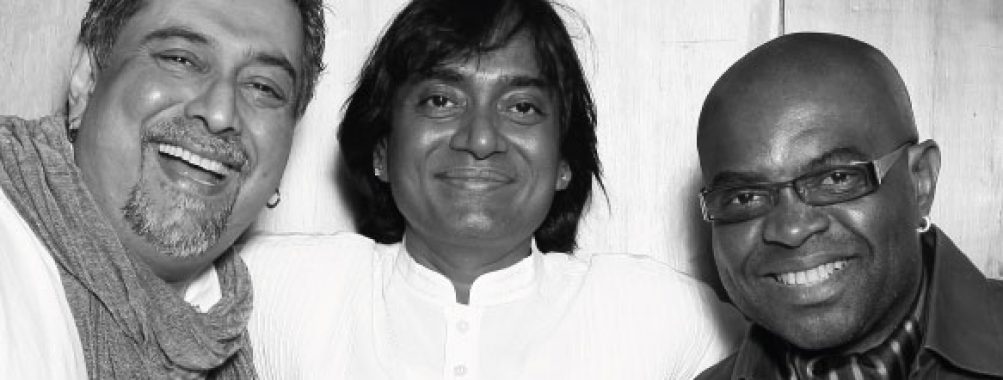
RANJIT BAROT – ETIENNE MBAPPE – U. SHRINIVAS
BOMBAY MAKOSSA
By Rod Sibley

The old saying goes, “Where there’s smoke, there’s fire”. But you can’t have a fire without a spark. In Hindi, the word for “spark” is “chingari”. Chingari is also the name of the new group comprised of drummer / composer Ranjit Barot; bassist / vocalist Etienne MBappe; and mandolin virtuoso Uppalapu Shrinivas.

Their debut recording, “Bombay Makossa” on Abstract Logix Records, is a unique mix of Indian and African rhythms, Duala and konnokol vocals, underpinned with serious funk and fusion played with monster chops.

Barot and MBappe are no strangers to intricate compositions and complex time signatures as the rhythm section of John McLaughlin’s 4th Dimension. They ground the music with body shaking grooves and soulful vocals sung in Cameroonian MBappe’s native language of Duala. The addition of Shrinivas gives Chingari a Carnatic voice that expands and refines the power trio format with his raaga styled improvisations.

Although a trio, Chingari makes a loud noise. The production on “Bombay Makossa” allows the arrangements to have the sonorous sound of a larger group without sacrificing the clarity and openness of a smaller one. The material allows the trio to stretch not only their musicianship, but music genres. Fusion-style instrumental breaks are interwoven with pop-style melodic vocal harmonies; all smothered in infectious R&B and funk.

I spoke to Ranjit Barot – who also produced “Bombay Makossa” – shortly before he and Etienne were to join John McLaughlin and drummer / keyboard player Gary Husband for a 4th Dimension tour of Europe. The familiarity of two previous interviews and the pleasure of having met him in person removes any stiff formality; and allows a loose conversation. My goal is to not only capture his words, but convey his humor and depth of thought through them.

Tragically, Mandolin Shrinivas (“Shrinivasji”) passed away shortly after the release of “Bombay Makossa” due to liver failure. Not only a supreme musician, he was a supreme human being whose loss is deeply felt among those he touched. But the music is not filled with the doubt of what could have been. It is filled with the joy and spirit that was within Shrinivasji, and is a lasting testament to his greatness and musical legacy.

Let’s hope that Ranjit and Etienne continue Chingari in some form, and kindle the musical spark ignited on “Bombay Makossa”.

Rod Sibley: First of all, congratulations on “Bombay Makossa”. I really love it and it’s definitely another winner for you. Johnji should be pissed at you guys for holding back on him in the 4th Dimension [chuckles]. Because you and Etienne are really knocking this one out, man!

Ranjit Barot: Well, Johnji has the blame for that. Because really, after playing with him which guitar player are you gonna play with? Who you gonna ask, man? Where do you go? I’ve always been excited about the guitar power trio format – guitar-bass-drums – like Jimi Hendrix had. And Eric Clapton with Cream.

And I thought to myself, well I’d like to have John McLaughlin on guitar – that’s not gonna happen [chuckles]. You’re spoiled for guitar players when you play with Johnji. When I say that it’s more from a perspective of not just the way Johnji plays, but as he very rightly puts it, I need a guitar player that’s gonna kick my ass. You need that all the time.

Western improvisational music is still at a very nascent stage in India. There are some fine young players. And I think they would morph into some very, very fine players if they got the opportunity to play with good people from the west; like I got the opportunity. But unfortunately, there are not many venues to play.

So in-between tours with 4th Dimension, as a drummer / composer in India it becomes quite challenging for me to keep myself occupied on the drum set; for me to stay in shape. The only way I can do that is by playing with Indian classical musicians who are very, very highly trained, skillful, imaginative, and at the top of their game. Because they have the discipline, the attitude, and the mental make-up that they get onstage, and everyone kicks each other’s ass. Everyone is trying to elevate the music to a very high level. They challenge you; push you to the place where you do actually start performing. Because it’s only when we’re pushed that we get to be who we really are. You understand? Those are the situations you want to find yourself in.

My playing with Johnji has been a perfect training ground for me to explore those dynamics of what it takes to play properly on stage.

RS: So how did the project take shape?

RB: I’m fascinated by a lot of things that are similar to Africa and India. I know there’s a tribe that sings the 12-bar blues in Africa. And there’s a tribe in India that sings the blues. I mean, really a tribe; they’re like village people. I think the whole rhythmic aspect of Africa – the swing married with the Indian Carnatic – I really wanted to explore. I wanted to see what it would sound like. Really, it was just curiosity.

Spending time with Etienne on the road, seeing Etienne with his band Su La Také; he has such an incredible voice. And then I started hearing all these melodies and I thought it would be great if Etienne would sing it. He’s an incredible musician. He’s so intuitive. And he grooves like such a bad ass. But he’s rhythmically and melodically so sound. For me, he’s probably my favorite bass player. I was blown away when me and Etienne started playing and we started recording.

Me and Shrinivasji have done quite a few concerts together, and we were always talking about doing something. So I threw Shrinivasji into the mix. I knew that there would be a great vibe between this Africa and India connection with a western harmonic approach, and improvisational aspects of jazz and jazz-rock. And it really turned out far greater than I imagined.

It wasn’t that I was totally convinced of the marriage of cultures. But I knew when you have consummate musicians like these two, that something like this is possible. ’Cuz they will bring some unique sensibilities into the music. I know both of them. I know their awareness and capabilities; how they approach music. And more importantly, I know them as human beings.

Even with “Bada Boom” I said I like to go where all cultures meet – where music meets. And I think there’s a place where it doesn’t matter who you are or what culture you represent. But when you have that spirit to search and find the unknown, we all become the same thing. We all are looking for the same thing. When you meet the right people, they not only chase it down, they elevate the music. You know then that there’s some real chemistry going on and there was some magic to the thought process.

And eventually, what are we doing? It’s a meeting of the minds. It’s us having a conversation. All three of us are fond of each other and want to have a dialogue. So it’s gonna be some good shit that comes out that. It has to be.

RS: Most of “Bada Boom” was produced by you crafting sound files sent to you by musicians from various countries of the world. Were the three of you able to play together in the studio for “Bombay Makossa”?

RB: Etienne was visiting Bombay with his band, so I got him to stay on for a couple of days so I could track with him. And I flew to Chennai and tracked with Shrinivasji. I had to do Shrinivasji separately because he was on tour with Remember Shakti. It was hard to get everyone in the same room, at the same time. I’ve sort of developed my production skills to a point where really it sounds we’re all together playing at the same time.

RS: Shrinivasji overdubbed his parts later? That’s incredible!

RB: What Shrinivasji recorded, I put drums off. It was nice to have a blank canvas from him, and let him dictate the dynamics. After recording him, I went back and did some drum tracks. It kind of made sense for me to interpret what everyone was doing so that it sounded more organic; sounded more like what you’re listening to now.

RB: And Shrinivasji finished all seven songs in one day!

RS: Whaaat!?

RB: I booked the studio for two days. And it’s not even like we started in the morning. It was just after lunch, like two o’clock or something. He had never heard the songs – I never mailed him anything – and he just burned through the whole session. Like nine o’clock at night. Like an hour a song, he just went straight through. And I said, “Shrinivasji, we’ve got the studio tomorrow. Why don’t we go grab a bite?” And he was like, “No, no. I’m really in the zone. I’m enjoying this. Let’s just do it. I don’t wanna stop now.”

So one afternoon to late evening, he finished everything. And that gave me a couple of options on solos. I did a little editing. I did my drum tracks. And that was the album basically.

RS: Wooow!

RB: It was insane. His level of focus was really insane. But this is again a testament to his genius. He wasn’t just coming in as “the mandolin player”. I think he had more sense of what I was imagining, or what my intent was, than even I did. Because being a trio – you see when he starts his solos – he leaves so much space. He takes so much time for the idea to develop. I mean, that’s a very, very deep understanding of music and compositional structure; and how to build a conversation. I learned a lot just listening to him play on this record.

RS: When did you write the songs? Were any of these pieces gonna be used for the follow-up to “Bada Boom”, or were they specifically for this project?

RB: I started writing all of this after “Bada Boom”. They were melodies, little riffs I had. Melodic vocal lines. I kept putting it down; and I would play it. I remember Johnji saying in an interview once – much like him, I have to wait for melodies to come into my head. I don’t write at the keyboard. I like for it to come from somewhere. I don’t know, it sort of parks itself in my head, and then that seed then allows me to imagine what else could go around with it.

RS: My research tells me that “makossa” is a Cameroonian music style?

RB: I got a lot of information from Etienne. While he was writing lyrics in Duala, his native language, I would ask him things. I would say, “This section here, what do you want to do? Is there some intrinsic groove from where you come from that I could…?” He says, “Yeah. We should do the makossa, man.” And he sang it out for me. You know the snare drum rhythm [sings a pattern]. And I said, “Okay. That’s what we’re gonna lay down.” All his other parts, I just let him loose on the mic. I said, “These are the melodies.” But beyond that; I mean, he brought so much to the table, man.

RS: Did you have any lyric sketches for him to translate into Duala? Or did he just write lyrics of his own?

RB: I had the idea of what I thought the song would be like. Like “Sona Inon”. I had called the song “Song Bird”. And he related to it instantly. He said, “Yeah, yeah. I know what you mean. This wonderful bird that travels through the jungle carrying a song on its lips.” And he wrote something in Duala. He just sat – ten, fifteen minutes. He’s very, very intuitive.

Etienne hadn’t really heard much of the tunes before he came to the studio. And he just nailed it. Like one and a half, two days. He nailed everything [chuckles]. I said, “Etienne. That’s far out, man.” He said, “Yeah man, brother. [sniffing] I just smelt where it’s happening [sniffing], and I just played.” [laughs]

RS: [laughing] Playing together in 4th Dimension, you already have some sort of telepathy and intuition going on with each other.

RB: When you listen to the album, there’s such great connectivity between me and Etienne. But it’s very different from what we do with Johnji. That’s apparent. Straight up. I think the album plays to each one of our strengths; but really to Etienne’s strengths. It really does. I mean, this is his turf, man. He’s really, really killing it on this record.

RS: Where his parts written out, or did he make up his bass lines?

RB: Just the melody and the arrangements were written. But everything in-between was his.

RS: Before you mentioned that they recorded separately, I imagined you giving Etienne charts since he reads, and doing konnokol vocals for Shrinivasji for the sessions. I was trying to figure out where the meeting point to get everyone on the same page was?

RB: You know, I went through great pains to write everything out for Etienne, and he didn’t even look at it [chuckles]. Man, I was like [shakes head]. He said, “No, no. I can’t read it. It’d be really faster if you just play it.” And really, that’s true for me, as well. When Johnji sends me stuff, it would take me forever to read that shit, man. I would just listen to it four or five times, and let it become part of your thinking and absorb it into your body. Then I think you get to play it with a lot more conviction than if you’re reading off paper.

RS: With the mandolin not being a chord playing instrument, the arrangements are wide open for the bass and drums. And you guys really take advantage of the space. You and Etienne could have just made this a duet record. Was that an intended goal, or was it something that happened and you just went with it?

RB: I had no idea, really, how it would pan out. I suppose I wanted to go so differently from “Bada Boom”, which was so expansive in nature – which was such a big soundscape. When you listen, Etienne is also the chordal element. And I wanted that very much. I knew the trio format itself lends itself to a lot of space and for a lot of room to improvise; and really share the intimacy. The dialogue is immediate. And it’s relying mostly on the synergy between the three of us.

I wasted some time trying to tinker with it and impose some other silly elements which I thought would enhance the thing; but which really was only spoiling things. Like, “Okay there’s three of us, and then I’m gonna trigger a laptop or something to bring some other harmonic textures in.” I wasted three or four months with that bullshit.

RS: I don’t think the production is overdone.

RB: There was this thing of “How much I can push it?” And then I just backed off. I knew that there was no question of crowding anything with anything else. I said, “I’m just gonna let it be.” It eventually turned out just how I wanted it to, yeah. But it took a long time for the album to come out. By that time, Souvik had a couple of other releases. You know how it is. It’s a tough time for the record industry. And I really have to thank Souvik for even wanting to put it out. Because it’s so hard today to put anything out. He’s a real brother in that sense of the word. He’s truly committed and he shared the vision; and I’m very thankful to him.

RS: Let’s talk a little bit about the songs. The first track “Pack Up Your Bags” starts off with a bass and konnokol vocals pattern which turns into the main theme of the song. But it sounds like Etienne re-harmonized it again and plays it as a separate theme with Shrinivasji.

RB: Yes. I sat with a young keyboard player friend of mine in the studio and I said, “Hey man. Instead of him just playing unison, why doesn’t he play a harmony with Shrinivasji?” And we sketched something, and it sounded great as a harmony to the main melody line. And it ends on two chords that he plays.

It’s coming from “How do we explore the full potential of the trio?” What is it that we can all do together that adds some value to the trio format; as opposed to just the three of us jamming and playing together? Yeah, it would sound fine. But start paying attention to little things in detail that give the trio some more value; some more focus and direction. Bring in certain arrangements and orchestration that pushes all of us to be cohesive as a single unit. And when you look at each person independently there’s all this stuff going on.

So yeah, that’s a harmony line there. Yeah.

RS: You mentioned that the next track “Sona Inon” means “song bird”. Etienne’s vocals in Duala are very soulful and expressive. Even though you both sing in 4th Dimension, I’ve never heard you guys sing like you do on this record.

RB: Well you know, Johnji wants to add more vocals in the band. I think he’s planning things that we don’t know about yet? I don’t know. Etienne I’ve seen with his own band, and I wrote these melodies for him. I wrote them in a key which would show off the full timbre of his voice. He’s got such an incredible voice that I really, really wanted to explore that.

Bobby McFerrin has been a big influence in my life compositionally and vocally. I’m a big fan of his work. So I wrote some things. And when Etienne sang, it just transformed into this wonderful, wonderful sound. His voice is such a wonderful instrument, man. Sounds killer.

RS: You added effects to Shrinivasji’s mandolin, just like his brother U. Rajesh on “Bada Boom”. Did you tell him you were going to do it, or did you surprise him?

RB: I love him and respect him so much that I said, “I gonna mess with the sound later. I really want to make you sound like a rock instrument.” He said, “Yeah, yeah. Please, Sir. Do whatever you feel like. No problem.” And I sent it to him the files once I processed his mandolin, and he loved it.

I think all of the participants were very, very happily surprised on hearing the final product.

RS: It seems like Shrinivasji took on the role of a guitar player in a trio on this recording, as opposed to being a soloist in a Carnatic context. Did he do that consciously?

RB: I think so. I think he kind of connected with what I was trying to go for. He brought such a sensibility to the record that far exceeded anything I’d imagine. We all know he was wise, way beyond his years. So I think he had assimilated every kind of music there is. And playing with Johnji in Remember Shakti. You have to also remember that when you’re playing with Johnji on stage – playing with one of the greatest guitar players ever – a lot of that must have rubbed off on Shrinivasji as well.

RS: The ending of that song is sweeeet. It could have been a separate song on its own.

RB: Yeah. When he goes into that double-time thing at the end.

RS: Did he play that part, or did you create a loop and pitch shift it?

RB: No, no.

RS: He played both parts?!

RB: And that was his idea.

RS: That’s some wicked shit!

RB: It’s killing, man. And it’s all one take. Just sick.

RS: Just amazing, man.

RS: The third piece, “Fireflight”, is one of my favorite tracks.

RB: “Fireflight” is a traditional piece that Carnatic musicians play. And I really like the melody. A friend of mine, Palakkad Sreeram from Chennai, he helped me a lot. He’s there on “Bada Boom” as well. He’s my “Go To Guy” for Carnatic information and finding those rare melodies that you don’t get to hear so much.

RS: I think there is a song on a record Shrinivasji did called “Flight Of The Fire Bird”. Is there any connection?

RB: No, no. I would just listen to the song and it would prompt a title in my mind.

RS: This one took me out because of the funk break that Etienne and Shrinivasji riff over. With the different melodies and the merging vocals-mandolin-bass parts, you wouldn’t think it could come together. But it’s all so seamless.

RB: Yeah, yeah.

RS: Is that distorted bass, synth, or both in the middle section?

RB: Both. It’s a synth underneath Etienne’s distortion bass – for me to blow over a little bit.

RS: There’s another wicked riff going back to the funk break after the vocal section. I know that it’s Johnji’s gig, but I would love to hear 4th Dimension do this song “live”.

RS: On the fourth track “Longue Lami”, the intro sounds like a short alap section for Shrinivasji. Is that you playing keyboards?

RB: Yes.

RS: And Etienne’s vocals have reverse echo on them?

RB: Yes.

RS: It has a slow march feel before it goes into the break with a count of 2-3-3-3 with 4-5 at the end. But the main thing that surprised me was the tabla sound. Was that you playing tabla, or was that the Wavedrum?

RB: That’s Wavedrum.

RS: ’Cuz I’m like, “Ranjit never told me he played tabla!”

RB: It’s a Wavedrum. I’ve had it for a while and I use it sparingly. But I like to use it in this context and take it on tour with me.

RS: The next one, “Tempest”, is my other favorite track. In my review for “Bombay Makossa”, I wrote that this tune was “a straight-up bitch”. It starts with various counts of 15, and then you guys double it to 30!

RB: Yeah [chuckles].

RS: How did you come up with that one? It’s insane!

RB: Actually, it’s a Carnatic rhythm concept that even Remember Shakti has used. I think when you grow up with South Indian music, especially the rhythmic structure, you get very familiar with numbers and how to use them in a musical context. I’ve always liked that 5 can become 6, played five times. And 15 and 30, and 2-1/2…

RS: You do something like that on the next track, “Third World”; throwing in an even count at the end of an odd one.

RB: Yeah, yeah. So it’s 13 and then you got a little bit in 6 in the middle. It’s just part of Carnatic rhythmic culture.

RS: The part that’s killer to me is when you guys hit it and go to 30, the “one” seems to disappear. It sounds like there’s nothing to ground you. I had to count it by dividing Etienne’s phrasing; something ridiculous like 5-7-3-7-8.

RB: He’s holding it down. Actually, what’s the guideline is the chordal element; the harmonic structure.

RS: Really?! I kept trying to feel for the pulse when I listened to it, and I kept getting lost.

RB: [sings the chord progression] So the way the chords are moving, those are the anchors that let us know where we are at the improvisational thing. So then me and Shrinivasji take off on that little flight where we’re really going neck-to-neck. But it’s Etienne’s chordal structure, and the set of changes that I gave him, that is the anchor.

RB: And the interesting thing about this song is when I first joined 4th Dimension – that’s 2011, my first tour – we were in Cordoba in the south of Spain. I remember we had a couple of days extra because we were supposed to go from there to Morocco to play; and that got cancelled. And Johnji had a guitar workshop. That’s all flamenco country, the south of Spain. Johnji’s very big in that part of the world, even in the flamenco circuit, because of his own contribution to flamenco music.

So we were at breakfast and Johnji says, “I’m gonna do this guitar workshop.” I said, “Listen, I’ll come along.” And basically he spoke about life and being a human being; and what it takes play the music that we play.

But he also mentioned an interesting thing about how a lot of the chords he writes, the melodic changes, comes from combinations of notes in the scale. Okay? So that scale in “Tempest” is a C-diminished scale. And every chord change you hear in that – all the notes in the chords – are from notes in that scale. I didn’t take one note outside of the scale. I kinda learned that from that workshop going with Johnji.

And you see that the first part of that section, the changes underneath Shrinivasji are quite angular. They’re dark and they’re a little hazy. It’s the same scale for which the chords come later for Etienne’s bass solo; which is so beautiful and sweet, and soulful. But it’s still chord tones from the same scale.

RS: Another highlight is Shrinivasji’s solo on this track. It’s bad ass enough when you guys take off as a trio. But he just ripped it!

RB: Yeah, yeah. He’s flying in that one, man.

RS: The fifth track “Third World” is in 13. It’s a very light pop tune, and quite a change following “Tempest”. I was surprised to hear your drums with a “gated drums” effect. RB: Yeah. I don’t know. I was just hearing this weird kind of throwback to the ’80s kinda thing. And that bass line is the first thing that came into my mind.

RS: Did you find yourself thinking more like a bass player for this project?

RB: Yeah, yeah. It was like, “What would the Brothers Johnson do in 13?” [sings the bass line] Like a funky kind of thing. You can get down on that. You put a horn section and a guitar player there – that will kill, man. That’s like a funky tune.

RS: The whole CD is funky! I say in my review that you and Etienne are laying down some “phat grooves”.

RB: I wanted one kind of funk thing on the record, so that was it.

RS: You also wrote the lyrics and sing lead on “Third World”.

RB: Yeah. I enjoy singing. In a playing context, I haven’t had much opportunity. Now with Johnji, I do a couple of songs: “Abbaji” and “The Creator Has A Master Plan” by Pharoah Sanders. And I’m singing harmony with Etienne in “Sona Inon” and in “Fireflight”.

Vocals are an important part of this band. I think people love to hear singing. They like to hear songs. And I try to dig deeper into a playing context intelligently. It’s not really pop – it could be – but it’s not. And there’s a lot of intense playing to support the other stuff.

RS: The title track “Bombay Makossa” is a reworking of “Origin” from “Bada Boom”. Shrinivasji is playing what was a synth part as the melody.

RB: Yes.

RS: And Etienne is singing your original vocal part from “Origin” in Duala.

RB: Yes. Yeah. I wanted that.

RS: You can dance to this sing. I also wrote in my review that “Bombay Makossa” is “not just for Fusionheads.”

RB: It’s very accessible. It’s very accessible on a lot of levels. I really think if we just try and have fun – everything doesn’t have to be so serious. We’re happy…not preachy – or anything. Just having fun. We’re like little kids; unbiased and really enjoying ourselves. See, it’s good to be child-like, not childish. There’s a difference between the two. When you’re child-like, it’s an innocent state-of-mind. But being childish is like being a little petulant and a little self-absorbed. Child-like is a wonderful state-of-mind.

I just wanted to make a record that was fun for me to make, represented our strengths, and share it with people. Its got all our DNA’s there. It’s got all our identity and our ability to blow and stretch; that’s evident in quite a few of the songs. And then it has all this groove and vocals which give it a very, very accessible kind of vibe.

Even Shrinivasji was very vocal about that. He said, “This is one album I’ve done with somebody that I think a wide range of people are going to appreciate. Because I think it’s gonna translate through a lot of genres.”

RS: Did you have any goals for Chingari as a group? I mean, did you want it to do something?

RB: Well, I’ll be honest with you. I wanted to develop properties that I could tour and travel with. Because the reality is I don’t know how long… What will I do outside of the 4th Dimension? It’s a band, led by a gentleman that has affected all our lives. I owe Johnji such a debt of gratitude that I think it will be many lifetimes before I can ever, ever thank him properly. He changed my life. I mean, he changed it with his music way before I met him. And then by including me as part of his musical vision, he’s given me the biggest gift that I could expect from this life. Outside of my immediate family and my daughter, seeing those wonderful things in my life, I think this is the biggest, biggest gift I’ve got.

But all things must pass. All things come to an end. What would I do without the 4th Dimension? What would I do if I was not playing with Johnji? So really the biggest motivating part was I gotta make some music. I have to take the blessings that Johnji has given me, and all this validation that he has given me as a musician, as a composer, as a human being; I have to do something with those blessings. ’Cuz part of Johnji is in this music, too. He’s shown me the way – The Path. He’s made things very clear for me.

So really it was that. I must create something. I don’t think I’m a gun for hire. And I also know that any band has to have love. I need to play with people I love and respect. Etienne is my brother from another life, for sure. And what we share with the 4th Dimension is something I am carrying into Chingari.

It’s not even a conscious thing. I’m just being true to my nature. Music comes in my head and I want to do it. I’m already planning a big band project. I want to do some songs from “Bada Boom”. I would like a 20-30 piece orchestra: strings, choir, horns, keyboards. I’ve already written the music. What else are we going to do? We’re gonna write music and find ways to play it, [and] find collaborators to play it with. That’s all we can do.

RS: Was there anything that you wanted to do, but weren’t able to do on this project?

RB: No, no. It was logistically very simple; just the three of us. It was just a matter of getting the right dates. Had it not been for Shrinivasji – his involvement in it – and Souvik’s desire to do something, it would have been very hard to put this project out. You know how it is, Rod. It’s becoming almost impossible to put good music out. Because it’s the nature of the business, now. Of course we can do it digitally, and upload it, and iTunes, and blah-blah-blah. But to actually get a record label behind it…just to get the machinery working to try and reach people about the product; I mean that just doesn’t happen anymore.

So I’m very lucky that Abstract Logix and Souvik are still fighting the good fight. Allowing us to make this music and reach out to people with it. Once I wrote the music I spoke to Souvik about it. And he was instantly on board. And that gave me great strength to pursue it wholeheartedly; and not vacillate and think, “Wow. What’s gonna happen?” Souvik’s been incredible like that. Like “Bada Boom”, I just played him the drum track for “T=0”. I just played him the head of the drum track and he said, “You’re on.”

So I would imagine that would be the biggest hurdle for any musician: how to get it out and reach people. More and more you’re forced to work – nothing wrong with working with big names and people. But there are so many talented, killing, young composers and soloists that are dying to be heard. And unless they collaborate with some big artist or a big name; they’re not even gonna get looked at.

So once Souvik agreed, there was no real challenge because I knew that the musicians would all be more than happy to do it.

RS: I asked you this during our last interview, so I’ll ask you again. What did you learn about yourself from this project? What did you come away with?

RB: I feel more confident about my – not compositional abilities – but more confident about my communicative abilities. You know we have to kill this big giant that lives inside us: it’s our ego. That’s the big monster – which is necessary also – but it’s a two-edged sword. You can enter a very self-gratifying process when you start to write. The mind is this incredible playground where anything is possible. And more and more it forces you into a world where you want to share everything you’ve learned. And what we have to understand is that in wanting to communicate with people, we have to take into account that everyone is at different points in their spiritual journey.

The first responsibility that comes with knowledge and wisdom is that you must share it. And for us to share this magic we have in our minds, we have to create things that audiences can [take] – sugar-coated pills. We gotta share this wisdom, and this wonderful gift we have, in a form which they like. And we can elevate their consciousness with it.

That’s what the old books and great works of literature were enlightening people about: deep truths through very simple parables and very simple tales in which were hidden very deep messages. I think some songwriting is like that. And I feel with Chingari I achieved some degree of giving some very very deep and meaningful music, but through a very accessible structure. Does that make sense?

RS: Oh, yeah. Yeah.

RB: People love Stevie Wonder; and there’s a reason. Because Stevie is a consummate genius. He can write songs that you could play for a maestro connoisseur of music; and a young couple in the third row both will be equally smitten by something. Because Stevie has the gift. All the doors are open for Stevie. Stevie can see everything clearly.

That’s conquering the ego and it’s being able to communicate in the truest sense of the word. So if anything, that’s what I learned from this project. And having said that, I wouldn’t have walked away with this sense of achievement had it not been for Etienne and Shrinivasji. Because without them, there is no concept.

RS: How about your drumming? Are you in a comfortable place with your drumming?

RB: Yes and no. I just want to get better and better at what I do.

RS: I think you’re playing some monster shit on this recording.

RB: I think what I really like about my playing on this record is…like take songs like “Longue Lami”. That’s like one of my favorite tracks of drumming; and I’m not doing anything on it. And I really like that. I really like that I was able to serve the song succinctly; and yet love to listen to what I did.

Normally, we have to do one song like “Tempest” where we breakout. I have to do it because I love doing that with Johnji. And I’m always chasing that feeling. I like serving the music and just supporting what incredible stuff is going on with the rest of the guys.

So I’m in a happy place with my playing. But having said that, it’s a process. We’re continuously growing – as with any musician that has dedicated their lives to music. You are always a student. And we will always stay students. Learn from each other. Keep growing. And that’s it. Like I said before, I’m just trying to be a little child in my sandbox. Have fun, that’s all. That’s all.

RS: You’ll be on tour with Johnji and the 4th Dimension in Europe in early November 2014?

RB: Yes! I spoke to Gary last night. And I think as much as we miss the music and the playing, we miss each other a lot. We’re all very deeply connected spiritually and musically. So I’m really looking forward to seeing Johnji and being on the road with the boys again.

RS: Was there anything personal you’d like to say about Shrinivasji?

RB: Shrinivasji has always been a mentor for me. He was a consummate musician when he was 8-years-old. So it’s a really big honor and blessing that he actually wanted to be part of the project and blessed it.

He’s not with us anymore. Of course, the human being in us misses him. And I think it’s such a shame that he went with an illness that could have been treated had it been caught in time. Jaundice and liver failure are not things that we cannot handle. It was just something that was…I don’t know how it came to be…and it was so sudden. I think that’s what freaked everyone out. Within a month it was already terminal.

But he’s in our hearts forever. He’s in this music. And I will always carry his vibe inside me. He was an angel. I don’t think he was a regular human being. I think he was already a big messenger. And he’s gone home now. What are you gonna do, man? He’s sitting in some beautiful light-filled place, sending his love and blessings to us. We have to celebrate his life and carry on.

I don’t think there’s enough that can be said about Shrinivasji. I’ve never, never met anybody with such keen insight into what is possible in an ensemble. It’s a level of musician and humanity that really is unparalleled. Shrinivasji, Johnji, Zakir bhai: these are people that stand out. Their insight into music and how to get the best out of other people around them is incredible.

But for Shrinivasji to have all that ability at such an early part of his life. We carry gifts from one lifetime into the next. I mean, he was playing classical concerts when he was 6 and 8. How much practice are you – even if you start in your Mother’s stomach, 6 years is not enough, man? [chuckles] And he was playing at a very, very high Carnatic concert level. Where he was sharing the stage with U. Sivaramanji and A. K. Palanivelji – drummers who are like 3-4 times his age.

There was a very popular incident at a concert that I saw here, where at the end of the gig Sivaramanji touched Shrinivasji’s feet! [a sign of reverence and respect, as it is the elder’s feet that are always touched – RS] And Shrinivasji was 10! Sivaramanji at that time would have 40. And he touched Shrinivasji’s feet! So what are you going to say about somebody like that? This is the thing: we get touched by such great people. We have no excuse to sit around lamenting more than is necessary. Because when they touch you, you are given a responsibility to do something with that blessing. And share that music; and that spirit of humanity with people. And that’s what I want to do. I’ve been touched by Johnji, by Ustad Zakir Hussain, by Shrinivasji; and so many other great musicians. I just feel that…okay, there must be something in me that they saw. And I must do something with this music.

RS: It’s open mic time, where I turn it over to you. Is there anything you want to talk about?

RB: I’m very lucky to do this music in Chingari. And sharing space with the greatest musicians alive today. Etienne is, for me, one of the greats today. Electric bass playing, musician, his sense of time and harmony. Everyone knows him, and everyone thinks that he’s great, blah-blah-blah; all that. But I think he’s still under-rated.

RS: Well, you can really hear what he’s doing on “Bombay Makossa”. That’s one of the great things about the production on this recording.

RB: That’s another reason I wanted the trio. Because I know when you hear him – his intonation; and his instrument is such an incredible instrument. But the way he plays, it fills the whole spectrum; the whole record.

Johnji sent me an email the other day saying, “I really love it, Ranjit. But is it just me, or could the drums be louder?” [chuckles] You listen to “The Boston Record”, and I’m the loudest thing on the record; as loud as his guitar, if not more. So he’s very supportive of the drummer in the band [laughs].

RS: [laughing] That’s for sure.

RB: I wanted the bass to fill the record, you know. And it does. The way Etienne makes use of that space – see that’s the thing. Somebody can give you room to roam around. But what are you gonna do with all that space? And Etienne knows what to do with that space. There are great bass players out there, don’t get me wrong. But I don’t think they have what Etienne has. It’s groovy, it’s melodic, it’s funky, it’s big; it’s beautiful, bold. I like it, I love it. That’s the kind of music I want to hear.

RS: Anything else you’d like to add?

RB: Just I thank the people that played on the record with me. And Souvik for having faith. And as always, Johnji and Zakir bhai for their guidance. Really, that’s it.

RB: Oh! When Shrinivasji woke up in the hospital, before he went into the downward spiral, he asked for Chingari to be played in the room. He loved the project, man.

RS: That’s very touching.

RB: Very touching. He wanted to listen to it. And he looked at his brother [U. Rajesh], and he told his brother, “See. I told you. Ranjitji writes some very tricky shit, man.” [chuckles] And he looked at his brother – his brother was standing – he looked at him and said, “Do you like it? How am I playing? What do you think about my playing?”

RS: [quiet pause] Nothing I can say after that, man.

RS: Well, I think we got it covered, Ranjit. Thank you very much, man. As always I had a great time talking with you. I really hope “Bombay Makossa”gets the exposure it deserves.

Latest album

Latest NEWS

SUBSCRIBE

Please Subscribe your mail to get notification from AbstractLogix.


Facebook-f


Twitter


Instagram


Youtube

Copyright © 2021 ABSTRACT LOGIX

Facebook-f


Twitter


Instagram


Youtube

Copyright © 2021 ABSTRACT LOGIX

Drummer Ranjit Barot Interview

April 26, 2008
News, Ranjit Barot
Ranjit Barot

Buy

Itunes-note


Amazon


Bandcamp

DUALITY ON THE DRUMS
THE FUTURE OF MUSIC DEPENDS ON ALL OUR CULTURES INTEGRATING.

Ranjit Barot is India’s premiere drummer on the drum kit…and if you live outside of India chances are you probably wouldn’t know that. But with the release of “Floating Point” , John McLaughlin’s studio CD on Abstract Logix, that is about to change.

Recorded in Chennai, India, “Floating Point” features what McLaughlin calls some of the “young lions” of India’s music scene. A wonderful amalgam of “raga meets fusion,” “Floating Point” will undoubtedly expose these amazing Indian musicians to a wider western audience. And while there are many musical highlights on the CD, it is the drumming of Ranjit Barot that is truly the standout performance.

Ranjit infuses his western influenced chops with his Indian soul. He creates rhythms that are intricate and unpredictable; yet they groove ferociously and swing effortlessly. He makes odd-time signatures seem as natural as breathing. Ranjit plays with limitless energy, endless imagination, and total abandon. McLaughlin calls him “One of the leading edges of drumming.”

Ranjit Barot is also one of India’s top music producers, and an accomplished composer and arranger. He has written numerous films scores and performed with some of India’s best musicians. Information on Ranjit’s early career and his film work are at www.ranjitbarot.com and www.heritagejazz.com/ranjitbarot.html.

In addition to music and drumming, Ranjit is very passionate about life and his family. That passion was very evident during our phone conversation from his home in Bombay, India. Throw in a sense of humor, and Ranjit is engaging, insightful, and a sheer delight to talk to.

During the “Floating Point” sessions, McLaughlin would jokingly say “You got it, or you don’t got it!” to the musicians after working with them on song arrangements .

Ranjit Barot – you got it!

Rod: Did you play any instruments before the drums?

Ranjit: Well, I come from a classical family in as much that my mother is a classical dancer. She’s the exponent of a form of Indian classical dance called Kathak, which is North Indian in its origin. I grew up with that. It’s funny, I really didn’t think I’d play music until I was like maybe 14 or 15. Somebody in school said, “Hey, we need a drummer.” I said, “Alright, I’ll give it a shot.” And I played. And I played how I thought you should play. But, my life changed; my life changed after that for sure.

So I didn’t really play any instruments before that. The drum set was my first sort of initiation as a performing musician. I played in a lot of progressive rock bands, and if the guitar player went out of the room I’d pick it up and I’d start messin’ about. I taught myself how to play a little bit. But my primary instrument was drum set.

Rod: You just had a natural affinity for it?

Ranjit: Yeah, it’s something. I wasn’t really like the quickest learner. I kind of plodded through. I mean, I had good time and I think I had good taste – so I could disguise. Even if played really badly, I kind of made sure nobody else found out [chuckles]. I didn’t really know how all the pieces worked. You have to understand when I was 14 in India, we had no television; there was nothing, man. It was hard to kind of put it together. Most of the guys who played ended up playing in lounges in hotels. So it wasn’t a career option for a lot of kids. I’d have to listen to records and try to put it together to see how the hands and the feet worked. So it came slowly, but eventually it came.
I had this “thing.” I felt this instrument. If I listened to a James Brown record, I could feel that backbeat. I knew the emotions behind that rim shot; it was not alien to me. And I said, “I want to be a drum set player.” I think that’s the beauty about music. Alla Rakhaji had an American student, who is no longer with us, but he played tabla. I mean he played like very few Indians ever played. So I think music belongs to all of us. And it’s possible to feel this culture that’s so far away.
Here’s an interesting thing. I knew very early in my life – I don’t know if it was like a point I had to prove – I knew that the drum set was a “western” instrument, so to speak; that it came from the west. And I wanted to play the drum set. I didn’t want to transpose Indian stuff on it, and I didn’t want to do mouth percussion, and I didn’t want to play tablas so I could dazzle western audiences with something they didn’t know. Unless you are Zakir bhai, then it doesn’t matter where the instrument or the audience is from, it just blows it away. I wanted to play their instrument and be accepted as a drummer; as a drum set player.

Rod: What types of music were you listening to around that time?

Ranjit: When I was growing up in England, The Beatles were getting big. I kind of slowly got into them. All the popular TV stuff – The Monkees, Spiderman, Batman – we’d be exposed to all those themes.
But you know something: I kind of got into the Mahavishnu Orchestra before I got into the pop-rock stuff. It’s like I got into The Beatles later. I wasn’t so interested in the whole pop-rock thing. And when I came to India I started messin’ with music. And the first time somebody played me “Birds Of Fire” and I said, “Forget that other stuff, this is how music should sound! I mean really, I’ve been messing around ’til now. This is IT, man!”

Rod: Did you feel you had to reconcile between the music you were listening to and the music that was part of your classical background?

Ranjit: No, no. The interesting thing about my childhood was that even when I was living in England, vacations would be back in India. I had this really Cockney accent. One minute I’m playing soccer in a park in London, and then I’m in India flying kites and I’m messin’ with the local kids. Winter was really cold, so my mother would like to be here in India. It was this incredible duality. And I seemed to kind of fit in where ever I was. So nothing about any of the cultures actually threw me. It came quite naturally to me.
And then once I started playing music, I think in a subconscious way, I kind of brought everything that I’d been exposed to through my mother. Because of my mother I got to meet all the great guys. Ustad Zakir Hussain’s father Alla Rakha would come to the house. And great sitar players like Vilayat Khan. I got to meet all these guys and get blessed just being in the same room as them.
So it was an incredible childhood for me.

Rod: Did you take lessons from the Indian masters when they visited your home?

Ranjit: It was sort of informal. I was really young man; like 12, 13, 14. Alla Rakhaji would come over and he would get me into a room and he’d say, “Okay, sit down.” My mother used to have a lot of jam sessions at home. Great jams where musicians would come, food would be cooked; they would play, she would dance. It was quite a buzzing scene.
It was great for me, I got all this exposure. Alla Rakhaji would sometimes get bored and he’d say, “Let’s go in the room.” And he’d just start reciting these patterns. I’d just sit there and – I was too young to really deconstruct all of it. But I knew that some shit was going down, man. I knew this was some heavy stuff. I just let it wash over me.

Rod: When I was preparing for this interview, the thing that blew me away was when I read that you’ve never have any formal training on the drum set!

Ranjit: No. I’ve never learned the drum set, or anything else.

Rod: Woooow.

Ranjit: Yeah [chuckles]. Well, having said that, I think we all create our own academy. I think we all create our own training ground. I mean, I copped so much stuff from all the drummers that I listened to. I had to rip them off initially to understand how the drum set worked before I could unlearn it and find my own style. I tried to play like Billy Cobham and I tried to play like – the first time I heard Elvin Jones I was like, “Man, what is THIS?” That was a whole other thing; and so linear and incredible.
And then later on, Jack DeJohnette. All the Weather Report drummers: Alphonse Mouzon – all these great drummers. And I would try and see how – try and rip them up just to understand that this is what your hands and legs can do. And then put it aside ’cuz they’ve already said that. There’s no point in me trying to sound like that.

Rod: You sound like a hard-core fusion fan.

Ranjit: Aww, man, of course! And I’m telling you, I got into all of that stuff before I went back and then revisited everything that was happening in the rock scene in the ’70s. The whole progressive thing just got me going.

Rod: I know what you mean. I was into Hendrix and the rock thing, but when I saw John McLaughlin and the Mahavishnu Orchestra, there was just nothing else after that. It was like some big revelation had hit.

Ranjit: That’s about how it was for me. When I heard Cobham play – and I tell you this in retrospect: I’m a fan of every drummer on this planet. I think there are so many, so many great drummers out there that it’s hard to create a list. But Cobham is a pioneer, for sure. Cobham is the closest I’ve heard a drummer playing with an Indian soul. He had the whole “speech” thing down.

Rod: I read where Billy said his approach in the MO was based on he thought the MO needed a percussionist. So he decided to be the drummer and the percussionist.

Ranjit: The whole tradition of mouth percussion that comes from India hasn’t really yet been mirrored strongly on the western instrument. You hear kids doing beat box, and you hear things like that. And I think in a contemporary vein, yeah, that’s vocal percussion; but not as deep as what Carnatic percussion and North Indian percussion does.
But Cobham, when he played, I could hear him talk. His snare drum, that’s the heart of his language. He really had this speech happening on the kit.
That’s what stopped me in my tracks. Because I’d been listening to tabla players, and I said, “Hold on. This guy, he understands. He understands where this whole thing is coming from.” So he was probably the first big influence. And I just love everything he’s done, man.

Rod: Speaking of languages, when did you learn konnokol?

Ranjit: I toured Europe with kind of a jazz-rock band from here and there were a lot of south Indian percussionists. I started informally learning from them, because I had to play a lot of that stuff on stage. We’d travel by bus through Europe and I’d sit and take lessons from the mridangam player in the band. I have a friend – very, very close brother of mine is a mridangam player, Sridhar Parthasarty – who now I formally learn from.
Within the last 5-10 years was when I started actually going back to my Indian roots rhythmically: finding a meeting point for what I can do on the drum set and phrase and syncopate with some kind of Indian soul; and not take away from the language of the drum set. I take an Indian rhythm and transpose it on the drum set; you understand what I’m saying? But to take a rhythmic pattern and then play it on the drum set [sings] “da-da-da-da” is too literal. I want my playing to be the duality that I am. I am very, very Indian. I dream in English. And that’s who we are. And I want to play like that.

Rod: I think it’s fair to say that you’re a pioneer as well, playing the kit drum in India.

Ranjit: In some way, yeah. When I started playing there were a couple of guys who played really nice and who I’d sneak out to go and listen to gigs. There was not a whole lot happening. There were a bunch of rock bands, but nothing really that heavy. And because I got into Mahavishnu and Return To Forever before I started playing pop-rock, I started gigging.
I dropped out of college, and my mother said, “Listen, if this is what you want to do, fine. But I need to see you making money. I need to see you supporting yourself. Because otherwise, get your ass back in college.”
So I took any gig that came, you know. I was lucky that I was this sort of this new kid in town and guys wanted to play with me. And I got to play with two really good bands. In fact, in one of the bands I played in I replaced Trilok Gurtu; ’cuz Trilok left and I joined the band. It was a progressive rock band, and it was one of the few bands that was really playing in odd-time signatures. We had a song in 10-1/2, and for that time, it was kind of a little whacked-out [chuckles]. You go play a college festival, and the last band has just played a Rolling Stones cover; and we’re on stage playing in 7 and 10-1/2.
But you know, it was an interesting time. Nobody had told people that you can’t groove to a 5. There was no television to tell you that four-on-the-floor is the only way you could have time. So we had kids bopping to anything we played. Even if I played backbeat and I played rock’n’roll, I played it like if Lenny White was to play a backbeat.
So broad is simple. I always told musicians that it’s more of an eastern philosophy. But all of the great – I mean, look at Vinnie Colaiuta, man. What a great drummer. And he can groove…

Rod: Oh yeah, killer.

Ranjit: …and he plays a groove, I mean, that’s a groove . And I think that’s because he has so much in reserve. It’s like being a 10,000 watt amplifier and saying, “Oh well, I’m just going to use 50 watts today.” That 50 watts is so sweet and it’s so clean . So full of conviction. And it’s got so much in reserve, that it’s pure. I think even if you’re a session player, or whatever, I think you should be able to play a lot more in reserve and not maxed out.
So I guess what I’m trying to say is that when people came and heard me playing in tavil bands or heard me playing in a rock’n’roll band they heard a groove. And because I could play a lot more, it kind of swung and sizzled in a way. And it’s great because it made a lot of kids get up and play drums and join bands. I have a bunch of kids who come to the studio; they kind of learn from me, and I’m happy to teach what I know.

Rod: I read where you said that in the ’80s, it was hard to make a living as a drummer.

Ranjit: It was. 1986, I think, is when the electronic revolution hit India; and I got replaced by basically a drum machine. It was heavy, because I was not making any money; and it was kind of scary for a bit. I got a break working in a studio. This piano player, who’s also on “Floating Point” , Louiz Banks – an old friend of mine – he gave me a break in the studio. I wanted to leave. I said, “Well, I’m gonna go to America. At least there are still drummers there.” I didn’t really know whether they needed drummers, I just felt that any place besides Bombay would be okay.
And Louiz said, “No, no, no, no. I can’t have you leaving ’cuz you’re around here and the only drummer really that can play the way we want. Grab your kit, come to the studio, and I’ll get you a gig working on advertising scores and stuff.” So I went. And that’s how I started working in the studio; making a living doing sessions, programming drums, and producing a little bit. Then I kind of branched out on my own, and it sort of progressed from there.

Rod: What eventually happened with the drums?

Ranjit: I wasn’t playing so much drum set for awhile, I was doing all this production stuff. One day Zakir Hussain just threw me in the deep end. He said, “Well, you know there’s a gig here. I‘m playing with L. Shankar; come in and sit in.” I was kind of nervous ’cuz – you know how it is? It’s like Narada Michael Walden. You spend ten years producing Mariah Carey, and your chops are not up. And these cats will eat you up, man. They won’t hesitate letting you know how out of shape you are, you know. And I think that day when I played with Zakir – yeah, I mean, I played okay. But I knew. And I said, “I’m never gonna let this happen again.”

Rod: So you had to do some woodshedding to get your chops back up?

Ranjit: Gotta keep ’shedding, keep ’shedding. And when I got the call to play with John [McLaughlin] it was just like, it was absolutely…he’s my hero, man!

Rod: Do you have a favorite John period?

Ranjit: I think everything – I love everything he’s done. Everything from the Mahavishnu Orchestra; Lifetime with Tony Williams and Larry Young. Then his whole flamenco period. Shakti, of course, because we grew up listening to Zakir bhai. So when Shakti came on the scene, we were blown away, man, you know. And of course, that whole flamenco period with “Belo Horizonte” and those albums. And what he did with Trilok.
John’s a – he’s John McLaughlin, man. Everything he does is steeped in great taste and sensibility. And he understands all these cultures; he’s not messin’ around. He’s played flamenco with respect and humility; and he understood that music.
Same with Indian music. He can take – well his connection with India is so strong that because he’s such a master with all the western harmonic stuff, he’s able to look at Indian music and integrate it with what he knows so seamlessly. But he’s scary with time too, man! He’s like a drummer, really. There’s nothing you can throw at him that he can’t…incredible, man. Incredible. John’s such a visionary. Awww man, he’s a master.

Rod: Had you met John before the “Floating Point” sessions?

Ranjit: Yeah. We met once, really briefly, in Europe with Trilok. Trilok was playing with John and Kai Eckhardt. I was in Holland at the time and I knew they were playing the North Sea Festival. So I met John briefly backstage; it really wasn’t a very long meeting. And then, in Bombay for Zakir bhai’s memorial for his father. The third time I met him, we jammed onstage.
It’s quite an interesting episode. You know Zakir bhai does this 3rd of February memorial to his father. Steve Smith has come; Terry Bozzio has come; Vinnie was supposed to come, but I think his mother was very ill. Ah, every young drummer – oh, Antonio Sanchez was here. And the year I got to jam with John, Eric Harland, the young drummer who Zakir bhai and Charles Lloyd play with was featured.
Zakir bhai features a drummer every year. The first drum set player to be featured at one of the festivals was me; and then subsequently every year he gets someone to play the drum set. The festival starts with sun rise and it finishes like at 10:30, 11:00 at night. And in the evening there’s this sort of jam: all the musicians who participated during the day come onstage and basically jam. So, Eric Harland was there and he did a solo in the day time.
John landed up with the guitar; he had done the morning session. When I knew John was onstage I said, “Wow, man. I get to play with John McLaughlin. This is fun.” John and I started, and I think he heard something in my playing, man. He just turned towards me, and that’s it; the next 10-15 minutes we just connected.
And what happened was, during the jam Zakir bhai – we look at Zakir bhai – conducts the jam. So he told me, “Why don’t you tone down and let John play with Eric?” So I kinda backed out a bit so that Eric could kick in and start trading with John. And as I started kind of winding down, John just shouted – he just looked at me – he says, “You can’t stop now, man! We’re just getting started! You can’t stop now! Forget about the other guys. Keep playing!” So I begged Zakir bhai’s forgiveness and I went for it. ’Cuz John’s my hero, man. I mean to play with him is…
I finished the jam with him, and I remember I was – two days after that I was sitting having my morning chai with my wife Maya and I said, “I played with John. That’s like…I played with John McLaughlin. That is something, man.” And as I sat there – it was really like a movie – my phone rang and it said “John McLaughlin.” We had traded numbers that evening. I said, “Hello.” John just called and he said, “I wanted to tell you how much I loved that night, and I’ve decided that while I’m here I’m going to do an album. And would you play drums?”

Rod: And your reaction was?

Ranjit: “Yes, of course [chuckles].” It was kind of unreal. It was almost surreal, you know. But yeah, I just jumped at it. I said, “Yeah, sure. Count me in.”

Rod: Did you feel any pressure trying to record 8 songs in only 5 days?

Ranjit: Well, I didn’t really think about it too much. I had lived with the songs for a bit. ’Cuz John came to Bombay and gave me a CD which had sketches of the songs; basically the melodies and the heads. John expected you to know the songs, and I did my homework. And if you were there, man, it was quite, quite spontaneous. We just walked in, we set up, we said hello, played for 5 minutes, and we started recording [chuckles].
We’d play it once, and I would kind of understand what John was going for. We really didn’t do more than – I guess the first day, I think was, it took longer for the set-up. But every other day, not more than 2-3 takes of each tune. Different vibe and “Okay that’s the one. Let’s mark that and let’s move on.”
It’s a jazz record. We’re not spending millions of dollars. You’re in a top studio, you want to go in, you want to capture the moment – you want to get things done. It’s not like you’re going to come there and try to go through stuff.
And it’s interesting, the “Floating Point” sessions were essentially John, me, Siva, the Indian soloists; and Louiz was the primary – Louiz was holding down changes and shit. But there were a lot of overdubs happening for the soloists. There was no bass player at the session; Hadrien dubbed later.

Rod: I thought I was up on Indian music, you know. But after hearing Niladri Kumar, Shashank, and Naveen Kumar play on “Floating Point” , I said, “Maaan, where the hell have I been? I gotta check these guys out!”

Ranjit: There are some cats here, man, who are – yeah, there is some shit going down [laughs]. Look at John: just to bring it all together and bring it all out to the west…I mean, what can I say? He’s done it again! That’s what John does, you know. He’s done it again.

Rod: I worked with Souvik on John’s last tour. And just to be around him was just…

Ranjit: Oh, he’s something else, man.

Rod: I can only imagine what it must have felt like to play with him.

Ranjit: Oh! Those five days, man, he had the energy of like an 18-year-old. Just by giving us all this space and love, he got us all fired up! All the music is – let me tell you, man. I’ve always said it: when you play music, play with people who are better than you; always. Always, always, always. You will up your game, and that’s what it’s about.
You play with people who have such standards – it really got crazy for me because after John I had to do this other gig with a bunch of guys and I was like, “What am I doing here? What am I doing here? I mean I sound like shit. What is this music?” [chuckles] It’s hard, when you get exposed to that stuff. It’s hard. So yeah, being around John was…wheew, it was a fantastic experience.
If you spend time with John, you’ll understand that you’re in the presence of a very, very deeply spiritual person. He’s definitely someone to look up to and strive to be like. During the session, John had no shame to come to me after a take, and he’d hold me and he’d say, “You have giant steps on the drum set.”
Now I’m a student, man. I don’t look at myself as any – I’m filled with humility. I’m just somebody enjoying playing this instrument and feel blessed to be in the presence of these people. I almost wept because it was so moving for me to hear my hero tell me – and validate me. More than anything else, everything I believed in, which I can’t – you know, India’s a crazy kind of place, too. There’s still not that many trap set drummers. And it’s hard to connect with shared things with people. It’s not a large drum set community like there is in the States. So when you have somebody like John validate you, it’s a big deal.

Rod: Seeing you and percussionist Anandan Sivamani play on the “Meeting Of The Minds” DVD was amazing. You guys were just killin’ it.

Ranjit: I think I was so “zoned,” man. It is hard when you play with someone you look up to. You don’t want to disappoint them…you know what I’m saying? Because we had never really “played” played together. We just jammed for 15-20 minutes that one evening, and we introduced ourselves. So when I got there, I wanted to make sure that the record sounded good. I wanted to make sure that I gave everything I had. And I wanted to make sure I lived up to whatever expectations John had of me.

Rod: John gave you guys a helluva lot of freedom on this record.

Ranjit: So much, that you can hang yourself with that much rope! And that’s dangerous, that kind of freedom. It is. It’s like, alright, here’s all this space: say something. It’s scary, it’s scary.
That was sort of an indication to me that John really wanted us to feel the moment. And it goes back to all the records that people like Miles and everyone made – that how committed are you? I think that’s all John was looking for, the commitment. Don’t pretend! Don’t play something that you think I would like to hear. Play your heart out! I want you to play, now. I wanna hear what you’re saying.
Yeah, he gave us a lot of room.

Rod: How different would it have been if bassist Hadrien Feraud had played with you at the sessions?

Ranjit: You know it’s funny. I was just talking about it the other day in the studio. I don’t know.
John was going for a really, really spontaneous combustion; that’s the only term I can think of. He wanted something that was very, very rooted in the “now,” and explosive. There was nothing – I mean we played a ballad for his wife – we’re like all over that too, man. We’re not showing “the one,” and John just loved it. Normally I would have kind of laid back. He was like, “No, no, no. I just love what you’re doing.”
So I think maybe, in one way because there was no bass player, I got to interact with John a LOT; like one-on-one. The albums got like a really, really sort of “edgy” quality to it. I mean it’s very, very – you can hear the moment. It’s very transparent. There’s no going back and trying to clean things up. It’s very, very natural.

Rod: So how did you and Sivamani arrange parts and play together without “hanging yourself”?

Ranjit: I’ve known Siva for years. It can get tricky ’cuz Siva plays percussion, but he plays a lot with sticks; it’s not just hand drumming. Siva is also a trap set player: he can play. And I think he understands the spaces and understands what I’m going for. If you listen to the track “Off The One,” you’ll see there are moments when Siva would just stop playing because he knows I’m going for something. And towards the end of “Abbaji,” I kind of stop. We had a blast.
It was very spontaneous. We weren’t trying to find just a language to speak together, we were also giving each other space ’cuz it made sense. He started playing something which made sense at that time compositionally and I didn’t need to be saying anything. I remember this one tune, I think “Raju,” I just stopped for like half a bar ’cuz I was straining to hear what was happening in the cans [chuckles]. But it was cool, it was cool. It kind of made sense musically. And John understands that – I mean, he comes from that school. It didn’t seem odd to him at all. Even Tony Williams would do that; he would just stop playing for a bit.
I think all good musicians – you listen to the song and you let the song play you. I didn’t really do anything. I just let the song play me. And I phrased it the way I understand melody and the way I would like to play a song.
There was no deep sort of intellectualizing anything. I just went with my gut on every tune, and I’d wait for John’s reaction. And in 5 days and 8 songs, all John and me did was enjoy. There was no conflict of direction or approach at all; which is great for me. ’Cuz being the first time playing with such a great musician, I was prepared for him to tell me, “Hey, maybe not like this. Play like this.” But John never, never once ordered us to be anything else but who we were.
Really, I just listened. I let the tunes play me.

Rod: I think of musicians as spiritual people, but some don’t take that approach to their music. Most listeners would say John’s music has a spiritual quality about it. Do you relate to a spiritual aspect of music?

Ranjit: Absolutely, absolutely. I mean, we’re blessed, man, in what we do. We’re very, very, very lucky. And we have to understand that if we play music, whether it’s for a living or not, we’ve been given a gift. And it’s magic; it’s nothing short of magic. To be able to imagine something in your mind and externalize it on an instrument, and bring joy not only to yourself but everyone who hears it – yes, definitely.
I basically surrendered. I’m not looking to be in control of anything – even my instrument. I seriously feel that my instrument plays me. I have to spend enough time with my instrument. The instrument looks at me as a friend. And when you spend enough time with your instrument, it shows you secrets. It shows you hidden things. It’s just like a friend: you don’t spend time, it has nothing to show you. The more time you spend with your instrument, it shows you all of its magic, and hidden things, and small things; and shares secrets with you, and tells you about stuff. That’s my approach.
I have. I have in my life; I’ve surrendered completely, man.

Rod: Kathak dancing is like a devotional in a sense. Did your mother ever talk about feeling a spiritual connection when she danced?

Ranjit: Of course, yeah. Absolutely. Plus, all the compositions that she dances to are basically hymns to the Gods, you know. So it’s all sort of revolving around religion and spirituality, both. I grew up with all that in the house. But I sort of found myself gravitating more and more towards being a Buddhist. A very close friend of mine actually exposed me to some of the beautiful teachings of Buddha.
I don’t belong to any organization, I don’t really believe in – spirituality is like the meeting place for all religions. So I’m not a great over-ritualistic guy. I think good action and good speech, that’s your religion.

Rod: You’ve been playing for awhile, now. What changes have you gone through as a musician?

Ranjit: I went through a couple of phases. For me, making the transition from being predominately a drummer to a producer in the studio – again, there were no guidelines or tech books to tell me “How do you be a good producer?” Or, “How do you make sure that everything you do is sonically excellent?”
So I did the same thing I did with drumming: I listened to the best records that were made. And the best records that I thought were being made were by people like Bruce Swedien, Al Schmitt; and all these guys. They just sounded fantastic. And I tried – again: how do I copy this sort of sonic imprint? How do I chase that thing that I’m hearing in my mind? So, it took me a long time, man.
And that’s a period where I wasn’t playing too much drums; I was doing all this other stuff. I really felt that “Well, maybe drums was my primary instrument, and maybe I was supposed to be a record producer.”
Yeah…that’s bullshit!
I can make some good records, sure. But I’ve come full circle, man. I’m back where I belong, playing drums. That’s my bag, man, you know. That’s what I love to do.

Rod: I understand you had a chance to work with Bruce Swedien?

Ranjit: Yeah, he’s Quincy Jones’ engineer. He’s a great engineer, and a very, very dear friend of mine, now. We were introduced through a common friend. He used to live up in Connecticut at that time. We met and I played him some of my stuff, and he loved it. And he said, “Anything you’re doing, I want to mix.”

Rod: Wow!!

Ranjit: That’s like a big deal.

Rod: I’ll say!

Ranjit: I’m one of maybe 15 people on this planet that he actually calls. I spoke to him the other day. I’m trying to record an album and get across so that he can mix.

Rod: He’s one of the top music engineers.

Ranjit: Oh, he’s a heavyweight, man. He’s just so – what a master.

Rod: You mentioned that you’ve been doing some teaching?

Ranjit: Yeah. There’s a bunch of kids that come to me. And really, there’s not much I can show them about the drum set. With the Internet today, if you want to learn paradiddles and slam-a-diddles; or what Mike Portnoy does and what Virgil Donati does – it’s all on the ’Net. Broken down, written out. You can ’shed and learn to play like them.
Or I can talk about a subtext of drumming: of music, really. I just sit them down and talk about the instrument. It’s great because I’ll get something out of it too. ’Cuz when you talk and you teach kids, you’re basically having to deconstruct stuff you already know; and in turn, revitalizing yourself.
It’s like the other day I told this kid who came in – and he’s got good hands this guy – and I thought what could I possibly tell him that will make his trip to me worthwhile? So I told him whenever we pick up our instrument, we have a comfort zone. We have something that we automatically gravitate to: a certain set of chops and a certain set of things that our body’s comfortable doing.
I said, “Sit down and just scat something; scat four bars of drums to me. Just say it, just say what’s in your mind right now.” And I said, “The minute you finish scatting, just play; play exactly what you just scatted.”
He just sat back and he said, “Wow, man. That’s kind of tricky.” And I said, “Yeeeah, that’s the idea [chuckles]. That’s to make sure that for the next half-hour you’re not going to bother me. You’re gonna be stuck in there, chasing that four bars down.”
What I’m trying to say is that if you spend enough time with your instrument then what you think, what you improvise, can be executed in real-time. You don’t have to rely on stuff that you’re familiar with. As a part of an ever expanding vocabulary, it’s possible to play the moment so exactly, that you think in real-time and you play exactly that.
So it’s really kind of an informal place I have; it’s not regular classes. Kids just roll up. I take an hour out during lunch, we sit, we talk, we play some drums. They show me stuff, too. A lot of these young kids they’re into JoJo Mayer. You know JoJo?

Rod: Uh, no.

Ranjit: Awww, GREAT drummer, man. I think he’s Austrian or German. Aww, killer!

Rod: Does he play with a group?

Ranjit: He has a band of his own called Nerve.

Rod: Naaw, I haven’t heard him.

Ranjit: Aw, man. You will love him. He is a KILLER, this guy! I love his playing. He’s one of the few cats on the scene recently I’ve heard who – yeah, I like him! I like what he’s doing. And he’s a great, great technician; obviously worked very hard.
And so, yeah you know. It’s an informal place, and I enjoy it. I enjoy it.

Rod: Is your daughter Mallika showing any musical talent?

Ranjit: She learning guitar, man [chuckles]. You know, I kept exposing her to stuff. I sent her to learn dance from my mother; she’s not into that. I started her on Carnatic vocals; kind of got into it, but naaaw. She’s like a “rock chick.” Yeah, she’s like a rocker, man. She hears all these bands like Green Day and shit and gets up – she’s learning guitar; and she can sing, man. And she’s got good time. I took her to the studio and I showed her a couple of grooves. She played it straight up, and that really disinterested her, and split.

Rod: Hey, maybe you guys will do duets like John and Billy in the MO days?

Ranjit: I tell you. No, I think she’s got something. And I’m just trying to expose her to everything, and then she’ll choose. She’ll choose.

Rod: That’s cool.

Ranjit: Yeah.

Rod: One of the things that I love about your playing is your cymbal work. You have a wonderful feel. I can’t really describe it. You know we guitar players are just frustrated drummers.

Ranjit: I’m a frustrated guitar player [chuckles]. I wish I could play the guitar, man

Rod: The way you place your hits and your ride; I just felt “Man, that’s the shit!” I really love what you were doing.

Ranjit: It’s like an extension, actually, of the way I heard Elvin Jones play. That whole “forward motion” thing. Constantly propelling, moving ahead. I mean, Elvin had that. For me he’s – he was something, man. The multi-timbre tabla players, they play that same forward propelling kind of thing. Zakir bhai does it.

You know the funny thing is, when I’m hearing drums in my head, the whole line between India and the drum set gets blurred. Because I’m hearing the same thing in my head. If I’m hearing like an up-tempo drum thing like [sings] boom, dah, chinga-chinga-chinga, boom, dah, I’m actually hearing in my head [sings in konnokol] da da taka takita takita takita da. It’s the same; it’s really the same, man. I play it right on the drum set.

Rod: In my review for “Floating Point” , I say that your rhythms, along with Sivamani, are “propulsive.”

Ranjit: Yeah, that’s true. It really is.

Rod: Just your whole playing, man. I really want you to know just how much I enjoy listening to you.

Ranjit: I appreciate that.

Rod: I see that you use two snares in your drum set. Is that for tonal reasons?

Ranjit: It’s more a tonal thing. For John’s session I used a sort of Jungle kit. The dimensions are really small; the bass drums like a 16-inch. Not even an 18-inch, a 16-inch. And John just loved it! John looked at the kit and he said, “Wow, do you like jungle music?” [chuckles]. I said, “I love jungle.” He said, “I love jungle, man. I think it’s like the new kind of jazz.” I said, “Well, we’re in agreement there.”
The whole idea of having the 10-inch snare on one side and the 12-inch snare as my main is I have two sorts of tonalities happening in the kit, basically. And I have two rides: I play one ride for the right hand, the other darker ride for the main kit and the snare. And when I switch over to the 10-inch piccolo, I have a brighter sort of ride. So you hear two sets of tonalities happening on the album.

Rod: Didn’t Tony Williams play a small bass drum?

Ranjit: Yeah. He played like an 18. He played like an 18; yeah, yeah. There’s something about that. I like it.

Rod: My promo of “Floating Point” was transferred from mp3’s, so you don’t hear the full resonance of the drums. But the drums sound good on mp3, so I’d imagine they’d sound awesome on the CD.

Ranjit: Well in fact, I find from the mixes that the bass drum has been kind of toned down a bit. The 16-inch? Oh, the 16-inch in my rough mixes is like an animal! It sounds huge. I was kind of surprised ’cuz that’s actually the first major recording I did with that kit. I was surprised at how big it sounded. In fact, Steve Smith hooked me up with that kit. I was touring the U.S. with Zakir bhai and we needed a compact kit to carry around. So Steve – living out on the west coast at that time – he hooked me up with that drum set.

Rod: John has a reputation for playing with awesome drummers: Cobham, Narada, Chambers, Zakir Hussain to name a few. Do you feel like you’re a “John Drummer” now?

Ranjit: Well, it feels good to be in this company, man. I think there is significance, if like you said, if John chooses you as a drummer. There’s some significance attached ’cuz he has such good taste. And I think he connects with a particular kind of drumming.
I think – let me tell you really what I got out of this whole experience. One is: I feel blessed to have played with John McLaughlin. Two: I remember telling John when we were wrapping. I said, “John, you spoiled me now. You came and you played with me for five days, you make an album, and now you leave…that’s fucked up [laughs]. You know that’s not fair.” He goes, “Ooooh, don’t worry, don’t worry. I’ll be back.”
I know we’re going to play again in the future, I know that. But what it did for me was – it was almost like your guru giving you a pat on the back and saying, “Say, you’re okay. Go. Go. Go into the world, go do your thing.” It’s also significant because that whole process from being a drummer, to record producer – and coming out of it, I’m back into playing drums. Now I am choosing to go and only play the drum set as a way of expressing myself, and also as a way of feeding my family. And that’s a big decision.
Record producers, let me tell you, make more money. There’s more money to be made in doing that, but that’s not what interests me. What interests me is that something I started doing a long time back is what I really need to do for the rest of my life.

Rod: So that feeling of realizing “your calling” is more solidified, now?

Ranjit: It’s more solidified. It’s been coming for awhile. Zakir bhai’s been exposing me and pushing me. Zakir bhai and Terry Bozzio came to see me play a gig here in Bombay. And it was a good night; the band was smoking. Zakir bhai took us out to dinner and he says, “Man, all the time you’ve put in, I’d love to see you more out there than just here. You gotta get out, man.”
But it’s been coming for awhile. John’s thing, it was just like “boom,” this is it . It doesn’t get any more real than this; it does not. So it’s very significant in my life from that perspective. That validation has helped me make things clearer for me – for my future. And I think that’s huge compared to anything else. To actually know where you want to go; what you want to do for the rest of your life.

Rod: So how would you describe your own music, your own direction?

Ranjit: It’s um…well what can I say? Sort of modern music with – I’m trying to find a very…it’s like what John is doing. How do you take such a deep culture like Indian music, yet make it easily accessible to everyone? So I have slightly more, how do you say – it’s not so much “jazz” jazz, but it’s also a strong influence of the late Joe Zawinul. ’Cuz he was another one of my heroes. I thought Joe was another prophet, you know.
Along with John, Joe has shown us how to make egoless music. Music with no ego, man. And Joe did that. He said, “I wanna make jazz that people can dance to.” Joe Z. was one of the most incredible musicians, ever. He took everything he learned from all the greats like Miles and distilled it into such a celebratory music. So I think he’s a big influence on my writing, as well.
Another big influence on my writing is because I worked for so long scoring films and cinema, there’s a certain cinematic element that I do as well. It’s a little “wider.” Some of it is kind of film score “live” on stage.
So those are things I’m gunning for. It just so happens that these are things that I feel for, I truly love doing. I get excited by playing and composing this stuff. And in turn, it’s also new territory, musically. We have to be in some sort of position to contribute to this vast pool of music in this world. There’s no point in just being a trio or quartet that’s gonna go out and say some stuff that’s already been done. We have to put a spin on things. We have to reinvent something in our lifetime so that we can contribute: if we get to do it at all.
So it’s hard to describe the music – it’s all these things. It’s all the stuff I’ve grown up with. I have to put my DNA on it and put it out.

Rod: I saw a clip of you on YouTube playing in a trio.

Ranjit: With Amit Heri. Amit is a very, very close friend of mine. We going to be playing – we’re recording an album, actually. We’re gonna record our music with a Carnatic musician: he’s an incredible virtuoso this guy. He’s just a scary, scary musician. He sings, plays mridangam, flute; and also plays keyboards – but – like a Carnatic instrument. And he’s fighting the Carnatic Music Academy to accept that keyboard playing as part of a Carnatic instrument. If you close your eyes and hear the guy playing, it sounds like a vina, man.

Rod: Oh wow.

Ranjit: This guy, he will scare you when he explodes on the scene. This guy’s a monster.

Rod: What’s his name?

Ranjit: His name is Pallakad Sriram. And he’s like a virtuoso, man. So him, Amit, me; and I have a bass player friend of mine from Belgium who plays with Dominic Miller: Sting’s guitar player, Dominic. He’s a Belgium friend of mine. He’s an old, old, old friend. Me, him, and Charlie Mariano played a long time back. His name is Nicolas Fiszman, and we’ve played on-and-off together; but he’s the bass player in the band. So we’re getting ready to record, and I’d like to put that out, and take this riding on the road, man.

Rod: What other future projects do you have planned?

Ranjit: Well I’m doing this album with Amit and Sriram. There’s one album – I really want to record with a great sarangi here called Ustad Sultan Khan. He’s an exponent of this instrument called the sarangi which is north Indian; very few people play it anymore.

Rod: Yeah, it’s a bowed string instrument.

Ranjit: Yeah, yeah. I want to do something with him. That’s a more sort of electronic – it’s an interesting band which I’m trying to do. The band is called Ohm Transport. There’s a DJ, Sultan Khan, there’s myself, guitar and bass; and it’s quite, quite interesting [chuckles]. But it’s going to take a little work to get it all to happen. So that’s something that I’m trying to work on.

Rod: It sounds as if you’re still pushing boundaries.

Ranjit: Yeah, I want to. You know when you start really paying attention to music, you find this meeting point for every instrument in everything. There’s a commonality. There’s a place where all cultures and everything meet. And I think all the great musicians like John can see it clearly. You know? They can see that place clearly. If we get even a glimpse of it, once you get a taste of that, you start chasing that. It’s very, very addictive.

Rod: Do you feel you still have to break down barriers between east and west to get to that point?

Ranjit: Actually, I’m trying to get – it’s really, really bizarre, man. I’m trying to get people in India more tuned into their own music.

Rod: Really??

Ranjit: Yeah. I mean, I’m talking about young western audiences, contemporary musicians. None of the guitar players and bass players here pay attention to Indian rhythms and Indian stuff. And I’ve been telling them for years, “Listen, man. The future of music depends on all our cultures integrating.”
So really, the hard part is – like the other guitar player that I work with Amit Heri, whose clip you saw on YouTube, he’s hip to the Indian thing. I don’t have to convince him, and I don’t have to teach him anything. He’s a master in his own right. Now the other kids, like the DJ…I mean, [chuckles] it’s not like I’m trying to make some hip-hop band. It’s gonna have some shit going on, and the DJ’s got to be tuned into that.
So, that’s a bit of a grind, but I think it’s gonna be interesting.

Rod: So how do you see yourself in – I don’t know, let’s pick a number – 10 years from now, where would you like to be?

Ranjit: I’d just like to be – what can I say, man? I mean, making music, playing, building bridges between India and the rest of the world. Play with more fantastic musicians, you know.

Rod: Do you have a dream list of musicians – not necessarily of the west, but musicians in general – that you’d like to work with?

Ranjit: I haven’t really thought about it that much, you know. I think I’m a bit of a uh, how you say, “outsider.” I like to do my own thing mostly, as a leader. Really, most of the musicians that I want to play with are from south India. They’re all incredible people, man. I have very strong compositional ideas and direction that I want to pursue. Like I had this dream idea for a band with an Indian horn section.

Rod: Wow!

Ranjit: The horn section is all Indian Carnatic players.

Rod: Yeah! Now that’s something you wouldn’t normally think of [chuckles].

Ranjit: Yeah, man. I’m telling you. That excites me, that excites me. To have three alto saxophone players, or two alto saxophone and one – are you aware of this instrument from the south called nagaswaram?

Rod: Yeah. It’s a double reed horn.

Ranjit: Like one nagaswaram player, two sax players; playing like unison parts and harmony parts. Man, that is the shit!
These are some of the things I’m gonna be chasing. I’m excited. I have to do music that I’m excited about. I’m not a gun-for-hire. I don’t really think of myself as a “drummer” drummer. I’m a musician whose primary instrument is the drum set. But I’ve got something to say compositionally and conceptionally; and I want to realize that. That’s really what I want to do.

Rod: Well, this is the “open mic” part of the interview. Is there anything that you want to say or talk about?

Ranjit: One interesting thing during John’s session – and I don’t mean to be controversial – but all my Indian musician brothers… I think it was the second day – it was the day Nildari was there playing zitar. We were all recording. But when John was not there, when John goes away, we don’t CONNECT that much as Indian musicians. And I said, “Listen, it took John to get all of us in one room. So when John goes away, let’s not be strangers, man.”
I feel we need to have some of that spirit creep into the contemporary Indian music scene. That “searching spirit”: the spirit to need to interact with those worthwhile. Art cannot exist in a vacuum, man. It’s not possible. This is a dialogue; these are conversations that we hear on tape. These are conversations, and it’s not a monologue, man.
So there’s a lot of stuff happening here, I just want it to explode. I want people to connect. Something sonically has to come out of this dialogue. The more we hang, the more we play, it’s gonna give rise to “A Sound”, you know. I hope it happens. [pauses] That’s it.

Rod: Ranjit, I can’t thank you enough. I really appreciate you taking the time to talk. I had a great time, and I hope you did as well.

Ranjit: It was a blast for me too, man.

Rod: You’re very gracious, and you’re a helluva drummer. I just love what you’re doin’, and I hope we get to hear more of it.

Ranjit: Inshallah.

Latest album

Latest NEWS

SUBSCRIBE

Please Subscribe your mail to get notification from AbstractLogix.


Facebook-f


Twitter


Instagram


Youtube

Copyright © 2021 ABSTRACT LOGIX

Facebook-f


Twitter


Instagram


Youtube

Copyright © 2021 ABSTRACT LOGIX

Recent Posts

  • John McLaughlin to perform at Crossroads Guitar Festival in Austin September 26-27
  • Paul Hanson, a musical innovator
  • GLOBAL FUSION PIONEERS SHAKTI NOMINATED FOR TWO 2026 GRAMMY™ AWARDS
  • Shakti – ‘Mind Explosion’
  • ‘THIS MOMENT’ AWARDED WITH GRAMMY

Recent Comments

  • irontemplates on Guns and Plants: Stardust
  • irontemplates on Carla & Bones: Trailblazers
  • irontemplates on Mantis: Glam Porn (Vinyl)
  • irontemplates on Love Elexir
  • irontemplates on Sweater The Rise

Archives

  • September 2026
  • August 2026
  • November 2025
  • June 2025
  • May 2024
  • December 2023
  • February 2023
  • May 2022
  • February 2022
  • June 2021
  • May 2021
  • April 2021
  • March 2021
  • February 2021
  • January 2021
  • July 2019
  • May 2019
  • February 2019
  • September 2018
  • August 2018
  • July 2018
  • February 2018
  • January 2018
  • November 2017
  • October 2017
  • September 2017
  • July 2017
  • November 2016
  • August 2015
  • May 2015
  • January 2015
  • November 2014
  • October 2014
  • August 2014
  • June 2014
  • February 2014
  • July 2013
  • May 2013
  • April 2013
  • February 2013
  • December 2012
  • September 2012
  • July 2012
  • June 2012
  • March 2012
  • May 2010
  • April 2010
  • December 2009
  • October 2009
  • August 2009
  • July 2009
  • May 2009
  • December 2008
  • November 2008
  • October 2008
  • August 2008
  • April 2008
  • February 2008
  • November 2007
  • October 2007
  • September 2007
  • April 2007
  • March 2007
  • February 2007
  • January 2007
  • December 2006
  • October 2006
  • September 2006
  • July 2006
  • June 2006
  • May 2006
  • April 2006
  • March 2006
  • February 2006
  • January 2006
  • October 2005
  • September 2005
  • August 2005
  • June 2005
  • May 2005
  • March 2005
  • January 2005
  • December 2004
  • September 2004
  • August 2004
  • July 2004
  • June 2004
  • May 2004
  • April 2004
  • March 2004
  • January 2004
  • December 2003
  • November 2003
  • September 2003
  • July 2003
  • June 2003
  • May 2003
  • April 2003
  • February 2003
  • January 2003
  • November 2002
  • October 2002
  • June 2002

Categories

  • Abstract Logix
  • Adam Nitti
  • Alex Machacek
  • Alex Skolnick
  • Allan Holdsworth
  • Andrea Marchesini
  • Anil Prasad
  • Avi Bortnick
  • Barry Cleveland
  • Barry Richman
  • Bela Fleck
  • Ben Monder
  • Bill Bruford
  • Bill Connors
  • Brett Garsed
  • Bunny Brunel
  • Chad Wackerman
  • Chris Beckers
  • Chris Poland
  • Chris Taylor
  • Chuba Aomori
  • Cindy Blackman
  • Colin D'Cruz
  • David ‘Fuze’ Fiuczynski
  • Debashish Bhattacharya
  • Dennis Chambers
  • Dewa Budjana
  • Dominic Miller
  • Dominique di Piazza
  • Ed DeGenaro
  • Ehsaan Noorani
  • Featured
  • Featured – John
  • Frank Gambale
  • Fresh News
  • Garaj Mahal
  • Gary Husband
  • Gary Wills
  • General
  • George Brooks
  • Gerald Gradwohl
  • Gergo Borlai
  • GIRLS DON’T LIKE REAL JAZZ
  • Gregg Bendian
  • Hadrien Feraud
  • Henry Kaiser
  • Hiromi
  • Hugh Ferguson
  • Ian Patterson
  • Jack DeJohnette
  • Jahloon
  • Jeff Babko
  • Jeff Berlin
  • Jeff Coffin
  • Jeff Richman
  • Jeff Sipe
  • Jennifer Batten
  • Jimmy Haslip
  • Jimmy Herring
  • John Czajkowski
  • John McLaughlin
  • John Molo
  • Jonas Hellborg
  • Keith Carlock
  • Ken Talve
  • Kevin Scott
  • Kirk Covington
  • Mandolin U. Shrinivas
  • Marc Rossi
  • Mark Egan
  • Mark Mondesir
  • Matthew Garrison
  • Mattias IA Eklundh
  • Michael ATONAL Vick aka VVV
  • Michael Landau
  • Mike Seal
  • Mitchel Forman
  • Nat Janoff
  • News
  • Ney Mello
  • Nguyen Le
  • Nima Rezai
  • Ohm
  • Oz Noy
  • Ozone Squeeze
  • Pandit Debashish Bhattacharya
  • Pat Martino
  • Paul Hanson
  • Percy Jones
  • Peter Fernandes
  • Prasanna
  • Rai Thistlethwayte
  • Rakalam Bob Moses
  • Ranjit Barot
  • Ray Gomez
  • Rez Abbasi
  • Richard Hallebeek
  • Rob Levit
  • Scott Henderson
  • Shakti
  • Shane Theriot
  • Shankar and Gingger
  • Shankar Mahadevan
  • Shawn Lane
  • Souvik Dutta
  • Souviks Music Blog
  • Stanley Clarke
  • Steve Khan
  • Steve Smith
  • Steve Topping
  • Stu Goldberg
  • Surinder Sandhu
  • T Lavitz
  • Terri Lyne Carrington
  • The 4th Dimension
  • The Mahavishnu Project
  • Tom Guarna
  • Tony Grey
  • Tony Smith
  • Trilok Gurtu
  • Uncategorized
  • Ustad Zakir Hussain
  • V Selvaganesh
  • Vernon Neilly
  • Vinnie Colaiuta
  • Walter Kolosky
  • Wayne Krantz
  • Wayne Shorter
  • Zakir Hussain

Meta

  • Log in
  • Entries feed
  • Comments feed
  • WordPress.org

SUBSCRIBE

Music news delivered to your inbox

Follow Us


COPYRIGHT © 2023 ABSTRACT LOGIX