Steve Khan Interview – The Green Field
Buy
Itunes-note
Amazon
Bandcamp
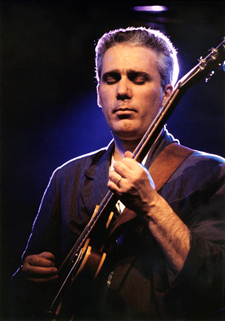
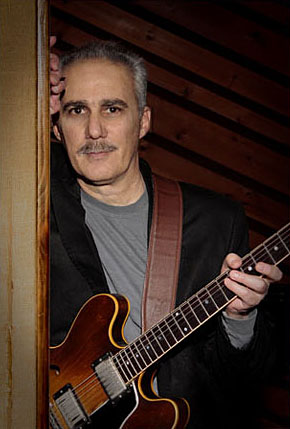
It took nine years for prolific jazz guitarist Steve Khan to return with one of the most refreshing recordings of the year. The music on this record is a representation of Steve’s distinctive sound and his unique approach to music. Joined by long time friends Jack DeJohnette, John Patitucci and Manolo Badrena, “The Green Field” is surely going to stay in your mind for years to come. It was a pleasure to interview Steve after a gap of two years.
AL: This is your first release in 9 years, surely a long time, almost too long. Did you feel that musically you did not have much to say in those years? Was this absence deliberate?
SK: Absolutely not to both of the latter questions! If I felt that, as a human being, as a musician, I had nothing to say…..I would seek out something else to do in life. There’s always something to say. I simply lacked the means to be able to self-finance a project during those years. Be assured though that I did contact the major labels, and those in Japan as well, in hopes of finding someone who wanted to record me, but their silences spoke volumes. From that, one can only take away that those people on ‘the other side of the desk’ felt that I was not worth recording. This alone is a most painful realization to face. But, I was not going to let that stop me. As you know, during that time, I did record “YOU ARE HERE” with Rob Mounsey, and shortly thereafter, I agreed to join the Caribbean Jazz Project as a co-leader with Dave Samuels and Dave Valentín. But this group, after two CDs and a lot of touring, proved to be a bitter disappointment for me. So, like the squirrel, I kept putting away my acorns for the winter, and, when I had enough, I was ready to begin the process of putting all the people and details together to record “The Green Field”. I feel very lucky that I was able to make this happen. And believe me, it was not easy!!!
AL: In a way, you started back up right where you had left off, at least with the core trio from “GOT MY MENTAL”. John Patitucci and Jack DeJohnette. The music on “The Green Field” is almost like a picture, as if you are trying to paint something.
SK: If that’s your perception, that’s a most kind and artistic one. There are any number of rhythm section tandems with whom I feel totally comfortable, but, for what I wanted to attempt here, there was no question that John and Jack would be the best way to go. For that choice, I was rewarded by spectacular performances from each of them. No two players could be more serious about playing and giving everything, being in the moment, than these two great artists. The performances on the title track were, in the end, worth everything to me. If we ‘painted’ something, it’s going to be in the imagination of the beholder. Doug West’s cover art just, by accident, happens to represent a view of what my particular “The Green Field” looks like to me. As you can see, it’s not very long, and then, you arrive at your own particular mountain…..and, that’s it!!!
AL: Can you tell me how you worked on the new tunes for the album? How long was the process for you? How were the dynamics recording with John and Jack?
SK: Once I knew, and for certain, that I would have the resources to finance the recording, and this was only in January of ’05. The process began in earnest. I phoned my dear friend, and sometimes production coordinator, Christine Martin to discuss every detail of what I needed to see happen. And she took care of the rest, leaving me free to concentrate on the the preparation of the music. When it was a certainty that the sessions would be on May 23rd-24th, I began to attack the compositions in a far more serious way. By the time our one rehearsal arrived, I walked in with some 15 pieces of music to record. As it turned out, we actually recorded 12 tunes, but two just couldn’t fit on the CD. I’m not certain just what I will do them. So, I guess you could say that the process took about 5 months of intense preparations.
The dynamics of working with John and Jack are, at once, both similar and totally different. With John, we have a great musical communication and empathy. All that I write for him provides him with a good place to start, and he only makes those things better. With Jack, I tend to try to express, in words, just how I would like the piece of music to unfold…..what kind of ‘mood’ I want us to create, and the ‘attitude’ with which, I would hope, we all bring to the piece. Beyond that, little needs to be said. John and Jack are two players who always show-up ready to play, and ready to play hard and tough. They also know me, and they know that I am not going to beat the livin’ crap out of them by insisting on doing take after take, after take! This is not my way. As usual, many of performances you hear were done in a single take, none required more than three takes.
AL: El Viñón(the first track) sounds like you have been exploring the world of jazz and free bop. And, it’s so great to have an 18-minute cut as well to close things out.
SK: A-ha! And speaking of three takes, this was the one!!! El Viñón is my tribute to the great Elvin Jones, and it is meant to capture the spirit of his unique ‘rolling loops of rhythm’…..rhythms which seem to topple over one another, self-perpetuating in a way. It was also my hope that Jack would simply inject his own feelings for Elvin through his playing, and, he did just that by staying true to himself but playing with a mean attitude throughout!!!
I’m not to sure just what you’re saying with your initial statement, but to me, the elements of Jazz and Free Bop have always been present in what I’ve been doing since ’81. More than this, I would say that this was always my direction in music, right from picking-up the instrument, and through my formative years in the mid-’60s. But, during the ’70s, I guess I became a bit side-tracked. Again, the 18-minute “The Green Field” is something special for me, and it is my hope that some of your readers will find the time to commit themselves to listening to something of this length. In this world, it’s not easy for people to find that kind of free time, they can’t even find 5-minutes on most days. But, let’s wait and see.
This had to be the last track on the CD, because I could not make everyone a prisoner of this tune by placing it any earlier in the sequence. Remote controls or not, it is not a good way to sequence a recording, so it had to go last.
AL: It was quite refreshing to see your take on Wayne Shorter’s “Sanctuary” and “Nefertiti”. What made you do some covers on the new record.
SK: O.K.! Let’s just be clear about one issue. On the CD, the credits for this medley are a little vague, so allow me to explain. From the beginning, it was always my intention that we were going to create a medley of Sanctuary going into Nefertiti – which was to be played as a cha-cha-cha! Knowing this, we also then knew, that this medley would be performed on two separate days. And so, we recorded Sanctuary on May 23rd with Manolo Badrena, knowing that he would sing the melody, in vocalese, doubling John’s bass expression of same. This also came out beautifully! On May 24th, we recorded Nefertiti with Roberto Quintero and Ralph Irizarry. As the statement of the melody concluded, it was intended that Ralph Irizarry’s ‘avanico’ would lead us into the arrangement of Nefertiti which features a tremendous timbales solo from Ralphy!!! Ralph’s timbales solo is an absolute gem. I wish everyone could have seen Jack’s smile of admiration, as he witnessed this kind of artistry.
As always, I’ve tried to select pieces that most guitarists do not play. But, more than that, to select tunes that have an emotional significance for me. These two tunes are most special for me, and for this project. Please let me further explain….
Wayne Shorter’s Sanctuary has always been a very special piece to me, since I first heard it on Miles Davis’ “BITCHES BREW”(‘69) many, many years ago. It took forever to understand any number of things about it. Several years ago, when I was on tour in Europe with the Caribbean Jazz Project, we played an outdoor concert in, I believe, a small town in Italy, but perhaps it was Switzerland? After we had played, we were taken to dinner by the promoter, but we could still hear the sounds of Wayne Shorter’s group playing, as the music filtered through the streets to our ears. I felt that I had heard a familiar melodic grouping, but, I wasn’t certain. And so, upon my return home, I e-mailed John Patitucci, and asked him if they had opened their set with Sanctuary. And, he wrote back that, Yes! that’s exactly what it was. And so, I asked him if I could see Wayne’s chart to this tune.
More than anything, I was fascinated by what Miles and Chick Corea had improvised out in front of the piece on the original recording. Was that part of Wayne’s composition too? Well, what John sent me did not answer that question at all. I was really confused. And so, having recently given my sister Laurie a gift of the BOX SET of the Complete “BITCHES BREW” sessions…..I phoned, and asked her if within the CD booklet, it said anything about that Intro…..the answer surprised, shocked and stunned us both. Believe it or not, it stated that, for some time, before the recording, in live performances, Miles and Chick had played an improvised duet out in front of Sanctuary……and that duet was on I Fall in Love too Easily which was, of course, written by our father, Sammy Cahn!!! And so, I knew that I would then have to make a small medley, combining this piece with the ever-mysterious, Nefertiti.
AL: How long did you spend on the recording sessions and the rehearsals before that?
SK: We were only able to have one 10 hr. rehearsal about 2 weeks before the recording sessions. Just as it was during the rehearsals for GOT MY MENTAL, Jack was late driving down from Woodstock,, and this gave John Patitucci and I some time to run through all the material with just bass and guitar. Manolo Badrena was around as well, so this acclimated him to these pieces. The last 4-5 hrs. of rehearsal time was spent working on the more Latin-oriented arrangements with Roberto Quintero and Ralph Irizarry. Manolo does not appear on those tunes so he was free to head home. The recording sessions were just two days long. May 23rd was the basic trio with Manolo. And May 24th, we recorded with Roberto Quintero and Ralph Irizarry.
Mixing was scheduled to have been for 2 days with one day held in reserve, in case I was dissatisfied with something. But, as it turned out, I didn’t like any of our initial mixes, and we needed two additional days for re-calls and fine tuning. In essence, that was the process. Mixing is always most difficult because even in an open texture like this, each instrument’s range and timbre has the potential to mask the clarity of another instrument. It can be so difficult and eventually one has to let go because making one thing better could make two other things sound worse!
AL: It’s really beautiful how, in addition to Manolo Badrena, you introduced the Afro-Cuban elements within the music, bringing in Ralph Irizarry and Roberto Quintero to the mix of things. I guess sometimes you can’t escape something that’s deep inside you.
SK: Well, though I am restating what I just said before. Manolo’s approach to making music and percussion is most unique. He is spirit not unlike Airto, Nana Vasconcelos, or Trilok Gurtu. These players are very rare and though they bring the flavors and spirits of their own countries to any music they play, they remain free of constraints and any ‘rules’ one might associate with percussion. One only has to listen to the title track to understand the depth of what Manolo contributes. You can’t put a label on this approach to music making!!! It is rare, and it is most special. To tell you the truth, I was totally shocked to hear Manolo playing all the parts for Salsa on John Scofield’s version of Ray Charles’ What’d I Say? That was hysterical to me.
However, that said, to create the mix I seek between the Afro-Cuban traditions, and melding those ideas with Jack DeJohnette requires some courage and flexibility from everyone. The Latin players must not be in awe or afraid to play with Jack, and, by the same token, Jack must not feel confined by the clave or the cascara patterns. It’s most tricky. I was thrilled to have both Ralph Irizarry and Roberto Quintero participate in the music. The most interesting marriage of these elements to me is achieved on Herbie Hancock’s Riot where you have Jack’s more traditional ride cymbal approach pitted against the swing of Ralphy’s cascara on the shells of the timbales. This is the 2nd time, on a recording of mine, that this has been attempted, and again, it worked. I first did this on Paraphernalia on GOT MY MENTAL with Marc Quiñones on timbales.
AL: You made a comment at your website that, after this recording, you understood that making a record is a privilege and not something to which a musician has a right. What made you make this profound statement?
SK: In truth, I came to believe this after I was dropped from Columbia Records in 1980, and then went into my own bank account to pay for EVIDENCE which then cost me $6,000. It was to be the only time, when I have paid for a recording, that I made the money back. The four times since, I have always lost the money. That caused me to appreciate the privilege of recording more than ever, and to never, never ever, abuse that privilege. It is even more important not to abuse it when a label, or someone else, is paying the bills. In my view, too many artists, especially younger ones, have no concept of what this means. For them, in time, they will learn the hard way. It will be a most painful lesson.
“The Green Field” to me is most special. At this stage of one’s life, as one approaches 60 yrs. old, one cannot be certain that this won’t be the last time they get to record. So, all the difficulties and painful experiences aside, I treasured everything that went into this CD.
AL: It was terrific to read that Japan’s JAZZ LIFE Magazine recognized your work by naming you as one of the 22 greatest guitarists of all time. That must have felt great, right?
SK: Well, that particular honor was bestowed upon us all in 1998. Of course, it’s an impressive quote to use in one’s BIO. And yes, it feels nice to be recognized as such, even though one could find other publications where my work is completely ignored! Surviving in the arts, requires maintaining a balance. One is never as great as they might say, and one is never as awful as they might say. The Rudyard Kipling poem, IF says it all best. Treating those two impostors: triumph[success] and defeat[failure] the same. If one reads that poem every so often, it can help to keep you grounded.
AL: Did you use the guitar to write the music on “The Green Field”. The voicings sometimes makes the listener feel that you wrote them on a piano?
SK: On this recording, everything was done on the guitar. The only piece that owes some inspiration to the keyboard is the interpretation of You Stepped Out of a Dream. Originally I did an arrangement of this to be used as a ‘play-along’ for students, and to use at clinics and master classes. The keyboard part was written in the style of Clare Fischer, one of my harmonic heroes. I did not believe that I could ever reduce those dense voicings to the guitar, but, at a certain point, I came to feel that it was possible, at least on some small level.
AL: Are you planning to tour?
SK: At present, there are no plans. I am hopeful that, later in the year, I’ll be able to, at the very least, go to Europe and tour again as I did in early 2005. In truth, I need for “The Green Field” to create enough ‘positive energy’ in the business community so that I can go and play, especially in my own country, and not be held hostage by promoters who would insist that I can only appear if I have two famous sidemen with me. This makes touring next to impossible for me, from a financial aspect. It forces me into a position of: How much can I afford to lose in order to play each night? When that amount becomes obvious and excessive, I can’t go out and realistically expect to tour.
AL: So I hope it is not going to be a 9 year wait again . Do you have any plans?
SK: Well, my first responsibility is to do everything I can to see this recording through to its best possible conclusion. But, there were several tunes that we never got to finish for this CD and I would hope that we can get them recorded, if there is to be a next time. It would be nice if a record label wanted to sign me, but, should that not happen, I believe that I will be able to go in one more time, and self-finance another recording. What that will be, and who will participate, I can’t say right now. But, if I could do it again with John and Jack, that would be wonderful.
Photo Credits: Richard Laird, www.stevekhan.com
Latest album
Latest NEWS
SUBSCRIBE
Please Subscribe your mail to get notification from AbstractLogix.
Facebook-f
Twitter
Instagram
Youtube
Copyright © 2021 ABSTRACT LOGIX
Facebook-f
Twitter
Instagram
Youtube
Copyright © 2021 ABSTRACT LOGIX